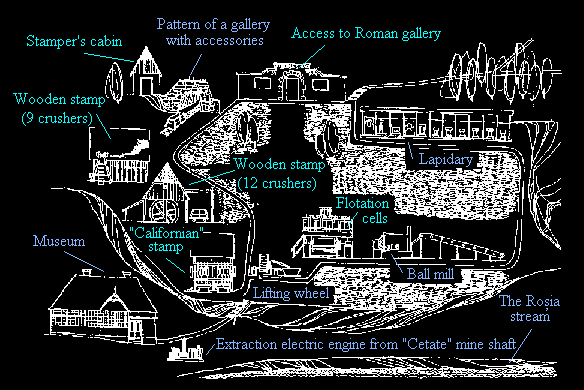
Surf the ImageMap and find out more...
Roman mining workings, flooded and muddy, were identified above "Sf.Cruce" (St.Cross) main gallery in the Orlea Massif. Following some complex research work, their touristic and scientific value came to be reorganised in 1971 and 1972. Due to the 1973-1975 development program, the Roman workings were open to the public.
Technical data:
The Roman Gallery is situated at height of +725 meters. Its propping was initially of wood but in the long run it gave way and today it is walled in prefabricated blocks. To the east, along a length of 40 meters, the gallery has an almost constant profile with the following dimensions: ceiling=1800mm, floor=1400mm, height= 1800mm. The next 60 meters of the gallery heads north and has various profiles. The intersection of several gold veins with the gallery left small cavities in the walls.

The wooden stamps in their actual size together with all their elements, were reconstructed between 1970 and 1979. The only structural and functional difference between the two stamps is the numbers of crushers.
Any person who bought (on a contract basis) or inherited a stamp floor could build a stamp. Gold ore was processed with the stamp by men and women alike either within a family or by employees who were paid by the week. The stamps were set to work on the 18th of each March and would operate until the 18th of November. They would rarely function throughout the whole year because of the weather. During the week, the stamps worked from Tuesday noon till Saturday morning, while in the dry season (August, September) they would operate just from Wednesday or even Thursday to Saturday.
As a rule, the stamps were placed in a cascade, on stamp floors along the valleys, using the difference of level as a condition for the water to flow which was absolutely essential for the crushing, segregating and concentration of gold.
The ore was fed into the stamp, with the help of corfs and troughs.
The Californian stamps provided with iron crushers were a step forward in the mining technology of Europe at the end of the 19th century. This type of stamp was used in Ro ia Montan between the two world wars and later until they came to be replaced by ball mills.
The exhibit in the museum was manufactured by the "Fraser & Chalmers" Company from England. The brand is 102-A but the year of manufacture is unfortunately unknown.
This type of stamp was set to work by an engine, usually an electric one, which manipulated the central shaft. The rotation motion was transmitted on the axle with cams which would raise and drop, respectively the crushers in order to crush the ore.
Among the main important elements of this type of stamp we mention:
It is a little house made of beams or fin boards and covered with shingle. This was the place where the stamper lined and where the following tools were kept:
The installation for the reprocessing of gold by means of flotation
Component elements:
The installation is needed to obtain gold concentrate by more advanced technical methods.
The whole process comprises the following stages:
[ INDEX ] [ Versiunea Românã ] [ Version Française ]
