|
Safety
Safety is very important to us and we do have a perfect safety
record! You must be careful while running but the only way
a player can be seriously injured by playing paintball is
if he or she removes their goggles during play, or if a player
uses a marker in an unsafe manner. Our referee's are there
to ensure that everyone follows the safety rules. Any infraction
of the safety rules will result in immediate ejection from
the field. It is always Safety FIRST!
------------------------------------------
NEWS from CPSC - U.S. Consumer Product Safety Commission
Office of Information and Public Affairs Washington, DC 20207
FOR IMMEDIATE RELEASE
March 24, 2004
Release # 04-105 CPSC Consumer Hotline: (800) 638-2772
CPSC Media Contact: Ken Giles, (301) 504-7052 or Eric Criss,
(301) 504-7908
CPSC Issues New Safety Warning for Paintball Guns
WASHINGTON, D.C. – Based on its investigation of two
deaths caused by carbon dioxide (CO2) canisters flying off
paintball guns, the U.S. Consumer Product Safety Commission
(CPSC) is issuing a new warning. Paintball gun users should
be advised that the brass or nickel-plated valve that connects
directly to the canister must not be unscrewed from the canister
when removing the canister assembly from a paintball gun.
This valve must stay secured and rotate with the CO2 canister.
In both of the deaths investigated by CPSC, the brass valve
unscrewed from the canister, turning the pressurized canister
into a deadly projectile. In June 2003, a 15-year-old boy
died after being struck in the head by a paintball CO2 canister
as he was removing the canister from the gun. In February
2004, a female bystander was killed by a CO2 canister that
was expelled as someone else was removing the canister from
a paintball gun. While these investigations are not complete,
CPSC is issuing this new safety warning to help people avoid
the hazard.
“We are very concerned about the recent deaths associated
with paintball gun canisters,” said CPSC Chairman Hal
Stratton. “We are actively investigating these cases.
Even though our investigation is not complete, we believe
it is urgent to provide this new safety message about the
valve detaching from the canister while unscrewing it from
the paintball gun.”
CPSC also recommends that people make sure that any modifications
to the paintball gun or the CO2 canister are done properly.
For example, installing anti-siphon tubes involves removing
and re- installing the canister valve. It is critical that
the valve be re- installed with the appropriate adhesive and
the proper torque.
o Make sure the brass or nickel-plated
canister valve is securely attached to the
canister, rotates with the canister, and does not
unscrew from the canister.
o The canister assembly should unscrew from
the paintball gun in about three or four
full turns; if you finish the 4th full turn and
the canister is not unscrewed from the gun, stop!
Take it to a professional.
o Some people have used paint or nail polish
to mark the brass valve and the CO2 canister
so they can see that the valve and the
canister rotate together while being removed from the gun.
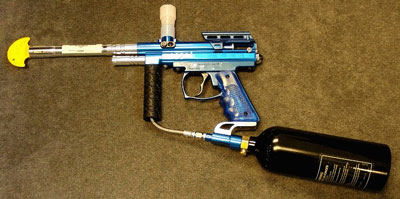
Figure 1:
Paintball gun and carbon dioxide (CO2) canister. |
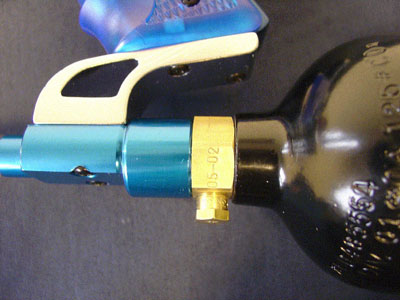
Figure 2:
Brass or nickel-plated valve must remain connected to
the CO2 canister |
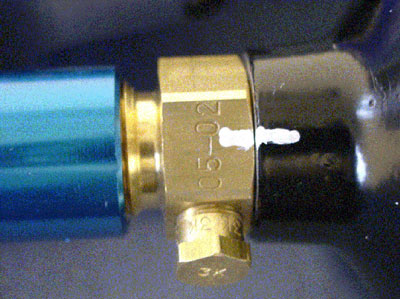
Figure 3:
Painted line between valve and CO2 canister. |
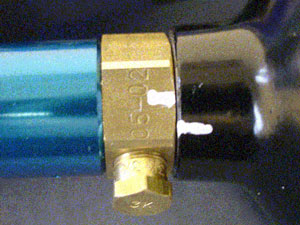
Figure 4:
Painted lines separating. The painted lines must stay
together as you unscrew the canister assembly from the
paintball gun. If the lines separate, stop unscrewing
the canister and take the gun to a professional. If the
valve unscrews from the canister, the canister can become
a deadly projectile. |
|