
Mary Magdalene
The Harlot God Loved
|
Mary of Magdala is a figure of enduring mystery and attraction in the Christian church. She has been used as an exemplar for saints and crowned queen of sinners together. In our age, as in mediaeval times, she has been claimed by women; only onw she is lauded as a female Apostle and as an example of women in the ministry. Altogether more vital, earthy and sensuous than the Virgin Mary, sexual theologians and feminists love her, while conservatives and old-style misogynists have used her as the ultimate figure of sinful Woman. She also appears in controversial films such as the Last Temptation of Christ and even in Jesus Christ, Superstar as the ultimate temptress and possible lover of Jesus Himself. Sinner, saint; temptress, penitent; independent, submissive; eternal Woman: Mary Magdalene is a fascinating figure. |
The Biblical Figure of Mary
For all the later devotion to Mary, and the legends woven around her, there are few references to her in the canonical Gospels.
Matthew 27:55-6 There were also many women there, looking on from afar, who had followed Jesus from Galilee, ministering to him; among whom were Mary Magdalene, and Mary the mother of James and Joseph, and the mother of the sons of Zebedee.
Matthew 28:1, 5-9 Now after the sabbath, toward the dawn of the first day of the week, Mary Magdalene and the other Mary went to see the sepulchre...But the angel said to the women, "Do not be afraid; for I know that you seek Jesus who was crucified. He is not here; for he has risen, as he said. Come, see the place where he lay. Then go quickly and tell his disciples that he has risen from the dead, and behold, he is going before you to Galilee; there you will see him. Lo, I have told you." So they departed quickly from the tomb with fear and great joy, and ran to tell his disciples. And behold, Jesus met them and said, "Hail!" And they came up and took hold of his feet and worshiped him.Mark 15:40-1 There were also women looking on [the crucifixion] from afar, among whom were Mary Magdalene, and Mary the mother of James the younger and of Joses, and Salome, who, when he was in Galilee, followed him, and ministered to him; and also many other women who came up with him to Jerusalem.
Mark 16:9 Now when he rose early on the first day of the week, he appeared first to Mary Magdalene, from whom he had cast out seven demons.Luke 8:1-3 Soon afterward he went on through cities and villages, preaching and bringing the good news of the kingdom of God. And the twelve were with him, and also some women who had been healed of evil spirits and infirmities: Mary, called Magdalene, from whom seven demons had gone out, and Joanna, the wife of Chuza, Herod's steward, and Susanna, and many others, who provided for them out of their means.
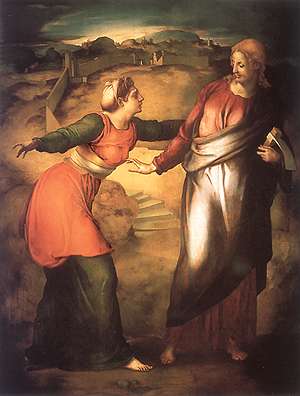
John 20:1, 11-18 Now on the first day of the week Mary Magdalene came to the tomb early, while it was still dark, and saw that the stone had been taken away from the tomb...[she tells Peter and the beloved disciple, they confirm that Jesus is not in the tomb, the other disciples go home]...But Mary stood weeping outside the tomb, and as she wept she stooped to look into the tomb; and she saw two angels in white, sitting where the body of Jesus had lain, one at the head and one at the feet. They said to her, "Woman, why are you weeping?" She said to them, "Because they have taken away my Lord, and I do not know where they have laid him." Saying this, she turned round and saw Jesus standing, but she did not know that it was Jesus. Jesus said to her, "Woman, why are you weeping? Whom do you seek?" Supposing him to be the gardener, she said to him, "Sir, if you have carried him away, tell me where you have laid him, and I will take him away." Jesus said to her, "Mary." She turned and said to him in Hebrew, "Rabboni!" (which means Teacher). Jesus said to her, "Do not hold me, for I have not yet ascended to the Father; but go to my brethren and say to them, I am ascending to my Father and your Father, to my God and your God." Mary Magdalene went and said to the disciples, "I have seen the Lord"; and she told them that he had said these things to her.
As well as these references, Mary has been connected to Mary, sister of Lazarus, and to Martha, also a sister of Lazarus. She has also been identified with Luke's sinner of Luke 7:37-50, who washed Jesus' feet with her tears, dried them with her hair, and as a result Jesus said that "her sins, which are many, are forgiven". It is very doubtful that these other figures are in any way connected with Mary of Magdala - certainly the evangelists themselves do not identify her as a sexual sinner (such as Luke's penitent probably was) but simply as one who had had seven demons driven out from her. Later commentators conflated these figures into one, and identified her seven demons with the Seven Deadly Sins.
We know from scripture only that Mary was a follower of Jesus, she had had seven devils taken from her, she ministered to Jesus and went with Him on His ministry. She was present at the Crucifixion, and was the first to see Him after the Resurrection, and thus was the first to declare the good news to the disciples.
After these few references, Mary disappears from the biblical narrative, and we hear no more of her. She appears in gnostic texts but those, aside from the Gospel of Thomas, were written rather later than the canonical texts.
So what do we learn about Mary? The most important references to her come at the Resurrection. The fact that she was the first witness to it, the first to believe in the risen Christ, and made a confession to Him equalling in significance the confession of Peter on the road to Ceserea Phillipi. We also know that Mary, along with others, "ministered" (diakonein) to Christ, thus placing her as an early deacon (diakonon). The fact that the evangelists are careful to name her gives us an indication of her importance - some scholars see her as the leader of Christ's female followers.
The Apocryphal Figure of Mary
Mary is mentioned several times in the gnostic gospels, which were discovered at Nag Hammadi in 1945 and date from the 2nd to the 4th centuries. Gnosticism was a heresy that the church fought hard to overcome, and which presented a very serious challenge to its authority. All the gospels with any trace of gnosticism (which often denies Christ's humanity, and claims Yahweh to be Satan as well as venerating the serpent in the garden of Eden and having a very complex creation account) were excluded from the canon. They are still rather "beyond the pale" in terms of faith, though they have proven to be invaluable for scholars anxious to learn about divergent beliefs and early legends about Jesus in the church. The Gospel of Thomas has, to some extent, been rehabilitated (notably by the Jesus Seminar), though obviously it is not a part of the canon, and never will be.
The gnostics seem to have had an amazing love for Mary Magdalene, proclaiming her to be a highly spiritual person who understood Christ when the others did not, a recipient and teacher of the saving gnosis and someone absorbed into or a part of the Sophia (Wisdom) of God in the Pistis Sophia. In the Gospel of Philip she is Christ's constant companion and one who reveals Christ in the Dialogue of the Saviour. In the Gospel of Mary she is the leader of the disciples and recipient of special teachings from Jesus. She is also known as Jesus' beloved, the disciple He loved the most. She is even presented as the actual lover of Jesus (speculation on that point began very early!), a fact which added to the condemnation of gnosticism by orthodox Christians.
These early (if heretical) Christians had such a high esteem for Mary Magdalene that this may be the reason that she came to represent all the sins of women for the orthodox church. As the Bible does not say she was a prostitute, and the gnostics did not either, it is possible that she became identified with the sexual sinner of Luke 7 in response to gnostic devotion. Whether she was a leader of apostles and special confidante of Jesus as the gnostics believed is rather hard to tell. On the whole it seems unlikely, given that the gnostic gospels are later than the canonical ones, and depend on a cosmology which demands a prominent female figure - Sophia - and thus needed an earthly figure in the ministry of Jesus to identify her with. However, the prominence they give to Mary cannot be ignored, and may represent an authentic strand of tradition concerning the prominence of Mary within Jesus' disciples.
Apostola Apostolorum
There are many depictions in art of Mary's role as witness to the Resurrection, of her discovery of the empty tomb and subsequent role as bearer of the good news to the other disciples. Her witness, rather than her mission to anoint the dead Christ, is emphasised and St Augustine described her visit to the tomb as "ocular proof" of the Resurrection. [1] Her witness was brought into Hippolytus' exposition on the Song of Songs (aka Song of Solomon, Canticle of Canticles) where he identified the Shulamite searching for her lover with Mary seeking Jesus. After she found Christ, Mary became the new Eve.
Hippolytus was the first to give Mary the title of Apostle in his exposition, saying "Eve has become apostle...So that the women did not appear liars but bringers of the truth, Christ appeared to the [male] apostles and said to them: It is truly I who appeared to these women and who desired to send them to you as apostles." [2] Mary's association with Song of Songs is still with us - Songs 8:6-7 is used as a part of the liturgy for her saints day.
Mary's title of apostle (or "apostle to the apostles") may sound strange to us, for female apostles disappeared quite early in the life of the church. There were still women apostles during the writing of the New Testament, however, and it is not incongruous to see Mary Magdalene as an apostle too. We know of these female apostles from Paul, who speaks in Romans 16:7 of Junia (or Julia) who was pre-eminent among the apostles, and even the misogynistic commentator St John Crysostom admitted this when he wrote:
"And indeed to be apostles at all is a great thing. But to be even amongst these of note, just consider what a great encomium this is! But they were of note owing to their works, to their achievements. Oh! how great is the devotion of this woman, that she should be even counted worthy of the appellation of apostle!" [3]
Mary was also called "apostle to the apostles" by Gregory of Antioch (d595ad) when he had Christ say "Be the first apostles to the apostles. So that Peter...learns that I can choose even women as apostles." [4]
Confusion over the Maries at the tomb began to set in, with the Syriac church identifying all of them, and the Virgin Mary, as one person, and the tradition was carried over to the Western Church, with St Ambrose questioning whether there were three people at the tomb or just one. By the middle of the 6th century Mary had become completely identified with Luke's sinful woman who washed the feet of Christ, a sinner, a prostitute and a penitent. Her title of apostle grew increasingly anachronistic and forgotten in a church which no longer accepted women into the 'discipleship of equals' and which had no place for them in church offices.
To come:
Mediaeval Mary
Modern Mary
Footnotes
1 Augustine, Commentary on John
2 quoted in Dictionnaire de Spiritualite, Ascetique et Mystique, Doctrine et Histoire ed M Viller et al. Paris (1932) 1978 col 565
3 Crysostom, Homilies on the Epistle to the Romans Homily XXXI in Nicene and Post-Nicene Fathers, Series I Vol XI, obtained from the
4 Dict. Spirit. ibid.
Ethics | Theology | The Bible
Links | Contact | Link To Us | Webrings | Sign Guestbook
© Rev Emma McCarthy, 2003. All content on this site, except for material written by others and designated as such, is copyleft under the provisions of the GNU General Public License. This means you can reproduce it in any form you wish, provided that you retain the copyright information.