Types of Volcanoes
The form of a volcano is determined by the ingredients of the erupting magma. Their shapes are determined by the explosivity of the eruptions and to the amount of water in the magma.
Shield Volcanoes
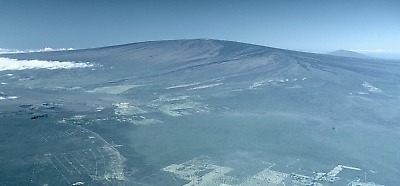
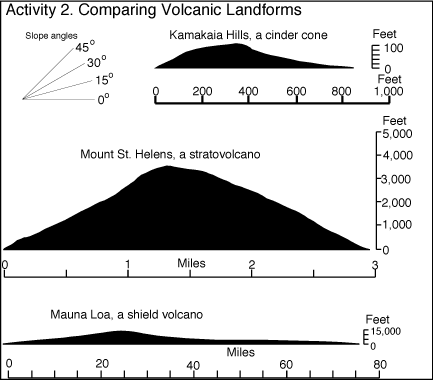
Shield volcanoes are large volcanic forms with broad summit areas and low, sloping sides. This type of volcano is caused by slow, basaltic lava flows. A good example of a shield volcano is the island of Hawaii (the "Big Island"). The Big Island is formed of five volcanoes of successively younger ages, the older apparently extinct. Mauna Loa, one of the main volcanoes, has a higher elevation than any mountain on Earth -- 30,000 feet -- from the floor of the ocean to its highest peak.
Cinder Cones
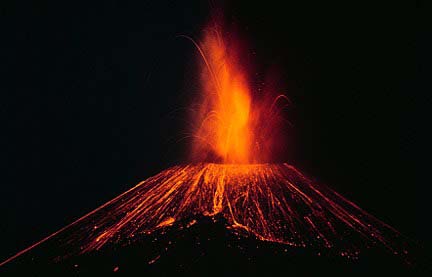
Cinder cones are mounds that are formed by streaming gases that carry lava blobs and ribbons into the atmosphere to form lava fountains. The lava blobs commonly harden during flight through the air before landing on the ground. If gas pressure drops, the final stage of building a cinder cone may be a lava flow that breaks through the base of the cone. The longer the eruption, the higher the cone. Some are no larger than a few meters and others rise to as high as 610 meters or more, such as Paricutin volcano, Mexico, that was a nearly continuous eruption from 1943 to 1952 and eventually destroyed the village. Rarely do volcanologist get to watch the birth, growth, and death of a volcano. Paricutin provided such an opportunity.
Composite Volcanoes (Stratovolcanoes)
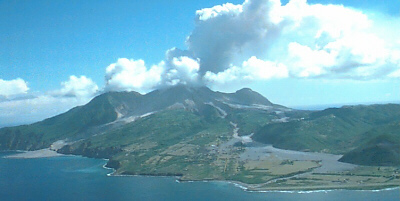
Composite volcanoes are constructed from multiple eruptions, sometimes recurring over hundreds of thousands of years, sometimes over a few hundred. Most of the tallest volcanoes are composite volcanoes. These form from a cycle of quiet eruptions of fluid lava followed by explosive eruptions of viscous lava. The fluid lava creates an erosion-resistant shell over the explosive debris, forming strong, steep-sided volcanic cones. Mt. St. Helens is an example of a composite volcano. On May 18, 1980, after nearly two months of local earthquakes and steam eruptions, Mt. St. Helens suddenly began a major explosive eruptions directed first northward and then upward. The blast, which lasted only the first few minutes of a nine hour continuous eruption, devastated more than 150 square miles of forest and recreation area, killed countless animals, and left about 60 persons dead or missing. Currently the island Montserrat is experiencing volcanic eruptions. Since 1995 residents have been evacuated three times from the area and 8,000 people have fled the island.
Volcanic Activity
Volcanoes are rather unpredictable phenomena. Some volcanoes erupt fairly regularly; others have not erupted within modern history. In order to indicate the relative activity of volcanoes, scientist classify them as active, dormant, or extinct. An active volcano is one that erupts either continually or periodically. There are several active volcanoes in the continental United States: Lassen Peak in Lassen Volcanic National Park (California), Mt. St. Helens in Cascade Range (Washington State), and Mt. Katmai (Alaska). A volcano that has been known to erupt within modern times but is now inactive is classified as a dormant, or sleeping, volcano. Mt. Rainier (Washington), Mt. Hood (Oregon), and Mt. Shasta (California) are examples of volcanoes in the continental United States. A volcano not known to have erupted within modern history is classified as an extinct volcano. Volcanologists consider truly extinct volcanoes to be those that have been worn away almost to the level of their magma chamber. But even so-called extinct volcanoes can prove unpredictable. Both Lassen Peak and Mt. St. Helens suddenly erupted after long periods of inactivity.