| OVERALL ASSESSMENT: This report is based on a short 15 day trip in March, 2005. As I had already visited most of these cities, this trip didn't involve that much sightseeing, per se. In fact, I didn't even take my camera, so I've included a few pictures from my previous trip and thank my travel companion, Johnny Highwater, for the new pictures. Thanks John! For more information and pictures see my Northern Laos Travel Report and
Southern Laos Travel Report from Sept-Oct 2003. Laos remains a slow and quiet country, and I was amazed with it's contrast to big brother Thailand. Laos, outside of the tourist towns, remains incredibly poor, with bamboo houses in dirt villages the norm.
RATING: a very strong thumbs up. Go now before it becomes another Thailand!
TRANSPORTATION: As Laos is geographically a long north-to-south situated country I would highly recommend that you arrange your trip so that it is not necessary to backtrack. Unless you fly, transportation is rather slow due to the extremely mountainous switchback roads. I made the mistake of going from Vientiane -> Luang Probang and then having to return to Vientiane to get my flight back to Bangkok. The VIP "air-con" bus indeed had air con, its just that about 2 hours into the 10+ hour journey they turned it off never to turn it back on. So it goes.
Some typical costs (1U$=10,000K):
- Vientiane Airport -> Downtown: 65,000K for a taxi or walk to the street and get a regular tuk tuk for 30,000K
- Vientiane downtown area: Tuk tuk rides in the downtown area should be 10,000K/1U$/40B or 2 people for 15,000K
- Vang Vieng -> Phonsavan: Regular bus 55,000K
- Phonsavan -> Luang Probang: Regular bus 60,000K
- Luang Probang -> Vientiane: VIP bus 78,000K
NOTE: Outside of the main cities Laos is dominated by small villages of bamboo thatched huts with chickens and pigs and water buffalo and dogs and children all running around in one big happy and dirty mess. Though Laos is very poor, it is generally easy to access the main tourist destinations using busses, boats, minivans, and the occasional saengtaew truck (an open-air truck with long seats in the back). U$ dollars are accepted for large purchases and usually at your guest house. In the cities it is easy to change traveler's checks at any of the government banks and they all give the same rate and there is no commission. There are no ATMs except for reports of one in Vientiane. You can also change Thai Baht into Kip with no problems.
If you go during the 'cool' season you can usually get by with fan rooms and save a few Kip, and the Plain of Jars, located at some 1200m can get downright frigid!
- Vientiane. The capital of Laos is the busiest, noisiest, and most Thai influenced city in the country. That being said, it's still pretty quiet, especially after about 9 pm or so. I haven't found many great bargains in guest houses. The Lovan GH is one of the nicer ones in the central tourist area and it's about U$12 for an air con room, less for a fan room. In a pinch the Vannasinh and Lao-Sakonh GHs offer windowless boxy rooms for under U$10.
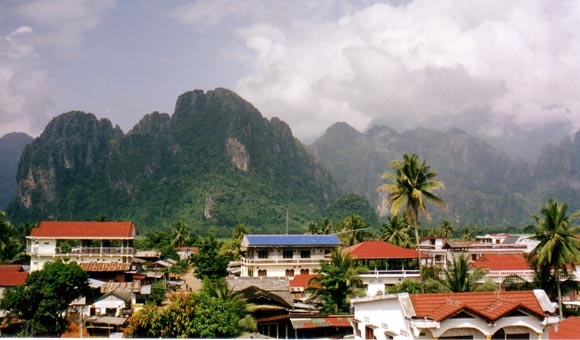
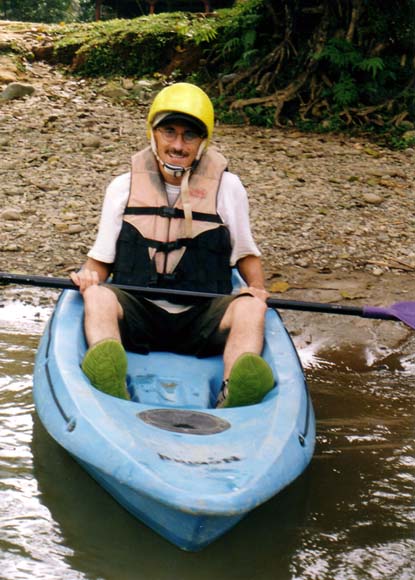
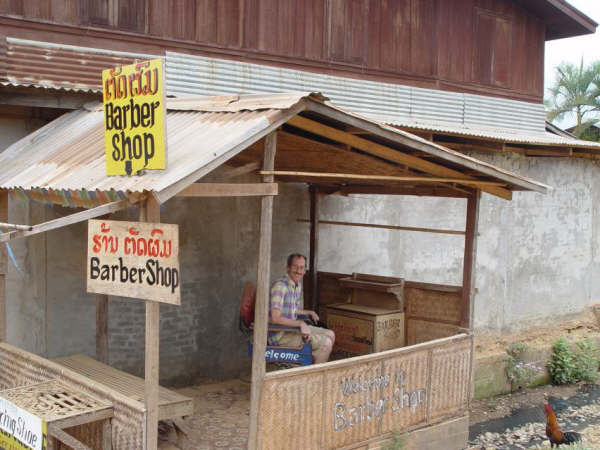
- Vang Vieng. With air-con minivans conveniently running between Vientiane and Vang Vieng in a couple of hours, this once sleepy town has now become the place to be. With an incredible number of guest houses and no lack of restaurants people often refer to it as the "Khao San Road" of Laos. I like staying at either the Sisavang or Milany GH, which at around U$3.50-$6 are both good value. If you want cheaper accomodations they can be found, too. The city is set along the Nam Song River with karst limestone mountains providing the background. There is plenty of activities to keep you busy such as kayaking, tubing, and caving, but to a large extent it's just one big party scene. There are not too many places in South East Asia still selling "happy pizzas", but VV is one of them! Tubing in VV is an experience unto itself. As you slowly float down the Nam Song there are numerous stations along the banks where you can stop for liquid or other types of refreshments. You can then continue down the river with a Beer Lao in one hand and 'cigarette' in the other and not a worry in the world. Not surprisingly many people find it hard to leave, though if you're looking for a Laotian cultural experience, this is not the place to find it. There's a small island in the middle of the Nam Song River with 3-4 bars that late in the evening were "the" places to hang out, meet other travelers, and party! Oh yeah, VV's a good place to get a haircut, too. (Photo courtesy Johnny Highwater.)
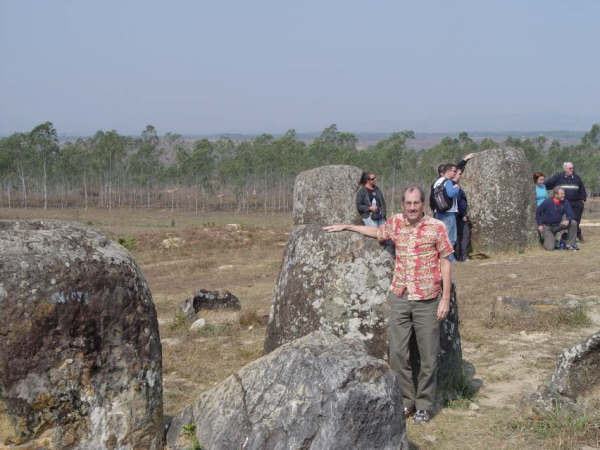
- Phonsavan (Phonsavanh). Located in Xieng Khuang Province this small town is the jumping off point to see the "mysterious" Plain of Jars. From the main Vientiane -> Luang Probang route it takes a day to get to Phonsavan and a day to get back, and most people only stay one day, so unless you have some extra time, or are really keen on checking out the jars, you may not want to include Phonsavan in your itinerary. That being said, the Plain of Jars (Photo courtesy Johnny Highwater) is one of those quirky archaeology sites that you won't see anywhere else, and I was glad I made the journey. Tours start at around U$10 per person, depending on how much you wish to see. Other tourist sites include a tribal village, a CIA airstrip, a cave hospital, and a UXO village. I found the UXO village fascinating. The locals are digging up all manner of bomb pieces as the metal is fetching about 1500K per kilo. A tidy sum when you figure how much some of this stuff weighs, and how ironic that what was once so destructive has now become a valuable commodity.
At 1200m the Plain of Jars can get extremely cold at night. During the first few days of March, 2005, an unusually cool front swept down out of China and no doubt it got close to freezing. Bring some warm gear if you visit during the cool season!
Traveler's Alert! Avoid the Seng Tavanh GH at all cost; it's absolutely terrible! The Kou Kham GH was clean and good value. Ask for Mr. Sota as a guide. He seems a young, hip guy with a decent command of English and a good knowledge of the area.
- Luang Probang. This incredibly atmospheric French colonial city situated at the confluence of the Mekong and Nam Khan rivers has quite rightly been declared a UN World Heritage Site. The peninsular downtown area is dominated by beautiful old buildings, many of which have already been restored or are in the restoration process. Work continues unabated, and many of the smaller side streets are now being fixed up. There are numerous restaurants with extensive western menus and you can dine 'al fresco' while watching the parasol protected saffron monks slowly wander by. Be sure and indulge in a delicious cup of Lao coffee sweetened with thick condensed milk while enjoying breakfast overlooking the Mekong River. Truly, what more could any tourist ask for?!
One of the few actual tourist sights I visited was the Kuang Si Water Falls. It's about 30,000K per person in a tuk tuk and a one hour ride over a dusty road through heavily deforested areas to get there. Entrance fee is now 15,000K for foreigners, but well worth it. The preserve is lush and green with many turquoise colored swimming ponds in the lower falls area. It's a steep 30 minute walk to the upper water falls, and the last bit is especially slippery and a bit dangerous. Once there you can jump from a tree into the pool below and cavort in the cool water.
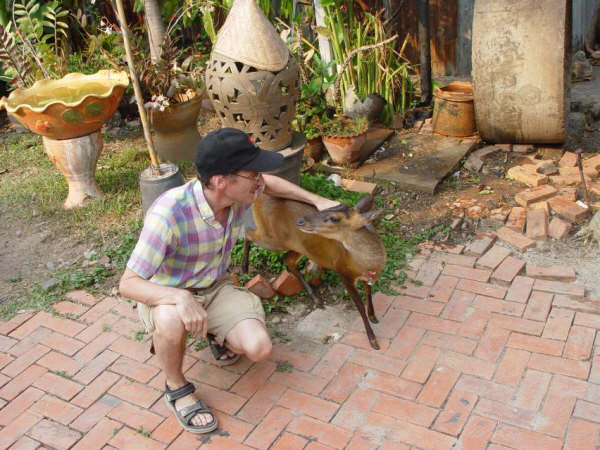
Guest houses have become relatively expensive in the downtown peninsula area. Cheaper accomodations can be found south of the post office. I stayed at the Jaliya GH (across from the Laos Aviation office) which cost U$8 for a large, comfortable fan room. It's a few blocks from the Mekong, but has a beautiful garden and I enjoy petting bambi! (Photo courtesy Johnny Highwater.)
Comments? E-mail me at [email protected].
Return to
Travel Reports |