
Scientific Explanation
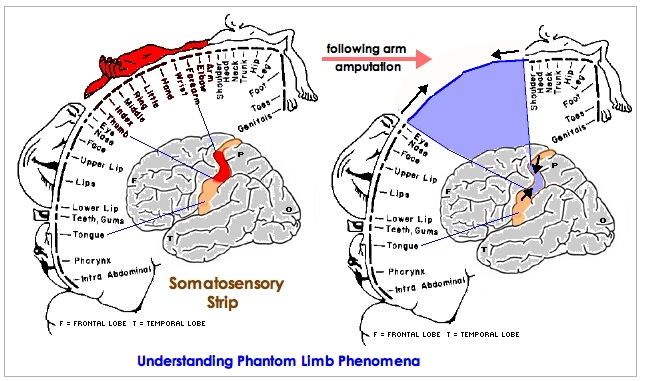
When a limb is amputated, the axons are severed and the area of the brain formerly used for sensations in that limb no longer has any signals being received/sent. Because the brain area was not damaged, plasticity allows axons connecting to a different body part begin to sprout in the sites that had been used for the amputated limb. The axons sprout in the spinal cord, brainstem, and thalamus where the amputated limb's sensations were sent/received. The cortex essentially becomes "reorganized."
In order to experience the phantom sensations, another area of the body must be stimulated. The area of the body removed can give a general map as to which body part stimulation will activate the "phantom limb." When one's face is touched, those with an amputated arm would feel the sensation in their missing arm. This is because the axons from the cheek sprouted in the brain area previously used for their arm. This doesn't mean they won't feel sensations in their face anymore, it just means they will feel both the stimulation on their face an a sensation in the missing limb.
In conclusion, the best word to use to describe what is happening in the brain to cause phantom limb is reorganization. The brain reorganizes itself so that it is as effective as possible, and this means re-routing areas of the brain whose axons have been severed to another part of the body that can use it. The more highly reorganized the somatosensory cortex becomes, the more intense the phantom limb sensations are.
Drawing courtesy of:
web.lemoyne.edu/~hevern/psy340/graphics/homunculus2.hantom.limb.jpeg
