In general one can say that they are still respected in certain ways. However, they also may be ridiculed at in some circumstances. In general hijras claim that in northern India and in Pakistan they earn a lot more respect than in the deep south. The highest respect they still find in old cities with a rich muslim heritage, especially Lucknow which once was the seat of the Nawab of Oudh.
Indians, since colonial times confronted with European values and Western exceptions, feel probably somehow unsure about their relationship to the hijras. No one would ever dare to ridicule them face to face, but still people may make fun of them behind their backs. Maybe the attitude that hijras have to face in India` s and Pakistan`s main entertainment industry, the movie business, shows this ambiguity in attitude towards them in the best way. In the past years there have been some serious Bollywood Movies in which hijras played the main role in a dramatic plot ( like in "Tamanna" and "Darmiyaan", describing the life of the mukhannath Tikku), but they are also frequently hired to play "comical fun parts" in mainstream productions, giving the reason for a "good laugh" in the audience. Actually, this reminds me a lot of how transgenders are treated in western film industry.
During the British raj the colonials passed a law in which the hijras were described as "sodomites" and people who did "homosexual offenses". This was the first time ever that hijras were openly discriminated against in Indian history. The centuries of muslim rule had never seen such an accusation (although from time to time some rulers wanted to abolish the act of castration)!
Although hijras were still hired as court eunuchs in places like Hyderabad and Lucknow, they couldn` t work their original jobs in places of the Indian Subcontinent that were more heavily controled by the British. Unfortunately, the British tries of abolishing the hijras and their society found some support among many wealthy Indians, muslims and hindus alike, who considered themselves "modern thinking" (which to them meant: to think western). Many hijras only had one opportunity to earn money and to survive:
The noble Prophet Muhammad (s.a.s.) had given the mukhannathun a place in society so that they didn`t need to earn their money with erotical entertainment; now, because this place was taken away from them, some of them had to go back to "erotical entertainment" (prostitution). Actually - no wonder, since we are talking about a European governed area - this mirrored a lot the development that took place among transgenders in the West. In the past most western TGs also had no other opportunity to survive than selling their bodies. Many still have to, today.
I don` t claim that there haven` t been hijra prostitutes before the British Raj. There have been, just like there have been male and female prostitutes. But during muslim rule it was never their main occupation, it was an exception!
In today` s India and Pakistan hijras are still stigmatized as prostitutes, although there is only a certain part of them that really sells their bodies. One has to know that prostitution is in no way seen as an ideal among hijras. In houses of traditional living hijras prostitution is strictly forbidden and hijra elders severely distance themselves from those who prostitute themselves. One has also to know that prostitition is mainly an issue of big cities like Bombay and Karachi. It is only a minor issue in rural areas and this is equally true for male and female prostitutes as for hijras.
The idea that hijras are in some way connected to prostitution per se is as wrong as the idea that western transgenders are.
Traditional hijras, living together in a social network that stems from the times of the moghul empire, try to lead a pious life, doing good to fellow humans. Many see themselves as "abstaining ascetics", although this ideal may not be fully lived by all of them. Prostitution is frowned upon, but it exists, because of the intolerance of society!
Another way of stigmatization stemming from colonial times is the ideas that "hijras kidnap children and force them to be castrated and become hijra". This is a parallel to the western legend that "transgenders could have a bad influence on our children". The Indian police has investigated acclaimed cases of "hijras kidnapping children" and has found none of them to be true. In fact, many mukhannathun in India and Pakistan care for children that have been left alone by their families with much love (Which forms the plot for the movie "Tamanna")
To put up with the social stigma that they have to face, hijras usually relate themselves to their "glorious past as guards of sacred boundaries" in the years of muslim rule.To many of them the idea that they are much more respected in northern India than in the South is related to the fact that there are much more muslims in northern India and that northern Indian culture in general carries many muslim influences. If this s true might be open to dispute, however, it shows in what way hijras -muslim and hindu hijras alike - realte to Islam and it`s history on the subcontinent.
Furthermore, many hijras believe that "political skills" belong to their heritage, since in the past they were so close to the ruling class. History mentions many hijras who rose to high positions in the moghul empire and in the muslim principalities. Many were of a significant influence and some even may have been the "true rulers" of the empire. In fact, hijra society itself carries on many political features of the moghul empire.
Today hijras are very active in local politics. Especially in India, but also in Pakistan.
And, besides having been stigmatized during colonial times, many have an impressive amount of voters. A new slogan arose: "There is one solution to useless politicians, give the mandate to eunuchs."
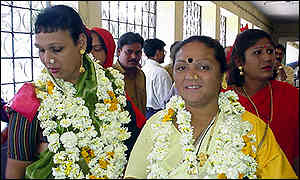
In a town called Gorakhpur a hijra with the name Asha Devi became mayor, another called Kamala Jaan became mayor in Katni; nowadays there are many local hijra politicians on the indian subcontinent, all following in the footsteps of "auntie" Shabnam (or Shabnam Mausi, as it is in Hindi/Urdu), the first mukhannath member of the Madhya Pradesh Legislative Assembly. In hindu-folk-lore there is an old legend according to which "in the end of time there will be an age in which the hijras will rule", because of a blessing from God. Many hijras believe this time has come!