Fossils
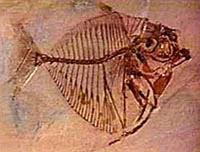
Most organisms are eaten or rot after they have died. Even hoofs, horns, hairs and feathers decay because of the work of certain fungi. Other micro-organisms clear-up wood. The lime of bones dissolves in water. Only that what escapes from these general destruction mechanisms can turn in to a fossil. Hard parts as the remains of the skeleton, shells and other armours make the biggest chance to be turned in to fossils, also wood and faeces can be petrified. Seldom an animal is found, which is that well conserved that it looks like as it looked at the time of its dead.
By the fossilisation the original material is replaced by gravel. Often, only the print are conserved: leafs, crawling tracks of worms or footprints in de clay that fossilised latter.
By the research of fossils became clear that the suggestion that living organisms in time remain unchanged (called fixism) was untrue. In many hundred millions of years, the living world has been gradually changed and it seems that these changes now and again were speeded up leapwise.
In very old layers of earth, only protazoas are found. Slowly bigger and more complex organisms developed, this were animals like sponges, worms, molluscs and echinoderms appeared relatively early.
Fossils of fishes, are first vertebrates to be found in layers from the Ordovician (435-500 million years old). Land was still a lifeless dessert of stones and the continents were then still attached with each other. The land was first colonised by pioneer-plants like algae, lichens and mosses. Later higher plants like ferns and horsetails settled on the land. Hereafter the animals could conquer the land.
The first amphibians are found in layers of the Devon (345-395 million years old) in that time the first insects appeared. In the next era, the Carbon (280-345 million years ago) many and large species of amphibians developed, but these went extinct for the biggest part in the Perm (225-280 million years ago). Meanwhile the reptiles succeeded the amphibians. Among the reptiles were the dinosaurs. Reptiles are better adapted to the land as the amphibians. The reptiles flowered in de Jurassic period (136-195 million years ago). At the end of the Cretaceous period (65-136 million years ago) all the dinosaurs went extinct.
The oldest fossil of a feathered animal that has been found so far originates from the Upper-Jura. This is the Archeopteryx, it had teeth like a reptile and claws at the wings. The development of birds species happened in the Cretaceous period. There is not much known of birds of that time, because only a few fossils of that time are found. The hoatzin from South-America is the only existing bird species that has claws on the wings like the Archeopteryx. Young birds use the claws to crawl in the twigs.
The first fossils of mammals are found in Triassic layers (195-225 million years old). The first animals were animals like shrews. During 160 million years, there were relatively few mammals, after the extinction of the dinosaurs, after the Cretaceous period, many thousands of mammal species developed. Most species however went already extinct, meanly because they lost the struggle for life of better adapted.
The oldest fossils of creatures with human characteristics are found in the south of Ethiopia and are approximately 5 million years old. These human species are named Australopithecus. It is supposed that the early men, just like the apes, descent from representatives of early prosimians. Three branches must have arisen from Australopithecus, two of them went extinct. The third branch is called Homo habilis. This branch leads eventually to the recent mankind.
