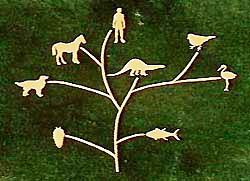
Evolution
Evolution comes from the Latin word evolutio and means ‘unroll’ or ‘development’. In the antiques, all the writing was done on parchment, to store the parchment had to be rolled up. When the documents were to be read, they had to be ‘unrolled’ again. Cicero called the ‘unrolling’ evolutio. In the 4th century evolutio was used by Saint Augustin for the ‘development’ of life. In the air, he tought, floated countless numbers of germs, which were created by God at the beginning of time. These germs were organisms that were alive, but at a microscopic format. By evolutio the germs grew out to their full extent.
In the antiques, some of the philosophers thought that in time living creatures develop from total different ancestors. Anaximandros for instance thought that animals of the land originate from animals from the water and people from shark-like organisms. Empedokles distinguished the origin of living beings from ‘equals’ and the origin from ‘unequals’. By the origin from equals, he meant the reproduction by higher animals, by the origin from unequals the warmth of the sun, dust and rainwater fuse, which result in life. Lower plants originate from the fusion of unequals, from the lower plants the higher plants develop, from which the animals arise. Looking at things now, his ideas can be seen as a precursor of the evolution-concept of the 19th century.
Because of better insight in the relations of the fossils in the 18th century, the evolutionary thoughts could be extended. One of the writers of evolution of that time was Buffon. He suggested that body-characteristics change by influences of the environment. Progeny of such influenced animals take over the adapted and unadapted characteristics of the parents. When the environmental influences, which caused the adaptions, sustain long enough, the characteristics of the parents become heritable. That is why generations of progeny become permanently different from the ancestors. This process was called transformism. According to Buffon, it could be assumed that all living organisms on earth originate from other living creatures.
Maupertuis (1698-1759), a contemporary of Buffon, thought that the progeny inherit all the characteristics of the parents, because with the seed fluids of the parents very minute germs are transmitted that contain these characeristics. When something goes wrong with the transport, the descendant will differ from the parents. In 1751, he suggested that in this way two parents could generate many different species. By the repeated ‘mistakes’ in the transport of the fluids, the great diversity that we see around us can be explained.
Erasmus Darwin (1731-1801), the grandfather of Charles Darwin, wrote in his book, Zoonomia 1794, that the de Christian calculation of the age of the earth was wrong. According to the bible the earth was created 4004 BC. He supposed that the earth was much older, millions centuries older. He also thought that people decent from microscopically small animals from the sea. And the evolution from those small animals to mankind took about 500 million years. His book was a best-seller and was translated in three languages, but the book was abolished by the Vatican.
At the beginning of the 19th century Jean-Baptiste de Lamarck published his evolution theory under the title Philosophie Zoologique (1809). It was Lamarck’s opinion that different types of animals with different extents of complexity are in fact a representation of a line of successive evolutionary changes. He thought that the simplest organisms originate from generatio spontane and that they developed out of non-living materials. Further the organisation-level of organisms got more and more complicated, till the supposed perfection of de mankind was reached. The theory had many similarities with the philosophy of Empedokles. In the beginning, his theory was not believed, also because the lack of evidence for the mechanisms that controlled these changes. Lamarck suggested that animals climb higher and higher up the ladder of evolution, because they want to improve more and more. The need to improve was the engine of the evolution. Lamarck knew that gradual changes lead to better adaptations to the environment, but he didn’t know what mechanism was behind this.
In a joint publication Charles Darwin and Alfred Russell Wallace, gave, independently for each other, the explanation the driving force behind the evolution: natural selection.
Darwin summarised natural selection as follows:
The organisms, as we see them now, are not created this way, but originate from species that lived before them.
More organisms are produced then possibly can survive, most of them die before they can reproduce. Individuals are constantly struggling with each other and most of the time also with the environmental circumstances, in order to survive. This is called The struggle for life.
The physical characteristics of the individuals within a species differ enormously and most of these differences are heritable.
Some characteristics are more suitable for the present circumstances and the individuals with these characteristics are better adapted to the environment.
Organisms that are better adapted have better survival chances and better chances for reproduction. This is known as survive of the fittest.
In time, natural selection can cause, in the first place for changes in existing species and secondly for the development of new species from species that lived before them.
In the year after the joint publication, Darwin published his book origin of Species by means of Natural Selection, his detailed bookwork in which he gave the evidence for the evolutionary changes and natural selection. In the way the book was received, made that Darwin is seen as the founding father of the theory of evolution. The truth however is different.
A few years after the publication of On the origin of Spesies by means of Natural Selection, it was generally accepted that organisms evolve, despite the attacks of the followers of the classical ideas. The acceptation of natural selection by means of inheritance came years later.
The mechanism of natural selection by means of inheritance was cleared by the time it was realised that all genetic information is confined in DNA. DNA consists of a big chain of serried information-units, nucleotides. The order, in which the nucleotides are arranged, determines the heritable characteristics. Mutations can change the order of the nucleotides, which results in a change in the genetic information. This may lead to progeny with different characteristics. When these changed characteristics provide the organisms better surviving chances, it will result in more progeny and these characteristics will spread. From a number of mutations new species can develop.
