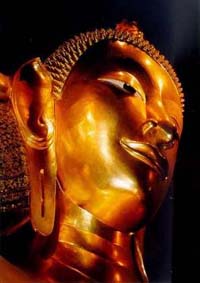
"To refrain from evil, to do good, to purify the heart." In a nutshell, this is the core of Buddhism, which it shares with the perennial philosophy expressed expressed by other religions around the world. The teachings of Buddhism, however, are more detailed than this and rather systematic. Continuing from the essay Who was the Buddha? I will here explain what Siddartha Gautama actually taught.
After he attained enlightment, which amounted to achieving a remarkable insight into the human condition, Siddartha was unsure what to do with this tremendous wisdom he had gleaned. At first, he thought of teaching it to others, but then doubted that it could be truly communicated in words, that others would be unable to comprehend what he was getting at. Perhaps this wisdom was for him alone to realize and use. Fortunately for us, however, a sense of duty prevailed and while then as now, in terms of great truth most people metaphorically have too much dust in their eyes to fully see, there are some whose sight is obscured by only a little dust. The Buddha hoped that his teaching might be of benefit to the. So, he set off to teach.
The Buddha gave his first lesson at Deer Park, Sarnath (near Varanasi, in India) to a group of wandering ascetics he knew. In it, the Buddha explained the human condition in terms of a framework called the Four Noble Truths.
Noble Truth 1: There is suffering. (Or more precisely, unsatisfactoriness.)
Noble Truth 2: There is a cause of suffering. That cause is desire and attachment.
Noble Truth 3: There is a way to eliminate the suffering, which is to eliminate the cause.
Noble Truth 4: The way leading to the elimination of suffering is the eightfold noble path.
The first noble truth, that there is unsatisfactoriness, is founded on a fundamental characteristic of being noted by Buddhism, which is that all things are impermanent and changing. Remember the Buddha's pre-enlightenment glimpses of old age, sickness and death in which he first confronted human suffering. Most people would not dispute that human life entails a certain amount of sorrow and loss and that this is in the nature of living. There is suffering and we cannot keep things forever and the same. The Buddha believed that this was the fundamental problem of existence. But, it is not a hopeless situation, for the Buddha, like a good doctor, examined the disease and identified the cause. This, he said, is craving.
Thus arose the second noble truth.
We are always desiring what we don't have. We want things to remain the same and in our possession, a form of attachment. This is futile, though, because of impermanance. This causes us to suffer.
Having identified a cause, there is a possible solution, simply the elimination of the cause. This is the third noble truth. It is very important. Get rid of desire and attachment (or reduce it) and suffering will disappear (or be reduced). That seems quite clear, but the question is how. The Buddha then explained the fourth noble truth as his elegant eight-fold noble path to the elimination of suffering by eliminating the cause of suffering.
The Buddha recognized further that craving was rooted in three fundamental types of defilement or imperfection: 1) ignorance, 2) greed and 3) hatred. He designed his noble path to attack and eliminate this three hindrances to happiness.
The Eightfold Noble Path
1. Right understanding.
2. Right thought.
3. Right speech.
4. Right action.
5. Right livelihood.
6. Right effort.
7. Right mindfulness.
8. Right concentration.
Everything you need to know about Buddhism to achieve enlightment is here. Elements one and two have to do with wisdom, which combats ignorance. Elements three, four and five are about morality, which combats hatred. The last three elements are about concentration, which combats greed. The path is thus broken into these three parts. The Buddha taught the eight points in different ways depending on the character of his student. For someone overwhelmed by greed, he emphasized concentration, while for someone full of hatred, he would focus on morality. The three sections are to be studied as is appropriate to the student.
Right understanding is the foundation of wisdom and the cessation of suffering. If you don't understand or misunderstand, the Buddha's teachings, then you will surely encounter problems. Right thought entails using right understanding in order for your mind to aspire to thoughts which are free of greed, hatred and ignorance. With right thought, you achieve a mind which is largely still and full of loving-kindness.
The next three steps underlie all the rest, for without morality, wisdom or concentration are difficult if not impossible.
One should be truthful and moderate in speaking and similarly in behavior. The five precepts of Buddhist life refer to 1) not killing (the converse:preserve life) 2) not stealing (the converse:preserve and respect things) 3) not lying (the converse: be truthful) 4) not being sexually indulgent (the converse: be moderate and true in sexual matters) and 5) not consuming intoxicants (the converse:have a healthy diet and care for your body and mind). This says so much. I might addthat one should not harm the universe around you, but be kind to all and everything. A right livelihood is important too, as one's job should not entail violation of the five precepts. Such jobs as butchers, executioners or thieves do not incline one to a moral life.
With wisdom and morality in place, it is then time to train the mind. Mental training, also called meditation, is critical to Buddhist practice and sets it apart from western religions. Suffering really originates in our mind as it is our response to situation and circumstance that creates sorrow and pain. So, it is through the mind that we can finally follow the third noble truth. One begins by making the effort to concentrate the mind and this effort is made towards achieving mindfulness. One should be aware at all times of one's thoughts, words and deeds and be cognizant of cause and effect. The Buddha taught that live in a realm of conditioned things called "samsara" (the cycle of suffering) that are fueled by karma which is fueled by ignorance and a lack of mindfulness. When one is mindful, one is more apt to refrain from doing bad and to do good. Concentration means focussing the mind (making it calm and one-pointed) and maintaining that mindfulness at all times in everything you think, say and do.
When all eight elements of the path work together, one will truly find a happiness that is strong and enduring. The four noble truths of which it is a part are the foundation of all forms of Buddhism and a philosophy and religion not so difficult to understand or apply. The Buddha taught this lesson in many forms for the next forty-five years until his death. Their truth still rings true.