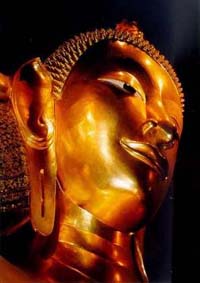
Who was Buddha? Who is Buddha? The world 'Buddha' comes from the ancient Pali term "Bodh' which means
awakened. To be awake to the world is to be Buddha. Thus, we can all be Buddha. In Buddhism, there are
and have been many Buddhas in the history of the world, many fully enlightened beings. In Theravada Buddhism
as practiced in Southeast Asia, when speaking of the Buddha one usually refers to the historical Buddha, Siddhartha
Gotama who lived in India around 2500 years ago. In Mahayana Buddhism as practiced in China, Tibet, Korea and
Japan, there are many mythical Buddhas as well, each worshipped for the specific attributes it symbolizes.
Siddhartha Gotama, the historical Buddha, was an actual man born in India 2500 years ago. He was born in Lumpini Park in Kapilavastu (now Nepal) to a wealthy royal clan called Shakya. The Buddha is thus often called by his family name plus a holy suffix, Shakyamuni. He was raised in luxury, but also an intentional blindness to the world. From his early days, he demonstrated special powers and intelligence. A prophesy was made to Siddhartha's father when the boy was quite young. It was prophesied that he would grow to be either a great conqueror of the world or as a priest,
the Enlightened One. Siddhartha's father preferred the former, not wishing to lose his son, and so kept the young boy insulated from the world.
The boy grew into a man, married and had a child. But there was something missing in his easy and sheltered life of splendor. He was dissatisified and inquisitive. With the help of some servants, Siddhartha snuck out of the palace on several occasions in an attempt to learn something of the 'real world'. He was shocked by what he saw, as these things had been kept hidden from him within the palace. On his first occasion, he saw a dead man, then a sick man, then an old man. Was this really life, he thought. Old age, sickness and death!! Such pain and suffering. Then on a subsequent outing, Siddhartha saw a religious wanderer. He there decided that he would follow a similar path in order to understand and resolve the problem of suffering in life. And so, one night after a decadent party in the palace, Siddhartha kissed his sleeping wife and child goodbye, uncertain if he would ever return, and fled. At the forest's edge, he gave up everything he had, cut his long, royal hair, shed his royal garb and bid his servant return to the castle with his horse. Siddhartha thus began at age 29, his quest to know, understand and solve the problem of suffering in life.
At this time in India, there were many religious wanderers and and teachers. There were ascetics and lofty Brahmins.
Siddhartha joined the wandering ascetics, and sought understanding and release from suffering through extreme bodily deprivation and meditation. After several years of such self-torture, he was no nearer the truth, just weary and lean.
One day a young woman came to him and offered him some sweet rice and he then realized that the way to enlightenment was not through depriving the body as he had been attempting nor through the pampering of his former palace life. Balance was necessary. The way to truth must be a middle way between the two extremes. One must be healthy and strong in order to learn.
Siddhartha then proceeded to meditate beneath a tree (now called a Bodhi tree). For seven days and nights he meditated, thwarted by Mara (the spirit of illusion and desire), but never succumbing. At last he attained enlightenment, at age 35, six years after setting out. He understood the power of the mind, problem of life and the solution. He considered what to do next. At first, he thought that what he had realized was truly too profound to teach. But, he had to teach it. While most people have too much dust in their eyes to see the truth, there are some with only a little dust in their eyes. He proceeded to Deer Park near what is now Varanasi and there found five young Brahmins to whom he taught his first lesson. After his first lesson, a community of monks arose -- the original Sangha. The Buddha continued to wander and teach until he died at age 80. But this was only a beginning for Buddhism.