 |
Le Cafe Singe Bleu Serving generous portions of history and mystery from our monthly menu |
| |
Le Cafe Singe Bleu Serving generous portions of history and mystery from our monthly menu |
|
BOLD STROKES:
Before serving the entree, I'd like to set the table by discussing briefly Charlie Chan's career in books and movies up until 1935. (If you can't wait, go to Paris now). The Charlie Chan of the movies, like the Charlie Chan of the books, is a positive role model. These movies are a product of their times in America, in which most people looked down on minorities. Yet Charlie Chan was a character who, while not speaking perfect English, revealed himself to be extremely intelligent and dedicated to truth and justice. He was also able to rise in his profession due to ability, and was given respect by everyone who knew him. Those who did not respect him soon had cause to regret it. In the books, Charlie Chan was born in China and immigrated to Hawaii and therefore had to learn English as a second language. His [many] children were born in that territory [Hawaii became a territory in 1900 and a state in 1959. See external site Hawaiian history] and therefore speak perfect, if ungrammatical, English of their own. (Hiya, Pop!) Charlie Chan was created by Earl Derr Biggers, who had achieved fame and fortune when his novel Seven Keys to Baldpate (1913), was transformed into a wildly successful play. In 1919, while vactioning in the American territory of Hawaii, he read about the exploits of a Chinese police detective, Chang Apana in the newspapers. So struck was he by this oddity (although probably not unusual in Hawaii it was unusual anywhere else in the States) that he decided to create a Chinese detective.
 Chang Apana
Biggers wrote a total of six Chan books, with five of them being made into films. (The final book, The Keeper of the Keys, was made into a play but never a film). The books and their adaptions:
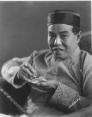
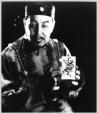
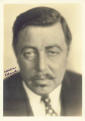
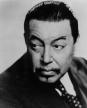
Chan's first three movies were silents, and there was no continuity with the character (except that it had been played twice by a Japanese). In 1931, Fox was ready to do a sound version of Charlie Chan Carries On. They contracted a Swedish/Russian born actor named Warner Oland to play the Oriental detective. (Could they have hired an Oriental actor to play the detective in a sound movie in 1931? Would such an actor have the drawing power that a more established Caucasian actor had? Would the Chan series have proved as popular and been able to, eventually, launch the careers of such Oriental actors as Keye Luke, Sen Yung and Benson Fong? By whites playing sympathetic Oriental characters under makeup in movies like Broken Blossoms, did not the subliminal message go out that everyone is the same under the skin?) Warner Oland was already a popular actor who had made his mark as an Oriental villain; most famously in The Mysterious Dr. Fu Manchu (1929) and The Return of Dr. Fu Manchu (1930). It was now time for an Oriental hero.
After the success of The Black Camel, also 1931, with Bela Lugosi in a role as one of the suspects, the Charlie Chan movie series was established as a viable moneymaker. Oland made other movies as well, but contintued to star as Chan in Charlie Chan's Chance, released in 1932, which has been lost. It was yet another version of Behind That Curtain. Charlie Chan's Greatest Case (1933) was based on the first Chan novel, House Without A Key. This is another 'lost' Chan, as is 1934's Charlie Chan's Courage, based on The Chinese Parrot. Charlie Chan Films Starring Warner Oland
The first original screenplay for the Chan series was written by popular mystery writer Philip MacDonald (author of, among many other books, The List of Adrian Messenger), and was called Charlie Chan in London. Chan's globetrotting had begun in earnest. In the books by Biggers, there were no characters to provide comic relief. In The Black Camel and in Charlie Chan Carries OnChan is hampered by an incompetent Japanese detective named Kashimo, but he has no such encumbrances in the other books. When it came time to write original screenplays, it was thought necessary to give Chan a 'sidekick'. Someone to 'open the stories out.' Someone who could ask Chan questions that the audience wanted to ask, and to whom Chan could reply. Therefore the character of Lee Chan was added to the Charlie Chan series, and played by Keye Luke.

Keye Luke (from Charlie Chan at the Movies, by Ken Hanke): In addition to writing this 'fat part,' McDonald also had fun with Keye Luke in another way. One of the characters in the film is Max Corday (played by Erik Rhodes). He is an artist, and is always making sketches of people he meets. One wonders if this was a hobby of Luke's as well. One also wonders if the sketches that appear in the movie were actually done by Luke. Continue to Charlie Chan in Paris.
|
 |
Thank you so much |