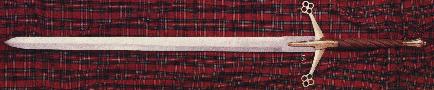
- Part II
-
- Basket-hilts:
- This very early
incarnation of the basket-hilt sword (right) was in many
respects more effective than later models. The basket of
steel bars does an excellent job of protecting the hand,
yet does not add a great amount of weight.
 Well balanced, this is
an excellent cut and thrust weapon. Although probably of
Scottish origin, and used both in Ireland and Scotland,
this particular basket-hilt sword was referred to as the
"Irish" hilt, as still is even today. Why?
Maybe because the English frequently referred to Celts as
"Irish" or because this sword was heavily
favored by the Irish. The sword is shown here with a
mated Irish hilt left-hand dagger.
Well balanced, this is
an excellent cut and thrust weapon. Although probably of
Scottish origin, and used both in Ireland and Scotland,
this particular basket-hilt sword was referred to as the
"Irish" hilt, as still is even today. Why?
Maybe because the English frequently referred to Celts as
"Irish" or because this sword was heavily
favored by the Irish. The sword is shown here with a
mated Irish hilt left-hand dagger.
-
- Never has there
been a sword so strongly identified with a people as the
sword (right) which has been mistakenly dubbed the
"Basket-Hilt Claymore". The Gaelic Claidh-mhor
is, literally "Great Sword", which this is not.
- Although many may
have been made from the broken blades of the great-sword
of the Highlands, the sword is
 more properly know
as a "Basket-hilt Broadsword".
more properly know
as a "Basket-hilt Broadsword".
- From the early
days of the 17th century until today, the basket-hilt has
been the symbol of the warrior race of Scotland. Scottish
through-and-through, strangely enough, the ideal
basket-hilted broadsword by Scottish standards was one
which bore a blade marked "Andre Ferrera" - an
Italian bladesmith....
-
- Claymore
- Great Sword of the Highlands:
- Used in the
constant clan warfare and border fights with the English
from 1500 t0 1650 and still in use as late as the
Rebellion of 1745, the two-handed Claymore seems to be an
offshoot of earlier broadswords as they were developed
into great-swords. Widely feared because its lightness
made it faster in combat than its European counterparts,
this sword developed a distinctive style of crossguard
with downsloping arms that ended in spatulate swellings.
The Claymore, from about 1520, shows the true Scottish
form which was finally developed.
- It was said that
the bearer of a Claymore needed no shield (how
could he carry one, anyway?) because the reach
of the sword provided its own protection. It is noted
that most Scottish edged weapons featured crossguards,
baskets, and pommels made of brass, rather than steel -
probably because of the damp weather of the area, which
would cause steel to rust and deteriorate much more
rapidly than brass.
-
- The Dirk:

- The Scottish Dirk
is a direct descendant of the medieval ballock dagger as
shown by
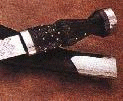 the grip of the early
version shown at right. The grip form began to change,
probably sometime in the late 16th century, becoming
purely Scottish. The late versions (left) though quite
popular, are somewhat debased in form, carved with a
basket-weave or traditional Scottish foliage and thistle
design, and some with engraved blades, etc.
the grip of the early
version shown at right. The grip form began to change,
probably sometime in the late 16th century, becoming
purely Scottish. The late versions (left) though quite
popular, are somewhat debased in form, carved with a
basket-weave or traditional Scottish foliage and thistle
design, and some with engraved blades, etc.
- Make no mistake
though... the dirk is a pure fighting knife and
unabashedly so. The 14 to 16 inch blade was single-edged,
made to use alone, left-handed with a shield and sword,
or just with a basket-hilt broadsword. The dirk was
usually worn with the scabbard afixed to the belt just to
the right of the Sporran.
-
-
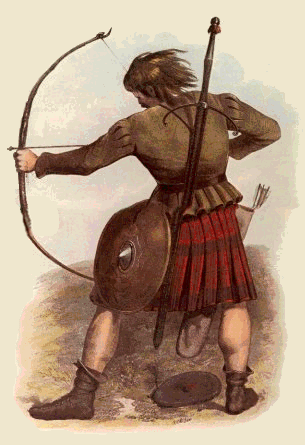 The Bow:
- Until about 1650,
the bow was an important weapon of the Highlands of
Scotland, and also served well in the hands of Welsh
long-bowmen.
- Even when it was
replaced by gunpowder and firearms and no longer needed
for war, it was used for hunting animals, and dogs were
used to bring down wounded deer.
- One feature of
Highland bowmen, which I have heard, but not been able to
substantiate, is the contention that the Highlander did
not use the bow in what is now considered the standard
manner, held vertically, and drawn to the chin or
cheekbone, but rather as the Native American - held
horizontally.
-
- The
Pistol:
- With the advent of
gunpowder and firearms making the bow obsolete as a
projectile weapon, Highlanders moved into the modern age
by carrying a brace of pistols afixed to their sword
belts. Pistols were used
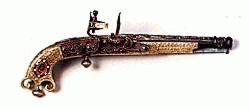 together with the
powder horn and shot pouch. Highlanders were known to
fire the pistols at the enemy before them, then throw
them down, leaving both hands free for using broadsword,
axe, targe and dirk, and to instantly charge the enemy
while they were still reeling from the effect of the
pistols. The weapon shown was distinctively Scottish,
engraved with the thistle motif and similar Scottish
decoration. It was a pistol such as this one which fired
the "Shot Heard 'round The World" at Concord
which signaled the beginning of the Revolutionary War
between the then fledgling United States and England.
together with the
powder horn and shot pouch. Highlanders were known to
fire the pistols at the enemy before them, then throw
them down, leaving both hands free for using broadsword,
axe, targe and dirk, and to instantly charge the enemy
while they were still reeling from the effect of the
pistols. The weapon shown was distinctively Scottish,
engraved with the thistle motif and similar Scottish
decoration. It was a pistol such as this one which fired
the "Shot Heard 'round The World" at Concord
which signaled the beginning of the Revolutionary War
between the then fledgling United States and England.
-
- Lochaber
Axe:
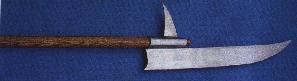 This type of axe was a
massive weapon used by foot-soldiers as a defensive
weapon against mounted cavalry.
This type of axe was a
massive weapon used by foot-soldiers as a defensive
weapon against mounted cavalry.
- Last used as a
means of defense by Highlanders at Killiecrankie. By
1769, Lochaber axes were mainly ceremonial weapons such
as those carried by Edinburgh's town guard.
- The Lochaber axe
took many forms and shapes, and the one shown is from a
private collection in Scotland. As to its actual
historical origin, it is hard to say. Certainly it has
all the earmarks of the axes in many of the castles and
museums in Scotland.
-
- The
Targe:
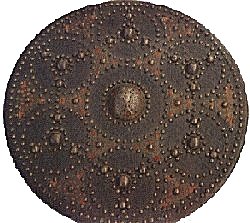 Also used in battle,
this was a round wooden shield, covered with hide. Most
had a central spike (the 17th century targe at the left
does not) and were decorated with embossed designs and
nails, which actually made it stronger.
Also used in battle,
this was a round wooden shield, covered with hide. Most
had a central spike (the 17th century targe at the left
does not) and were decorated with embossed designs and
nails, which actually made it stronger.
- Used by the wild
clansmen of the Highlands of Scotland, this shield was
still in use in 1745 when it gave the English real
trouble during Bonnie Prince Charlie's Rebellion. When
the Redcoats lunged with the bayonet, the Scots would
catch it on the targe, and then slash with the sword.