- The
Spear:
- One of the oldest
and most important of all hand weapons.
- Although you may
hear little about it, the Celts favored spears as their
main weapon in their far-ranging battles across Europe.
The "LaTene" spear (top) features a
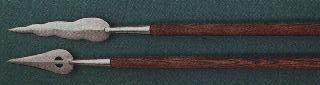
- wavy blade and is
modeled after the spears which defeated and demoralized
enemies 2,000 years ago. Featuring a lovely and fearsome
flame-shaped blade of some 14 inches in length, and
mounted on an ash pole of some seven feet in length, this
is a spear which could have belonged to Irish heroes of
legend. The widely-used leaf-shaped spear (bottom)
features an air of simple elegance and deadly intent.
Note the cutouts in the nine and a half inch head.
-
- The
Sword:
- Always the favored
weapon of the Gael, the sword underwent change over the
centuries as it progressed from the simple bronze-bladed
leaf shaped sword to the relatively modern swords you can
still see in Scotland and Ireland today. Although mostly
seen in museum displays, more modern versions of some of
these blades are still carried on ceremonial occasions.
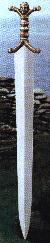
 One of the earlier of these weapons of
the Celts is represented at right, in this reproduction
of a Celtic bronze hilted short sword. Carried and used
to great effect, by these warlike people who dominated
most of central and western Europe for many years. Far
from being merely another warrior tribe, the Celts
possesed a taste for art and beauty which is reflected in
many of their artifacts. This Anthropomorphic hilt short
sword demonstrates one of their most entrancing. A
beautiful work of art, yet also a well designed weapon.
The short, quick blade was well-suited for the
hand-to-hand combat which was a feature of Celtic
warfare.
One of the earlier of these weapons of
the Celts is represented at right, in this reproduction
of a Celtic bronze hilted short sword. Carried and used
to great effect, by these warlike people who dominated
most of central and western Europe for many years. Far
from being merely another warrior tribe, the Celts
possesed a taste for art and beauty which is reflected in
many of their artifacts. This Anthropomorphic hilt short
sword demonstrates one of their most entrancing. A
beautiful work of art, yet also a well designed weapon.
The short, quick blade was well-suited for the
hand-to-hand combat which was a feature of Celtic
warfare.
-
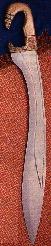
- The Celt-Iberians
of Roman times were justly famed for their weapons, such
as the Falcata (left), one of the most devastating swords
every made. The inward curving blade delivered a
tremendous blow and could split both shield and helmet!
Considered to be of Greek, or possibly Etruscan origin,
this sword spread into Southern Russia and also Spain. It
was in Spanish hands that it was most feared by the
Romans.
- Far-ranging
designers of some of the most beautiful objects of art
known, the Celts were one of the first to use iron long
swords such as the one at right. A fearsome weapon that
smote enemies of the Celts across the entire continent of
Europe, it is believed to be the forerunner of the Spatha
and the Roman cavalry sword. The Celts are also believed
to be the inventors of mail.
-
- Broadsword:
- Few weapons are as
rich in history as the exclusively Scots forerunner
(left) of the legendary Claymore
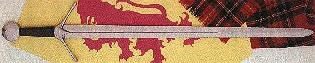 two-handers. Though no more than
two-dozen of these swords exist today, their presence has
been recorded for 700 years This is the sword on the seal
of King John (Baliol) from 1292. The most famous
documentation of this sword is its presence in stone,
carved on the gravemarker of Robert de Greenlaw, killed
in battle in 1411. A handful of these swords have been
found in Ireland, left there by the mercenary Scottish
Gallowglass. Though most surviving examples date from
1350-1450, King John's seal shows that it likely
originated circa 1250.
two-handers. Though no more than
two-dozen of these swords exist today, their presence has
been recorded for 700 years This is the sword on the seal
of King John (Baliol) from 1292. The most famous
documentation of this sword is its presence in stone,
carved on the gravemarker of Robert de Greenlaw, killed
in battle in 1411. A handful of these swords have been
found in Ireland, left there by the mercenary Scottish
Gallowglass. Though most surviving examples date from
1350-1450, King John's seal shows that it likely
originated circa 1250.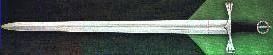
- Not to be outdone,
the Irish not only developed whiskey, they also developed
one of the most distinctive pommels and crossguards of
all medieval swords (right). A steel ring pommel with a
flaring steel crossguard bent in opposite directions. A
quick and powerful weapon which enhanced the Irish
reputation for being superb fighting men.
-

