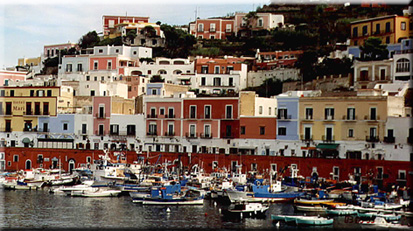
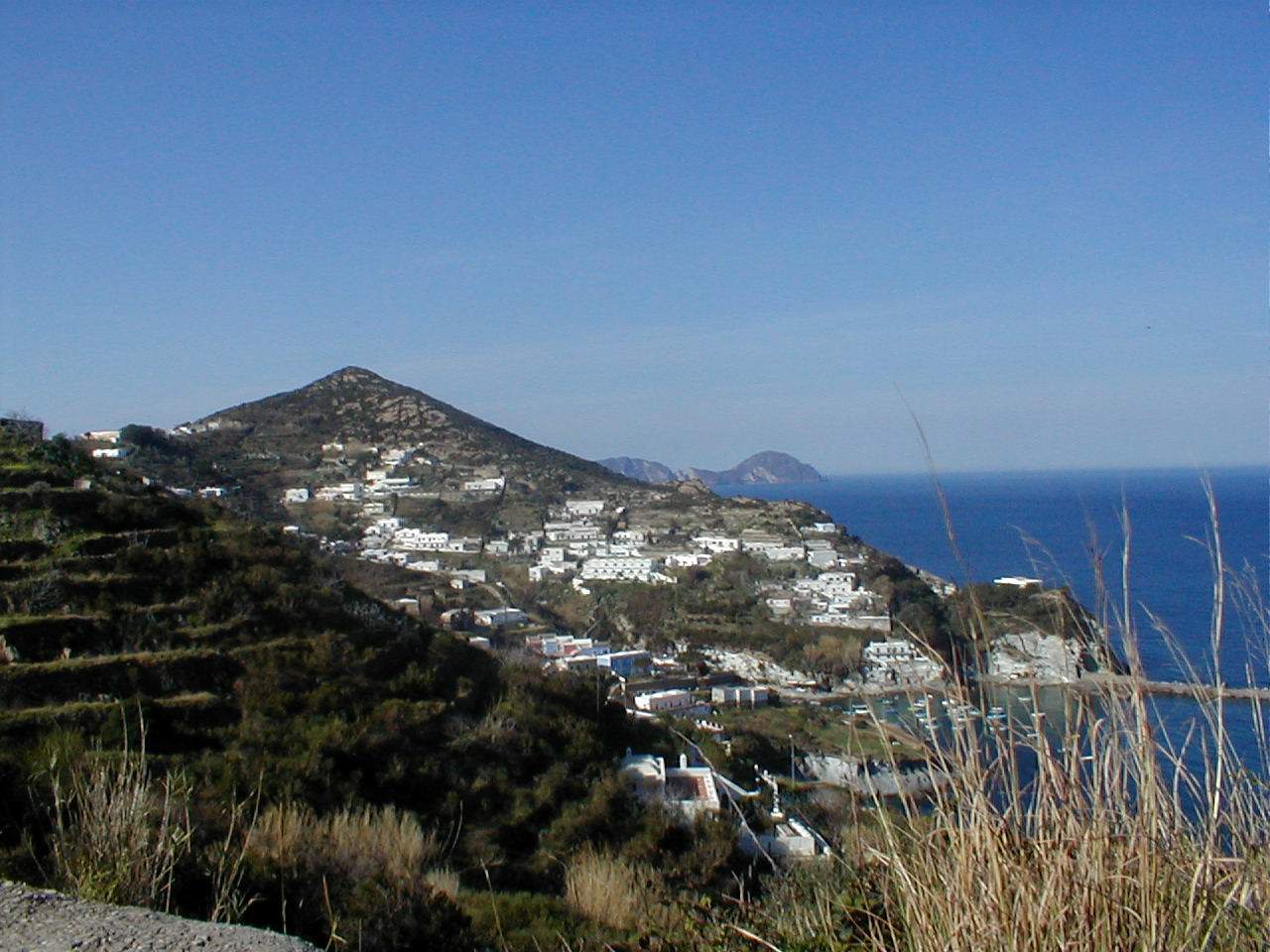
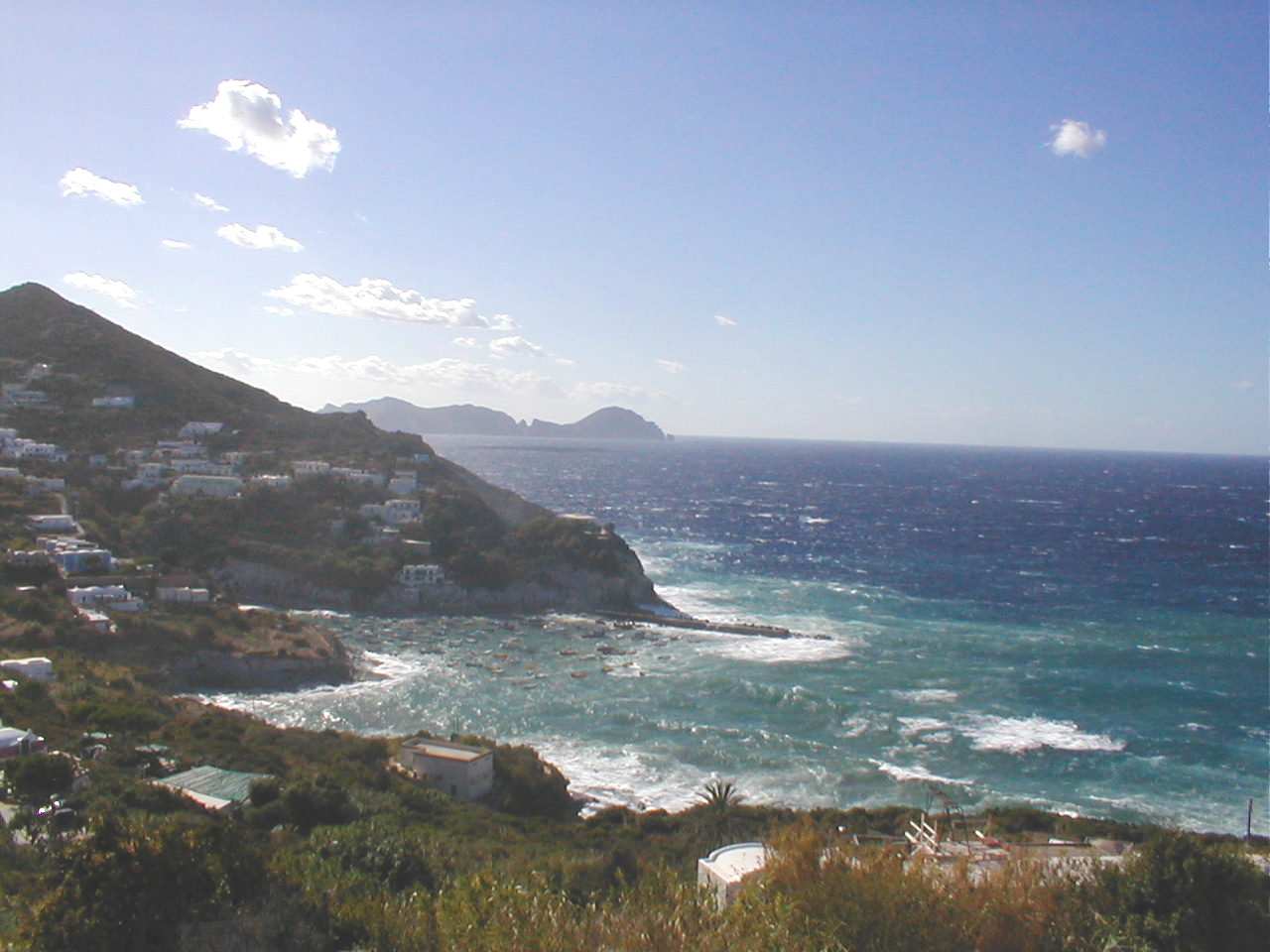
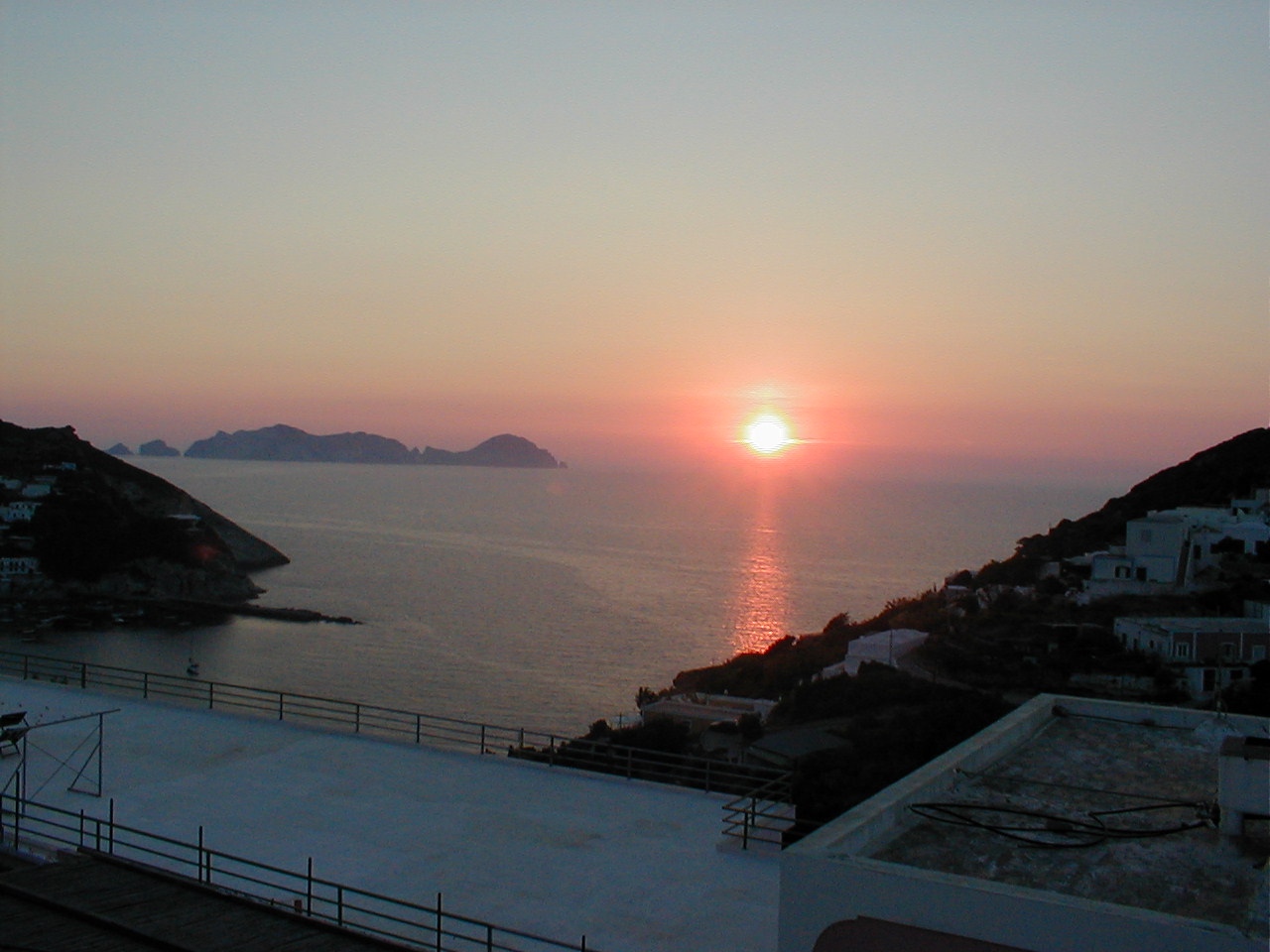
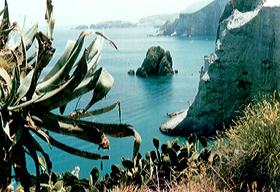
| Ponza is the largest of the islands, 5 miles in length and from 650 ft to one mile in width, and reaches a maximum altitude at Monte della Guardia of 1090 ft. Its outline is varied and broken, with an exceptional series of bays, inlets; the rock formation shows great variety of shapes and colours, seen in the volcanic layers which are predominantly, limestone and trachyte. The local people have christened the various places with the most colourful names. Starting from the north-eastern spur called Punta dell' Incenso (Incense Point) and continuing southward one travels through some enchanting places: the small Isle of Gavi, Gala Gaetano, Ravia di Aniello Antonio, Punta Nera, Gala d' Inferno. Gala del Core with its typical Scoglio Spaccapolpi or Calzone del Parroco, Punta Bianca, Gala di Frontone, S. Maria, Giancos, down to the shippinglane. This is protected to the east by the Punta della Madonna (with the nearby cliffs), under which lie the Pilatus Caves where the ancient Romans bred Muraena fish, and which have given birth to many picturesque local legends. Continuing the tour, one passes the Calzone Muto Cliffs, the Punta della Guardia with its lighthouse, Punta del Fieno, the Punta Bianca and so on: the Maria Rosa Cliffs, Capo Bosco, Gala Feola, Gala dell' Acqua, Punta del Papa, Gala Fontana, Punta Beppe Antonio, and finally Gala Caparra. The main town comprises two nuclei: Ponza itself which is built up around the port, and Le Forna, 5 miles away by road, with their attractive low, whitewashed houses affording a typical architectural unity. The port is a small amphitheatre designed by the architect Winspeare in Bourbon times. It can be reached from Formia, Terracina, S. Felice Circeo and Anzio by motorboats and hydrofoil. |
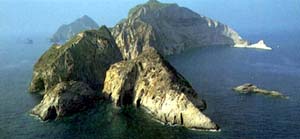
| Palmarola - Situated about 8 miles from the port of Ponza, Palmarola can be reached by hired boat. It is uninhabited, but in summer facilities are laid on for tourists. Its natural characteristics resemble Ponza' s. |
| The fortresses of the islands -The renaissance fortresses of the Farnesi are the characteristic aspect of some promontories of the island. There is one at Punta del Papa, at Le Forna, built towards the first half of the sixteenth century to protect the coasts from the pirates' assaults. From 1909 when a landslide made the south wing where once the officials where lodged fall down, the fortress is in a continuous wearing up. At the feet of the promontory of the Pope, there is the �Zi Teresa� cave where according to the tradition there is a treasure that the pirates The renaissance fortresses brought in there. The other Farnese'e fortress is of a remarkable interest, and overlooks from one side the bay of Fronton' with its famous beach and from the other one the Piana Bianca. It was strategically built to guard the Ponza's harbour and was submitted to plenty assaults of the sea among which that one of the major Napier (afterwards named Count of Ponza) which occurred in February 1813. |
| Le Forna - Following the second intensive colonization of the Bourbons towards 1771 some peasant farrieries settled down in this part of the island and shared the lands of Lucia Rosa up to Punta Incenso. In the last one hundred years, in spite of the touristic development the centre of the village has remained unchanged. The church of Le Forna, devoted to the Madonna Assunta, has a particular oddness: two bell towers set in a diagonal, one to the east, and the most ancient one towards the west. In the Cala dell'Acqua one part of the admirable imperial age aqueduct is still working. The ancient Romans build it by digging long galleries into the hills. The water dropping from the vaults of this underground labyrinth was conveyed in the huge containers which reached fifty cube meters size. This aqueduct satisfied the needs of the whole island and it was necessary to the supply of the triremes which passed by the island. The work can be really considered to be grandiose if one thinks that in the first century after Christ, the inhabitants were almost ten thousand heads, which is the double of the present population. In the first years of our century a bronze � epistomium � adorned with figures was recovered from the fountain of Gala dell'Acqua and it is today kept in the National Museum of Naples. The plac is rich in betonies (aluminium silicate) that is a very precious mineral and of kaolin; the latter was already extracted in the nineteenth century and exported to Capodimonte in the Naples Gulf to be used in the chinaware working. |
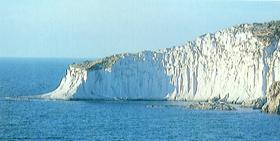
| Chiaia di Luna - West placed and protected from the north wind by a huge wall of yellow and white tofu is the most well-known beach in the entire archipelago. In ancient times there stood a Greek harbour devoted to the goodness Moon and still today you can recover the remains of ancient buildings and fragments of amphorae in its very clear depths. The cambered rock in front of the beach offers to those who dive in an admirable scenario. It is in effect wholly bored in the submerged portion and the sun beams filtering through it offer to it iridescent colours. You can reach the beach like two thousand years ago thanks to a tunnel likely to be of Greek origin. It was then restored by the Romans who made I rage skylights in the vault and strengthened the passage with walls �in opus reticulatum�. Very small bridges leading to the necropolis on the right of the tunnel entrance are worth while being visited. |
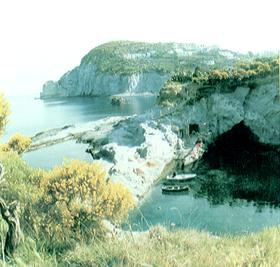
| Cala Inferno - The Gala is the result of an intense volcanic activity and it is one of the most evocative corner of the whole archipelago. One can now see an eroded cone for more than one third from the wearing action of the sea. At the feet of the cone there is a little wharf where one can still look at the wall works and at the excavations made by the Romans to carry out one of the many stores of the island aqueduct. It was necessary for the supply of the water to the Italian ships up to the Second World War. A little fountain still gushing almost at sea level continuous to restore the fishers. The steep wall of the Cala is bored by a very hard passage which permits to reach the sea. The path climbing on a precipice of sixty meters is protected by a natural fen of characteristic rocky mushrooms. The very white tofu is coloured of a deep red towards Punta Nera and gives intense tones to the water. Near Cala Inferno there stand a peculiar rocky island called �Calzone del Parroco� for the resemblance to the garment of an old priest. Its depths abound in dates very exquisite sea fruit. The path with no more than two hundred steps connects the bay to the centre of Le Forna and those who walk on it discovers very interesting landscapes and foreshortenings. Before the building of the cart way road, Gala Inferno was the wharf of some ferrymen which connected Ponza-harbour and Le Forna. Today it is one of the preferred destination of the tourists. A characteristically natural are called the �Spaccapurpo� by the inhabitants of the islands is placed off-shore the beach of the �Schiavone�. It was used by the first fishermen as a land-mark to detect a shoal particularly full of fish. Once spotted the position they used to say �spacca u purpo� that is cut the polyp used as a bait for the bow-nets; from this the name. On this particular rocky formation some specimens of the rare pasquinii lizard still survive. Not far there is the rock called of �Aniello Antonio� on which a mini-vineyard was cultivated until the past century, a real hanging garden. |
| PONZA ISLAND |
 |
 |
 |
 |
 |
 |
 |
 |
|
 |
 |
 |