| The origin of the name Gaeta (Caieta) belongs to the myth and is shrouded by legends. Virgil (Aeneid, VII, 1-4) made Aeneas' nursing mother die in that area and this should have given the name to the place. Dante confirmed the event (Inferno, XXVI, 92) almost giving proof of the historical value of the Virgilian poem. During the Roman age it became a very popular resort for Emperors, Consuls and rich Patrician families; it has also been a very impotant port, as Circeo stated in 66 B.C. Starting from the last century of the Roman Republic, wonderful villas have been built all along the crescent-shaped beach of Gaeta and the coast toward Sperlonga: the beauty of their gardens and swimming-pools, nymphaeums, temples and mausoleums is testified by the many impressive ruins. Today we can still admire the tomb of the Consuls Lucio Munazio Planco, on top of Monte Orlando, and Lucio Sempronio Atratino, on the northern side of Atratino hill. Because of the position of the high and rocky peninsula, very easy to defend, in the early Middle Ages Gaeta became a fortress, or castrum, and toward the middle of the IX century it came to be a prospering Dukedom as well as the Bishop residence, starting off an intensive sea-commerce in the Mediterranean. The Dukedom of Gaeta represented a very important entity between the Christian and Saracen world (the battle of Garigliano, 915), between the State and the Church, the Terra S.Benedicti, the Longobardic and Byzantine dukedoms and princedoms of southern Italy. |
| The first urban center on the easternmost side of the promontory expanded toward the sea occupying the area almost until the foot of Monte Orlando. Two surrounding walls were built under Docibile I (867-906) and Giovanni I (877-933): the first ones bounded the most ancient area around the churches of S.Lucia and S.Caterina untill the side toward the roadstead, near the Dominica gate and the palace of Docibile I as for as the upper part of the castle was built; the other ones bounded the populated area that reached the square now called Commestibili, so that it could defend the most exposed urban area from any siege during the first decades of the X century and dominated by the tower-palace of Giovanni I, an Imperial Patrician. While the Ducal civitas was being formed, a modest settlement of fishermen and farmers developed around the Church of SS.Cosma and Damiano ( where the "Borgo di Gaeta" was originated): it was far from the walls and at the foot of a hill that was to be named Cappuccini (starting from the middle of the XVIII century). With the Norman Ruggiero II (around 1140), Gaeta became the limit of the "Great Kingdom" toward the Papal State, assuming, at the same time, the role of a fortress with different curtains of bastions and artificial works, so that it was then defined as the "key to the Kingdom of Naples". This gradual militarization of Gaeta, highly due to its strategic position, will be underlined during the following centuries because of the many and important sieges. Until the end of the Middle Ages, but especially during the modern age, these events marked very important steps for Southern Italy. The capitulation of the fortress often corresponded to the coming of a new foreign domination or a new dynasty. |
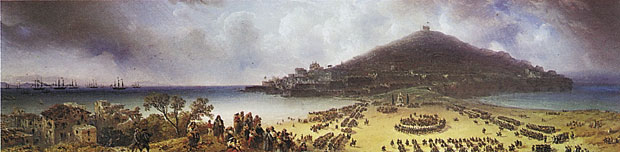
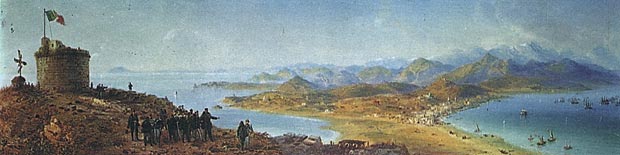
| Since 1032, when the power of the Docibiles over the Dukedom of Gaeta declined, till 1504, when the Spanish conquered the Kingdom of Naples, many dominations follow one another (the Longobards, the Suevians, the Angevins, The Durazzos, the Aragoneses) and this gave to Gaeta the role of second Capital of the Kingdom. During the same period Gaeta often became the base for the conquest of Naples (Ladislao of Durazzo in 1399; Alfonso of Aragona in 1442). The presence of sovereigns determined the construction of many important buildings, giving a particular historical and artistic mark to the very end of the promontory: we can take as an example the castle that became a royal residence with Alfonso of Aragona in 1436-42. The long presence of the Spanish in the Tyrrhenian town (until 1707) has deeply changed its role from a commercial center into a military town troughout important defensive constructions made by Carlo V (1538). The Austrians succeded to the Spanish and in 1734 Carlo of Bourbon, the founder of the new Neapolitan Bourbon dynasty, settled in Gaeta. Once again the fortifications and the various defence works had a prominent role in the urban layout. During the long Bourbon period there have been many sieges (1799, 1806 and 1815) as well as an event of international impotance: on the 25th of November 1848, the Pope Pius IX seeked refuge in Gaeta (escaping from Rome because of the proclamation of the Republic), so that the Tyrrhenian town assumed the role of "second" Papal State until the 4th of September 1849. The Bourbon dynasty ended on the 13th of February 1861 under the walls of Gaeta, giving birth to the unity of Italy. |
| The second world war has been a new tragedy over men and things. A new urban reality was born through the destruction of the war and the population dispersion. This led to a new economy, more related to industry and commerce. Today Gaeta can be acheived thanks to its scenic, monumental, artistic and cultural aspects. |
| GAETA TODAY |
 |
 |
| THE BEAUTIFUL CITY OF GAETA |
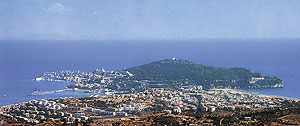
| Celebrated since Roman times for landscape beauties, mildness of the climate, enchantment of the sea and beaches, the city of Gaeta is rediscovering its ancient vocation: from a military city it's becoming a nice tourist resort place, thanks to its natural beauties, history and its celebrated walls that surround artistic and historic buildings. That Gaeta is a tourist city was well known to the rich Romans who built lots of villas and temples along its coastline. |
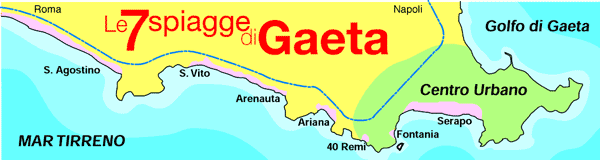
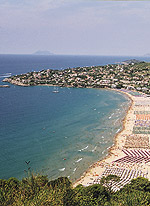
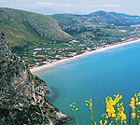
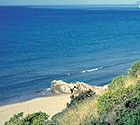
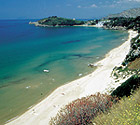
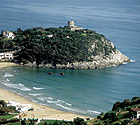
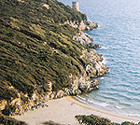
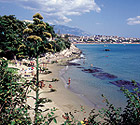
| The coastline of Gaeta Along the coastal road Flacca (Terracina-Sperlonga-Gaeta) the city shows the visitors its well known beaches: Sant'Agostino, San Vito, Arenauta, Ariana, Quaranta Remi, Fontania, Serapo; the mythical Greek hero Eneas landed on one of these beaches. And here, in Gaeta, the son of Anchise and Afrodite buried his nurse Caieta who, according to the Virgilian legend, gave the name to the city. But there is something else besides the sea for those who arrive at the western riviera: the rocky walls of Mount Moneta (m 359), that dominates the bay of Sant'Agostino, are well known to the free climbers. Much frequented is the gilded beach of Sant'Agostino, dotted of restaurants and camping areas. On Via Marina di Serapo, that for about one kilometer coasts the beach of Serapo, bathing establishments - of good and excellent level - spread out on the beach, which is very close to the center of the city The visitor who wants to stir easily in Gaeta needs to learn soon the names of the most important districts. First of all he can find out that Gaeta is divided into two big urban agglomerations: Medieval Gaeta (inside the walls) embracing the historic complex of Sant'Erasmo; Gaeta del Borgo (outside the walls) made up of more recent urban settlements. |
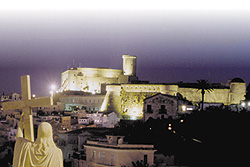
| Gaeta - Sant'Erasmo The complex of Sant'Erasmo bloomed for military reasons but then it soon got enriched by city planning and architectural works. Of pre-Roman origin, the city flourished under the Roman empire, then it became a dukedom and afterward it was under the Norman monarchy. The medieval citadel is rather picturesque in its urban structure: narrow sreets that at times are transformed into small stairways realized between the XII and the XIII century. The clear color, prevalently the white, characterizes most part of the houses and buildings that are like a frame to the Angevin-Aragonese defensive complex, whose first structure dates back to the VII century. The medieval district is an open-air museum built at the footstep of Monte Orlando, on whose slopes stretch the strengthened citadel, which underwent 16 sieges: the last siege took place between 1860 and 1861. The surrender of Gaeta (13 February 1861) marks the exile of the Borbone dynasty, tied to Kingdom of Naples, and the beginning of the unification of Italy. Pillboxes,emplacements, embankements and underground trenches testify the development of the military events that are connected to theto the history of southern Italy. It will be interesting to have guided excursions inside these bays once their layouts have been restored. Shopping in this area can be very peculiar: if you enter e restaurant or just sit at a bar for a snack, an ice cream, a coffee or a pizza, you could see an ancient column next to your seat or a sacrificial altar (Calpurnio Restaurant), or under a barrel vault or before a peculiar scene: that reminds us the splendour and the life of a past that is still alive. |
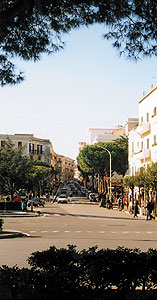
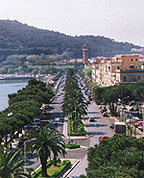
| The Borgo of Gaeta The first urban complex in the Borgo - developed in the area of the church of SS. Cosma e Doamiano at the beginning of the 1400 - expanded around the famous Via della Indipendenza that is basically the same street that went all along the Roman villas. The Borgo has a wider area than the citadel: it includes three hills (Atratino, Cappuccini and Sant'Agata) and the beaches of Serapo, Fontania, Quaranta Remi, Arenauta, San Vito and Sant'Agostino. From 1897 to1927 Il Borgo was an autonomous commune undere the name of Elena, in honor of Elena di Savoia, queen of Italy. The two autonomous communes Elena-Gaeta integrated under the only name of Gaeta after the suppression of the role of fortress held from the citadel of Gaeta. Via della Indipendenza is particularly commercially and touristically appealing: visitors are attracted by the intense commercial and handcraft activities that make the street that goes from Piazza della Libert� all the way to Calegna lively and colorful. The street - approx m 2,5 wide, whose pavement is made with eruptive stones has a peculiar characteristic that attracts the visitors to the point that it was renamed: the Romans call it 'er Budello and the Americans of the VI Fleet Flagship homeported in Gaeta call it Piccolo Alley. There are many little alleys (vichi) that start from Via della Indipendenza and lead to the sea crossing Lungomare Caboto, the longest street of Gaeta. At the fishermen's dockyard, next to the Villa delle Sirene, we can buy fish directly from the fishing boats. On the other side of the dockyard, crossing the double lane street. |
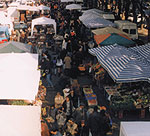
| Corso Cavour, Corso Italia and the free market. Corso Cavour, the commercial heart of the town, starts going up next to Piazza della Libert�, perpendicularly to Via della Indipendenza. Every Wednesday (h. 7,00-14,00), around the areas next to Via del Piano, Corso Italia and Via Venezia we can visit the typical and interesting market where you can buy at convenient prices. |
 |
 |
 |
 |
 |
 |
 |
 |
 |
 |
 |
 |
 |
 |
 |
|
|