 |
|
|
|
|
|
|
|
|
|
|
|
|
|
|
|
|
|
|
|
|
|
|
|
|
|
 |
|
|
|
 |
|
|
NEW INTRO #2 ! |
|
|
|
|
|
NEW STUFF #1 |
|
|
|
|
|
|
 |
|
|
Hello, my name is Leninskaya and my travels has taken me today to Intramuros Manila. A kindred spirit I am, so I frequently haunt these places. I have also terribly fallen in love with this old city that I think I'll be staying here for a long, long time. While I am at it, let me share the splendour of this old city to all you hopeless romantics. (And if you have some Filipiniana to share, please send them to me.) |
|
|
|
|
|
Manila got its name from the Nilad tree (Ficus elastica), a tree that belongs to the Ficus (Latin: Fig) family whose members number about 800 species. The Nilad tree, commonly known as the rubber tree, once grew abundantly in the area so the prehistoric residents who originally lived here commonly refered to the place as May nilad, meaning "by the nilad trees". |
|
|
|
|
|
|
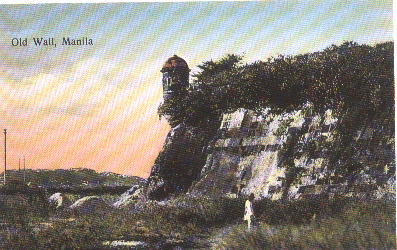
Above is an old postcard showing the icon that symbolizes Intramuros, the garita, or watch tower. |
|
|
|
|
|
 |
|
|
|
|
Don't mistake Old Manila for Metromanila. Although Old Manila (Intramuros as the locals call it) is situated within Metromanila, they are indeed worlds apart. One is reminiscent of a golden age that conjure images of old world prosperity, grandeur, lifestyle, and splendour; while the other one is the exact opposite (to say the least...let me say no more). Intramuros is at the core of Philippine history. |
|
|
|
|
|
|
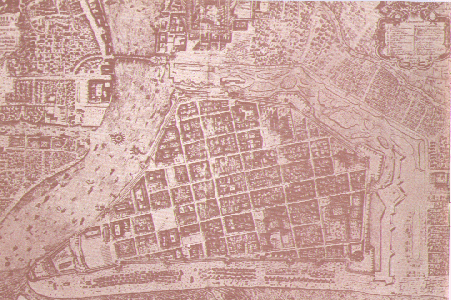
Above is an 18th century panoramic map of Intramuros. The map said to be the most detailed study of Intramuros ever made at that time was done by one Roxas. In the 1760s during the British invasion of Manila this map was taken back to England as part of the spoils of war. It is now in the British Museum. Now if only i can recall what war that was which brought the British to these islands...The Seven Years War was it? Anyway, much of Intramuros has changed since then. Intramuros today still retains much of her grandeur and eloquent past. |
|
|
|
|
Historians have commonly referred to Intramuros as an irregularly shaped pentagon with various bulwarks (baluarte) strategically positioned for defense of the city, and various gates (puerta) to facilitate commerce with the surrounding communities. As this walled city grew, more and more fortifications were added. The list below of sites to visit is arranged as if one were to take a walking tour of Intramuros. In general, the best sites to see are the ones along the periphery of the walls since not much can be seen in the center, unless one would like to visit squatter families and sample the third world, Manila style. If one were to superimpose a clock on the map of Intramuros and orient it with north at 12 noon, i suggest we begin at 10 o clock (Fort Santiago) where it all began, travel in clockwise direction to visit historical sites, and end at the same place we started.
Fort Santiago
Manila Cathedral
Intendencia ruins
Plaza Mexico
Puerta Isabel
Colegio de San Juan de Letran
Baluarte de San Gabriel
San Agustin Church
more later... |
|
|
|
|
|
|
Places to visit within the vicinity (i.e. walking distance) of Intramuros:
Malate Church (within jogging distance of Intramuros) & Cafes
Fort San Antonio Abad (inside the Banco Central ng Pilipinas)
The Finance Building (the new national museum)
The National Museum (just to see the Luna paintings) and Agrifina Circle (just to get a whiff of fresh air after all that walking)
Luneta Park (aka Rizal Park) and Quirino Grandstand (to whiff more fresh air)
The Manila Hotel ( a 5 star place to spend 5 star bucks)
The Luneta Hotel (just to look in awe at what it could be) |
|
|
|
|
|
Places to visit a cannon ball's throw away from intramuros (i.e. cannon ball in cannon aided by gun powder):
Baclaran Church (at the Pasay/Paranaque border)
Malacanang Palace and the San Miguel District
The Sea Wall & Manila Bay (what's left of it)
Malate cafes (to sample night life)
Manila Zoo (if you're looking for stuffed animals)
Binondo, Divisoria, & Tutuban Railway (must have guide to visit this place)
more later...
|
|
|
|
Articles still to come once I get my pc and my connection to work properly:
1. Intramuros was built in the 16th century by Spanish conquistadors. It was the capital of western europe in asia, hence it was the most advanced civilization in this part of the world at that time. The Spanish philosophy of conquest was changed from one of force and intimidation to one of religion and assimilation. After all, they had learnd a lot from their previous experiences of conquest in the Americas (force and intimidation does not work, after all that's been said and done). Religion then was at the core of their conquest and development program. By the completion of the walls of Intramuros, 7 churches from 5 religious orders had been built. These churches would rival in grandeur their European counterparts (Oh yes indeed). From these churches and convents sallied forth the religious orders to christianize the rest of asia. Filipino art and mind developed into its peak.
2. in the almost 500 years of its existence, intramuros has weathered various calamities: fire, earthquake, the war of spain with britain in the 1760s that brought the british to invade intramuros (although briefly), world war ii that destroyed all of intramuros except san agustin church which still stands today, and THE WORST CALAMITY OF ALL, the ignorance of politicians who allowed intramuros to decay to its present state...but intramuros still stands.
3. The past ages of manila can be roughly divided into 3: the prehistoric Maynilad (pre-16th century), the spanish colonial period of Intramuros Manila (16th century until 1898), the american colonial period (1898 until world war ii and following) of Manila.
|
|