 |
|
 |
 |
| Welcome to Fort Santiago |
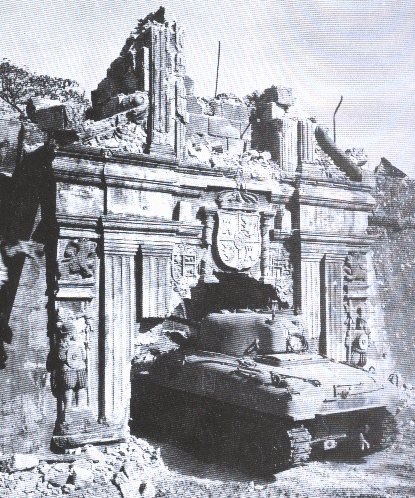
| Fort Santiago, located at the tip of the delta near the entrance of the Pasig River is where Manila began. In the mid-16th century when Legazpi, Spanish conquistador and first Governor-General of Manila arrived, it was already a palisaded fortress (most likely by wood and bamboo) and ruled by a local chieftain, Rajah Soliman. The Spaniards then began to rebuild the the fort into stone after they occupied it in 1571. From this enclosed triangular fort grew little by little the irregular pentagon that today is called the Walled City, or Intramuros, Manila. It was from the Fort that Spanish military might was felt throughout the achipelago. The Fort served as military headquarters of the Spanish (1571 - 1898), British (1760s for about 2 years), American (1898 - 1940s), and the Japanese (1940s - 1945) regimes. The Fort weathered all kinds of natural and man-made disasters. From wars of conquest, to piratical raids, to earthquakes every now and then, to fires, and to yearly tempests. Finally it was destroyed in the Battle of Manila 1945, by both the Americans as they tried to liberate Manila, and the Japanese as they ferociously held their entrenched positions in the city towards the end of World War II. It was then partially restored as a public park after the Congress of the Philippines declared it a "Shrine of Freedom" in 1950. |
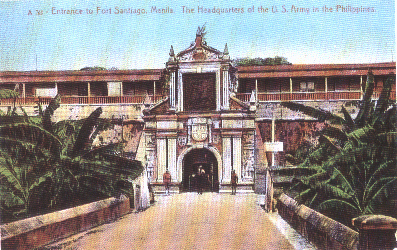
| Above is an old picture postcard showing the gate of Fort Santiago. This gate opens to the bridge at the foreground. This is continuous with the Camino Real (or Royal Highway). It passes from Fort Santiago through Intramuros and out into what is now Malate, Manila. It then continues to Pasay City, Paranaque and Las Pinas (of Bamboo Organ fame), all the way to Kawit, Cavite, and perhaps even beyond. This is the same highway where General Emilio Aguinaldo (president of the first philippine republic) and his revolutionary forces marched to take the capital in 1898. Today this Royal or King's Highway is no longer discernible nor fit to be called as such, as years of neglect and poor urban planning decimated this valuable cultural heritage. The only remnant of the Camino Real is the passageway from Fort Santiago through Intramuros via what is now General Luna Street. But once one is out of Intramuros, it is King's Highway no more. |
| Prior to entering the gate of Fort Santiago is a public promenade called Plaza Moriones. This area was fenced off by the Spanish military in 1864 effectively closing a sizeable portion Today Fort Santiago houses the Rizal Shrine (Jose Rizal, National Hero of the Philippines) |
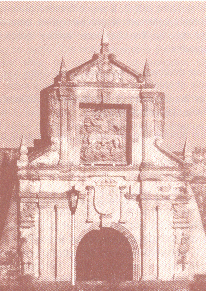
| The facade of the Fort as it stands today. Fort Santiago is named in honor of Spanish patron Saint James, Slayer of Moors (Santiago Matamoros), whose wooden relief decorates the main gate to the fort. |