|
UROPS project (May 2003 - April 2004) 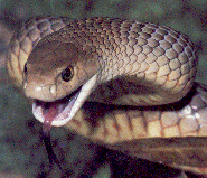
Title: Structural comparison between the nonenzymatic subunit of venom prothrombin activator Pseutarin C and liver factor V in Pseudonaja textilis snake Supervisor: Prof. Kini R. Manjunatha Abstract: We recently showed that
pseutarin-C, a prothrombin activator from the venom of Pseudonaja
textilis, is structurally and functionally similar to mammalian
coagulation factor Xa - factor Va complex. The catalytic subunit
of Pseutarin-C is homologous to factor Xa (FXa) and the nonenzymatic
subunit is homologous to factor Va (FVa). Thus, the snake has
two parallel prothrombin activator systems: pseutarin C in its
venom gland which acts as a toxin and FX plus FV in its plasma
which act as haemostatic factors. Here we determine the deduced
amino acid sequence of FV from P. textilis liver by cDNA cloning
and sequencing techniques. We also examine the evolutionary relationships
among factor V of various species. Our studies indicate that snake
liver FV is closely related to pseutarin-C nonenzymatic subunit.
They share 96% identity with almost conserved functional sites
accept several post-translational modifications and one critical
cleavage site for activated protein C (APC). The absence of this
site makes pseutarin-C nonenzymatic subunit resistant to APC and
acts as an excellent toxin. Honours project (May 2004 - November 2004) Title: Determination of postranslational modifications and expression level of the pseutarin C nonenzymatic subunit from Pseudonaja textilis snake Supervisor: Prof. Kini R. Manjunatha Abstract: From the determined sequence of pseutarin C nonenzymatic subunit, we have already shown its post-translational modifications predicted by homology or bioinformatic tools. The significant differences between these modifications in pseutarin C nonenzymatic subunit and their FV homologues may imply many interesting functional changes. For futher applications, these potential modifications need to be confirmed by more experimental data. In this project, we have optimized the purification of pseutarin C and the separation of its nonenzymatic subunit . We proposed to determine the disulphide bonding and the post-translational modifications of this molecule by mass spectrometry but the project has not been completed. At the same time, we have developed a novel method
of UniPrimerTM based quantitative real-time PCR which is reliable
and more economical than other DNA relative quantification techniques.
By the new method, we found that pseutarin C nonenzymatic subunit
is expressed specifically in venom gland at ~280 folds higher
than the specific expression of FV in the snake’s liver.
These two are thus encoded by two separate genes that express
in a highly tissue-specific manner. These results imply that the
gene encoding pseutarin C nonenzymatic subunit was derived by
the duplication of plasma FV gene and subsequently marked for
tissue specific expression. Conference Papers and Publications: Minh Le TN, M. A. Reza, Sanjay Swarup and R. Manjunatha Kini; Gene duplication of coagulation factor V and origin of venom prothrombin activator in Pseudonaja textilis snake; Thrombosis and Haemostasis, 93: 420-9 (2005) Minh Le TN, M. A. Reza, Sanjay Swarup and R. Manjunatha Kini; Use of UniPrimerTM in real-time quantitative expression analysis; Manuscript in preparation Minh Le TN, M. A. Reza, Sanjay Swarup and R. Manjunatha Kini; Two parallel prothrombin activator systems in Pseudonaja textilis snake; The Third International Conference on Structural Biology and Functional Genomics - Singapore (2004) Minh Le TN, Md Abu Reza and R. Manjunatha Kini;Structural comparison between the nonenzymatic subunit of venom prothrombin activator Pseutarin C and liver factor V in Pseudonaja textilis snake; The 4th Sino-Singapore Conference on Biotechnology (2003) Minh Le TN, Md Abu Reza and R. Manjunatha Kini; Cloning and characterization of blood coagulation factor V cDNA from eastern brown snake (Pseudonaja textilis); The Eight Graduate Congress on Biological Sciences - Singapore (2003)
|