| ABOUT TAROT |
 |
| In order to begin telling you the history of Tarot Cards I must first tell you that regular Playing Cards were around long before them according to historical data found so far. Regular Playing Cards first entered Europe around 1375 as far as we can historically track them. However, Playing Cards apparently entered Europe from the Islamic World, where they were already common and had been known for centuries. Around 1420 there was one intriguing reference to the cards with fictional pictures of animals that represented spiritual symbols (allergorical). The first refernce of the "Triumph Cards or "Tarot" was around 1442. In 1450 the newly installed Duke of Milan sent a letter to one of his underlings requesting two decks of cards be purchased. Interestingly he asked for "Playing Cards" if "Triumph Cards" were not available. It is believed the Triumph Cards were originally invented in the 1430's or perhaps even a bit earlier. Triumph Cards were originally used in a card game which is much like the game of Bridge we know today. By the early 16th Century Triumph Cards had spread from Italy to France. The card players of that time discovered that the game of Triumphs could be played with ordinary Playing Cards. In an attempt to separate the ideal of Triumph Cards from Playing Cards, around 1530, the Triumph Cards were renamed after an Italian Ancestor of the French Tarot, it was thus called "Tarocchi." The earliest names for the Tarot are all Italian. Originally the cards were called "Carte da Trifoni" (Cards of Triumphs). Around 1530 (about 100 years after the origin of the cards), the Italian word "Tarocchi" (singular Tarocco) begins to be used to distinguish them from a new game of Triumphs or Trumps then being played with ordinary Playing Cards. The Etymology of this new word is not known. The German form of this word is "Tarock" and the French form is "Tarot." Even if the etymology were known it would probably not tell us much about the idea behind the cards since it only came into use 100 years after they first appeared. Records from a trial in Venice in 1589 suggest that Tarot may have been associated with Witchcraft (at least in the minds of the accusers) at this date, about 150 years after the appearance of the Tarot. After this there are no references connecting Tarot with Magick or Divination until the 18th Century. The Rom or Gypsies began using Tarot around the 20th Century. Before that most of their Fortune Telling was through Palmistry and Ordinary Playing Cards. Tarot was used as early as the 16th Century to compose poems describing personality characteristics (tarocchi appropriati). In one case (1527), the verses are presented as relating to the person's fate. There are records of Divinatory Meanings assigned to Tarot Cards in Bologna early in the 1700's. This is the first evidence of Tarot Divination as it is commonly understood. However, it is known that ordinary Playing Cards were connected with Divination as early as 1487, so it is reasonable to assume that Tarot was also. From the 1790's we find Tarot Design being modified specifically to reflect Divinatory and Esoteric Meanings. |
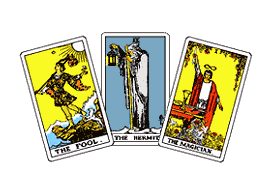
| The Rider-Waite Deck was created in 1909, making it a relative newcomer in the almost 600-year history of Tarot. A.E. Waite was a prominent member of The Hermetic Order Of The Golden Dawn. The deck owes much of its symbolism to that group and represents departure from the earlier French Tradition. The artist, Pamela Coleman Smith, contributed her own vision, especially in the innovative creation of fully illustrated scenes for the Minor Arcana. For many years, the Rider-Waite deck was teh only one available in the United States, so it became familiar to generations of Tarot Readers. There is actually no "definitive" version of the Tarot. |
 |
 |
| HELPFUL NUMBERS |
| ABOUT RUNES |
| LMF LINKS |

|
 |
| 2003 LEIANAS MYSTICAL FOREST |
| TESTIMONIALS |
| I cannot end this History Of Tarot without giving due tribute to Pamela Coleman Smith. Please click the link below to learn about more her. |