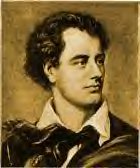
Our next Historical Hottie is the infamous Lord Byron, writer of lurve poetry. How Romantic! Get it? Romantic? Cause he was a poet of the Romantic era? ;) He was a very controversial figure in his time which makes him even more dashing and mysterious. Yes ladies, he was one of the great Romantic poets, the great three of the age (the other two being Shelley and Keats if you were wondering, but I don�t think they were nearly as hot�actually just now looking at their pictures online, I might have to concede that they were fairly good looking, but this is Byron�s page, so back off you other Romantics! Let the Byron shine, baby!). And so we begin our great journey into the life of babealicious Byron
The beauty of Byron entered the world on January 22, 1788. He was christened George Gordon Noel Byron, being the 6th Baron Byron, with bouncy brown buttery biscuits�tee hee�an alliteration! Sorry, that was childish (as the rest of this web site certainly is not). But he was simply known as George Gordon Noel. Hah! Simply�we shall just call him Georgie from now on, to simplify things and so I don�t have to type out that loooooong name. Because I am lazy. He was born with a clubfoot, an infirmity that as a young child he was very sensitive about. Awww, don�t hurt his feelings! His mother took him to Scotland, where they lived with very little money.
When Georgie was 10, his great-uncle died, and left all of his estate to Georgie. The family packed off to England (bye bye misty heelands! and heeland coos as well), where they lived in Newstead Abby, providing lots and lots of atmosphere to effect young Georgie�s young poetic mind, what with mist and big halls and ruins and stuff. His clubfoot was being treated by a doctor called Lavender, who as it turned out, was�well, in the words of Edmund Blackadder, the eyes are open, the mouth moves, but Mr. Brain has long since departed. Not someone you want working on your infirmity. Lavender joins others in the V.B.M category. But as luck would have it (yay!) Georgie�s attorney John Hanson, rescued him from the crazy doctor, and his mother's temper, taking him to London, where a good doctor gave him and leg brace and where he was enrolled in a school in Dulwich in 1799.
In 1801, Georgie spent the summer with his mother in Southwell, which is near Nottingham (�No, certainly not! He doesn�t have the Nottingham twang!�), then went to stay with Lord Grey, and put the moves on his distant, just to make it clear, cousin Mary Chaworth. She however, was a big meanie poo, and told him to shove off. In those exact words. To help ease his broken heart (how could she, the supercilious harpy!?), he wrote sad poetry, featuring Mary. Only after Georgie had achieved fame did Mary regret that she�d mercilessly broken our poor boy�s heart. Oopsie! Too bad, so sad Mary! That is what you get for being a V.B.W (very bad woman, in her case.)
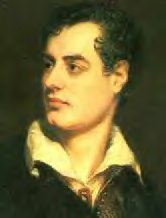
In 1806, after a term at Trinity College, and very badly in debt, Georgie gathered some early poems into his first collection called Fugitive Pieces, and then the following June, he published Hours of Idleness. Returning to Trinity, he befriended Jon Cam Hobhouse, who got him into politics. In 1809, he took his seat in the House of Lords, and anonymously published a satire called English Bard and Scotch Reviewers.
Then�phew this is gonna be a long one�he did a lot ya know? Anyhow, then he and Hobhouse decided to go off and see the world! Experience new cultures! See exotic places! Sample the cuisine! And so on�they visited Spain and Greece, both locales influencing Georgie to write poetry. Greece left a very strong impression on Georgie, who dreamt of returning some day. In the end, that was kinda bad, as you will find out if you are still reading�you are still there, right? Right?
July 14, 1811. It is a nice date, huh? But you wanna know what�s really great about it? I bet you are just bursting with anticipation! Well, that was the day that our boy arrived in London! Huzzah! But I bet you knew that already� :D The next year on February 27, he published Childe Harold�s Pilgrimage, which was a hit. He was taken in by society, and not only was his poetry a hit, but he was also a hit�with the ladies! He had an affairs with Lady Caroline Lamb, the Countess of Oxford Jane Elizabeth, Lady Frances Weber, and it is presumed he also had a fling with his half sister, Augusta Leigh. (though that is not fact so don�t get all grossed out.) So we�re not the only one�s who found Georgie to be a sexy beast, eh? Hoo lordy! (Just FYI, I do not condone his actions...just reporting the facts here, folks)
Hoping to put an end to his affairs, he married Anne Isabella Milbanke. But the marriage was unhappy (mostly due to him, unfortunately) , and after giving birth to a daughter Augusta Ada, Lady Byron left Georgie. They separated, and Georgie left England never to return. *sniffle* Why do all the Hotties have to live tragic lives?
I am going to compact the next part of his life, because it is basically him roaming around Europe, falling in love with various women. In Switzerland, he befriended Percy Bysshe Shelley (also one of our Historical Hotties), wrote Prisoner of Chillon, and the rest of Childe Harold and fell in love with and impregnated Claire Clairmont (who had very unoriginal parents apparently). Then off he went to Italy, where he wrote more Childe Harold and started Don Juan and had an affair with two women. His illegitimate daughter Allegra was sent to live with him as well.
More stuff happened�I am going to skip to the very end because the rest of his life is a lot of writing, another affair with a woman named Theresa, and some issues with the poet Leigh Hunt. It is really detailed and interesting, don�t get me wrong, but I am not going to put it all here. If you are burning with desire to know this part of Georgie�s life, if you wont be able to sleep anymore until the mystery is solved, then refer to the link at the bottom of the page, and take a few cleansing breaths.
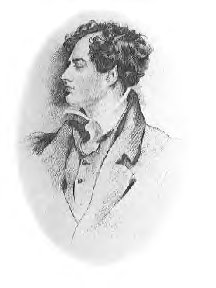
April 1823 the London Greek Committee contacted Georgie to act as their agent in aiding the Greeks in their war for independence from the Turks. Remember the whole foreshadowing earlier on about Greece? Yeah, well this is where it allele comes back, my friends. Georgie gave a definite YES to their offer, and sailed away to Greece on July 16. He entered into plans to attack the fortress of Lepanto, but on February 15, 1824, he got sick, and the doctors bled him, which weekend him. He didn�t die, but was very weak, and then in the Spring he was caught in a rainstorm, caught a cough, which again was made worse by the doctors bleeding (where have we heard this before? *cough cough*WASHINGTON*cough*). Doctors of Georgie, you suck big time and are hereby placed in the V.B.M category. Georgie fell into a coma, and died on April 19 1824. He was a mere 36 years old.
Lord Byron was one of the worlds greatest poets, and we bow down before his literary genius. He lived an�interesting...yes, there is a good word for it... life and died far too young. He loved waaaayyy to many women, but it is seemingly a trend with these poet types. Lord Byron, we heave a great sigh for you and your sexiness, which comes through in your terribly romantic poetry...even though you were kind of an ass...
She walks in beauty, like the night
Of cloudless climes and starry skies;
And all that 's best of dark and bright
Meet in her aspect and her eyes:
Thus mellow'd to that tender light
Which heaven to gaudy day denies.
One shade the more, one ray the less,
Had half impair'd the nameless grace
Which waves in every raven tress,
Or softly lightens o'er her face;
Where thoughts serenely sweet express
How pure, how dear their dwelling-place.
And on that cheek, and o'er that brow,
So soft, so calm, yet eloquent,
The smiles that win, the tints that glow,
But tell of days in goodness spent,
A mind at peace with all below,
A heart whose love is innocent!