Title 36, U.S.C., Chapter 10
As amended by P.L. 344, 94th Congress
Approved July 7, 1976
§ 170. National Anthem; Star-Spangled Banner
The composition consisting of the words and music known as The Star-Spangled Banner is
designated the national anthem of the United States of America.
§ 171. Conduct during playing
During rendition of the national anthem when the flag is displayed, all present except
those in uniform should stand at attention facing the flag with the right hand over the
heart. Men not in uniform should remove their headdress with their right hand and hold it
at the left shoulder, the hand being over the heart. Persons in uniform should render the
military salute at the first note of the anthem and retain this position until the last
note. When the flag is not displayed, those present should face toward the music and act
in the same manner they would if the flag were displayed there.
§ 172. Pledge of Allegiance to the flag; manner of delivery
The Pledge of Allegiance to the Flag, "I pledge allegiance to the Flag of the
United States of America, and to the Republic for which it stands, one Nation under God,
indivisible, with liberty and justice for all," should be rendered by standing at
attention facing the flag with the right hand over the heart. When not in uniform men
should remove their headdress with their right hand and hold it at the left shoulder, the
hand being over the heart. Persons in uniform should remain silent, face the flag, and
render the military salute.
§ 173. Display and use of flag by civilians; codification of rules and customs;
definition
The following codification of existing rules and customs pertaining to the display and
use of the flag of the United States of America is established for the use of such
civilians or civilian groups or organizations as may not be required to conform with
regulations promulgated by one or more executive departments of the Government of the
United States. The flag of the United States for the purposes of this chapter shall be
defined according to sections 1 and 2 of Title 4 and Executive Order 10834 issued pursuant
thereto.
§ 174. Time and occasions for display; hoisting and lowering
(a) It is the universal custom to display the flag only from sunrise to sunset on
buildings and on stationary flag staffs in the open. However, when a patriotic effect is
desired, the flag may be displayed twenty-four hours a day if properly illuminated during
the hours of darkness.
(b) The flag should be hoisted briskly and lowered ceremoniously.
(c) The flag should not be displayed on days when the weather is inclement, except when
an all weather flag is displayed.
(d) The flag should be displayed on all days, especially on
New Year's Day - January 1
Inauguration Day - January 20
Lincoln's Birthday - February 12
Washington's Birthday - third Monday in February
Easter Sunday - (variable)
Mother's Day - second Sunday in May
Armed Forces Day - third Saturday in May
Memorial Day (half-staff until noon) - last Monday in May
Flag Day - June 14
Independence Day - July 4
Labor Day - first Monday - September 17
Columbus Day - second Monday in October
Navy Day - October 27
Veterans Day - November 11
Thanksgiving Day - fourth Thursday in November
Christmas Day - December 25
Other days as may be proclaimed by the President of the United States
Birthdays of States (date of admission)
State holidays
(e) The flag should be displayed daily on or near the main administration building of
every public institution.
(f) The flag should be displayed in or near every polling place on election days.
(g) The flag should be displayed during school days in or near every schoolhouse.
§ 175. Position and manner of display
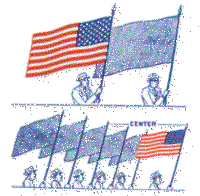 |
The flag, when carried in a procession with another flag or flags, should be either on
the marching right; that is, the flag's own right, or, if there is a line of other flags,
in front of the center of that line. |
(a) The flag should not be displayed on a float in a parade except from a staff, or as
provided in subsection (i) of this section.
(b) The flag should not be draped over the hood, top, sides, or back of a vehicle or of
a railroad train or a boat. When the flag is displayed on a motorcar, the staff shall be
fixed firmly to the chassis or clamped to the right fender.
(c) No other flag or pennant should be placed above, or, if on the same level, to the
right of the flag of the United States of America, except during church services conducted
by naval chaplains at sea, when the church pennant may be flown above the flag during
church services for the personnel of the Navy. No person shall display the flag of the
United Nations or any other national or international flag equal, above, or in a position
of superior prominence or honor to, or in place of, the flag of the United States at any
place within the United States or any Territory or possession thereof: Provided, That
nothing in this section shall make unlawful the continuance of the practice heretofore
followed of displaying the flag of the United Nations in a position of superior prominence
or honor, and other national flags in positions of equal prominence or honor, with that of
the flag of the United States at the headquarters of the United Nations.
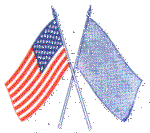
| (d) The flag of the United States of America, when it is displayed with another flag
against a wall from crossed staffs, should be on the right, the flag's own right, and its
staff should be in front of the staff of the other flag. |
 |
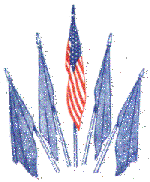 |
(e) The flag of the United States of America should be at the center and at the
highest point of the group when a number of flags of States or localities or pennants of
societies are grouped and displayed from staffs. |
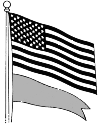 |
(f) When flags of States, cities, or localities, or pennants of societies are flown on
the same halyard with the flag of the United States, the latter should always be at the
peak. When the flags are flown from adjacent staffs, the flag of the United States should
be hoisted first and lowered last. No such flag or pennant may be placed above the flag of
the United States or to the United States flag's right. |
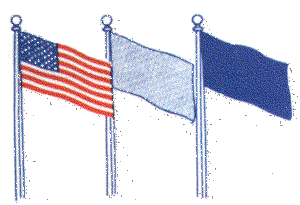 (g) When flags of two
or more nations are displayed, they are to be flown from separate staffs of the same
height. The flags should be of approximately equal size. International usage forbids the
display of the flag of one nation above that of another nation in time of peace. (g) When flags of two
or more nations are displayed, they are to be flown from separate staffs of the same
height. The flags should be of approximately equal size. International usage forbids the
display of the flag of one nation above that of another nation in time of peace.
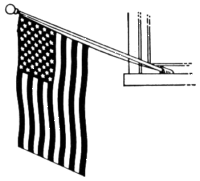 (h) When the flag
of the United States is displayed from a staff projecting horizontally or at an angle from
the window sill, balcony, or front of a building, the union of the flag should be placed
at the peak of the staff unless the flag is at half staff. (h) When the flag
of the United States is displayed from a staff projecting horizontally or at an angle from
the window sill, balcony, or front of a building, the union of the flag should be placed
at the peak of the staff unless the flag is at half staff.
When the flag is suspended over a sidewalk from a rope extending from a house to a pole
at the edge of the sidewalk, the flag should be hoisted out, union first, from the
building.
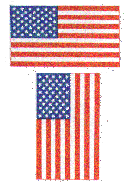
| (i) When displayed either horizontally or vertically against a wall, the union should
be uppermost and to the flag's own right, that is, to the observer's left. When displayed
in a window, the flag should be displayed in the same way, with the union or blue field to
the left of the observer in the street. |
 |
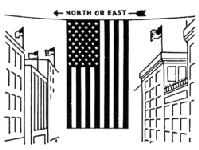 |
(j) When the flag is displayed over the middle of the street, it should be suspended
vertically with the union to the north in an east and west street or to the east in a
north and south street. |
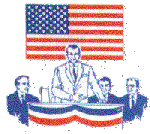
| (k) When used on a speaker's platform, the flag, if displayed flat, should be
displayed above and behind the speaker. |
 |
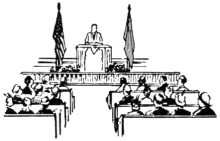
When displayed from a staff in a church or public auditorium, the flag of the United
States of America should hold the position of superior prominence, in advance of the
audience, and in the position of honor at the clergyman's or speaker's right as he faces
the audience. Any other flag so displayed should be placed on the left of the clergyman or
speaker or to the right of the audience.
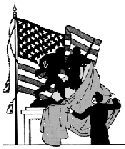 |
(l) The flag should form a distinctive feature of the ceremony of unveiling a statue
or monument, but it should never be used as the covering for the statue or monument. |
(m) The flag, when flown at half-staff, should be first hoisted to the peak for an
instant and then lowered to the half-staff position. The flag should be again raised to
the peak before it is lowered for the day. 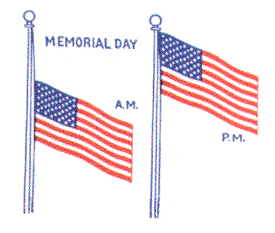
On Memorial Day the flag should be displayed at half-staff until noon only, then raised to
the top of the staff. By order of the President, the flag shall be flown at half-staff
upon the death of principal figures of the United States Government and the Governor of a
State, territory, or possession, as a mark of respect to their memory. In the event of the
death of other officials or foreign dignitaries, the flag is to be displayed at half-staff
according to Presidential instructions or orders, or in accordance with recognized customs
or practices not inconsistent with law. In the event of the death of a present or former
official of the government of any State, territory, or possession of the United States,
the Governor of that State, territory, or possession may proclaim that the National flag
shall be flown at half-staff. The flag shall be flown at half-staff thirty days from the
death of the President or a former President; ten days from the death of the Vice
President, the Chief Justice or a retired Chief Justice of the United States, or the
Speaker of the House of Representatives; from the day of death until internment of an
Associate Justice of the Supreme Court, a Secretary of an executive or military
department, a former Vice President, or the Governor of a State, territory, or possession;
and on the day of death and the following day for a Member of Congress. The flag shall be
flown at half-staff on Peace Officers Memorial Day, unless that day is also Armed Forces
Day. As used in this subsection -
(1) the term "half-staff" means the position of the flag when it is one-half
the distance between the top and bottom of the staff;
(2) the term "executive or military department" means any agency listed under
sections 101 and 102 of title 5; and
(3) the term "Member of Congress" means a Senator, a Representative, a
Delegate, or the Resident Commissioner for Puerto Rico.
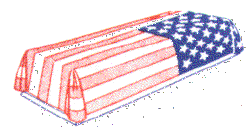
(n) When the Flag is used to cover a casket, it should be so placed that the union is
at the head and over the left shoulder. The flag should not be lowered into the grave or
allowed to touch the ground.
(o) When the flag is suspended across a corridor or lobby in a building with only one
main entrance, it should be suspended vertically with the union of the flag to the
observer's left upon entering. If the building has more than one main entrance, the flag
should be suspended vertically near the center of the corridor or lobby with the union to
the north, when entrances are to the east and west or to the east when entrances are to
the north and south. If there are entrances in more than two directions, the union should
be to the east.
§ 176. Respect for flag
No disrespect should be shown to the flag of the United States of America; the flag
should not be dipped to any person or thing. Regimental colors, State flags, and
organization or institutional flags are to be dipped as a mark of honor.
(a) The flag should never be displayed with the union down, except as a signal of dire
distress in instances of extreme danger to life or property.
(b) The flag should never touch anything beneath it, such as the ground, the floor,
water, or merchandise.
(c) The flag should never be carried flat or horizontally, but always aloft and free.
(d) The flag should never be used as wearing apparel, bedding, or drapery. It should
never be festooned, drawn back, nor up, in folds, but always allowed to fall free.
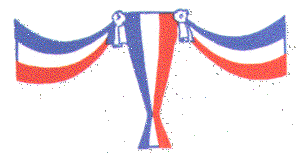 Bunting of blue,
white, and red always arranged with the blue above, the white in the middle, and the red
below, should be used for covering a speaker's desk, draping the front of the platform,
and for decoration in general. Bunting of blue,
white, and red always arranged with the blue above, the white in the middle, and the red
below, should be used for covering a speaker's desk, draping the front of the platform,
and for decoration in general.
(e) The flag should never be fastened, displayed, used, or stored in such a manner as
to permit it to be easily torn, soiled, or damaged in any way.
(f) The flag should never be used as a covering for a ceiling.
(g) The flag should never have placed upon it, nor on any part of it, nor attached to
it any mark, insignia, letter, word, figure, design, picture, or drawing of any nature.
(h) The flag should never be used as a receptacle for receiving, holding, carrying, or
delivering anything.
(i) The flag should never be used for advertising purposes in any manner whatsoever. It
should not be embroidered on such articles as cushions or handkerchiefs and the like,
printed or otherwise impressed on paper napkin or boxes or anything that is designed for
temporary use and discard. Advertising signs should not be fastened to a staff or halyard
from which the flag is flown.
(j) No part of the flag should ever be used as a costume or athletic uniform. However,
a flag patch may be affixed to the uniform of military personnel, firemen, policemen, and
members of patriotic organizations. The flag represents a living country and is itself
considered a living thing. Therefore, the lapel flag pin being a replica, should be worn
on the left lapel near the heart.
(k) The flag, when it is in such condition that it is no longer a fitting emblem for
display, should be destroyed in a dignified way, preferably by burning.
§ 177. Conduct during hoisting, lowering or passing of flag
During the ceremony of hoisting or lowering the flag or when the flag is passing in a
parade or in review, all persons present except those in uniform should face the flag and
stand at attention with the right hand over the heart. Those present in uniform should
render the military salute. When not in uniform, men should remove their headdress with
their right hand and hold it at the left shoulder, the hand being over the heart. Aliens
should stand at attention. The salute to the flag in a moving column should be rendered at
the moment the flag passes.
§ 178. Modification of rules and customs by President
Any rule or custom pertaining to the display of the flag of the United
States of America, set forth in section 171-178 of this title, may be altered, modified,
or repealed, or additional rules with respect thereto may be prescribed, by the Commander
in Chief of the Armed Forces of the United States, whenever he deems it to be appropriate
or desirable; and any such alteration or additional rule shall be set forth in a
proclamation.
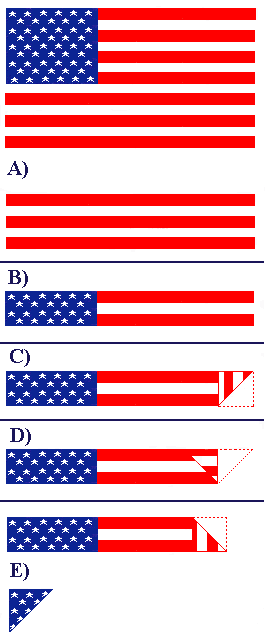
(a) Straighten out the flag to full length and fold
lengthwise once.
(b) Fold it lengthwise a second time to meet the open edge, making sure that the union of
stars on the blue field remains outward in full view. (A large flag may have to be folded
lengthwise a third time.)
(c) A triangular fold is then started by bringing the striped corner of the folded edge to
the open edge.
(d) The outer point is then turned inward parallel with the open edge to form a second
triangle.
(e) The diagonal or triangular folding is continued toward the blue union until the end is
reached, with only the blue showing and the form being that of a cocked (three corner)
hat.
|
 |
- What is the significance of
displaying the flag at half-staff?
- How are unserviceable flags destroyed?
- Can the flag be washed or dry-cleaned?
- Are you required to destroy the flag if it touches the ground?
- What is the proper method for folding the flag?
- May a person, other than a veteran, have their casket draped with the flag?
- What is the significance of the gold fringe we see on some American flags?
- What is meant by the flag's own right?
- Is it proper to fly the flag of the United States at night?
- What does it mean when the flag is not flying above the White House?
- What should be the position of the flag when displayed from a staff in a
church, public auditorium or other public meeting place, whether indoors or outdoors, on
platform, or on the floor at ground level?
- What are the penalties for the physical desecration of the flag?
Q: What is the significance of
displaying the flag at half-staff?
A: This gesture is a sign to indicate the nation mourns the death of an
individual(s), such as death of the President or former President, Vice President, Supreme
Court Justice, member of Congress, Secretary of an executive or military department, etc.
Only the President of the United States or the Governor of the State may order the flag to
be half-staffed. The honor and reverence accorded this solemn act is quickly becoming
eroded by those individuals and agencies that display the flag at half-staff on
inappropriate occasions without proper authority to do so. (ref: Flag Code 175m)
Q: How are unserviceable flags
destroyed?
A: The Flag Code suggests that, "when a flag has served its useful purpose,
it should be destroyed, preferably by burning." For individual citizens, this should
be done discreetly so the act of destruction is not perceived as a protest or desecration.
Many American Legion Posts conduct Disposal of Unserviceable Flag Ceremonies on June 14,
Flag Day. This ceremony creates a particularly dignified and solemn occasion for the
retirement of unserviceable flags. (ref: Flag Code 176k)
Q: Can the flag be washed or
dry-cleaned?
A: Yes. There are no provisions of the Flag Code which prohibit such care. The
decision to wash or dry-clean would be dependent on the material.
Q: Are you required to destroy the flag
if it touches the ground?
A: Flag Code section 176b states that the flag should not touch anything beneath
it such as the ground. This is stated to indicate that care should be exercised in the
handling of the flag, to protect it from becoming soiled or damaged. You ARE NOT required
to destroy the flag when this happens. As long as the flag remains suitable for display,
even if washing or dry-cleaning (which is acceptable practice) is required, you may
continue to display the flag as a symbol of our great country. (ref: Flag Code 176b)
Q: What is the proper method for
folding the flag?
A: The Flag Code does not require any specific method, however, there is a
tradition that has developed over time. This method produces a triangular shaped form like
that of a three corner hat with only the blue union showing. There is a diagram available
on Folding the Flag that lists the steps involved.
Q: May a person, other than a veteran,
have their casket draped with the flag of the United States?
A: Yes, although this honor is usually reserved for veterans or highly regarded
state and national figures, the Flag Code does not prohibit this use.
Q: What is the significance of the gold
fringe which we see on some American flags?
A: Records indicate that fringe was first used on the flag as early as 1835. It
was not until 1895 it was officially added to the National flag for all regiments of the
Army. For civilian use, fringe is not required as an integral part of the flag, nor can
its use be said to constitute an unauthorized addition to the design prescribed by
statute. It is considered that fringe is used as an honorable enrichment only.
Q: What is meant by the flag's own
right?
A: The "right" as the position of honor developed from the time when
the "right hand" was the "weapon hand" or "point of danger."
The right hand, raised without a weapon, was a sign of peace. The right hand, to any
observer, is the observer's left. Therefore, as used in the Flag Code, the flag and/or
blue field is displayed to the left of the observer, which is the flag's "own
right." (ref: Flag Code 175d,i)
Q: Is it proper to fly the flag of the
United States at night?
A: The Flag Code states it is the universal custom to display the flag only from
sunrise to sunset on buildings and on stationary flag staffs in the open. However, when a
patriotic effect is desired, the flag may be displayed twenty-four hours a day if properly
illuminated during the hours of darkness. (ref: Flag Code 174a) The American Legion
interprets "proper illumination" as a light specifically placed to illuminate
the flag (preferred) or having a light source sufficient to illuminate the flag so it is
recognizable as such by the casual observer.
Q: What does it mean when the flag is
not flying above the White House?
A: The flag is flown over the White House when the President is in Washington,
D.C. It is not displayed when the President is not in Washington, D.C.
Q: What should be the position of the
flag when displayed from a staff in a church, public auditorium or other public meeting
place, whether indoors or outdoors, on platform, or on the floor at ground level?
A: When used on a speaker's platform, the flag, if displayed flat, should be
displayed above and behind the speaker. When displayed from a staff in a church, public
auditorium or meeting place, the flag should hold the position of superior prominence, in
advance of the audience, and in the position of honor at the clergyman's or speaker's
right as he faces the audience. Prior to the Flag Code changes in 1976, the display
procedure was somewhat different. Now the staffed flag should always be placed to the
right of the speaker (observer's left) without regard to a platform or floor level. (ref:
Flag Code 175k)
Q: What are the penalties for the
physical desecration of the flag?
A: There are currently no penalties for the physical desecration of the flag.
The American Legion and other members of the Citizens
Flag Alliance continue working towards securing a Constitutional amendment to protect
the flag from physical desecration.
|