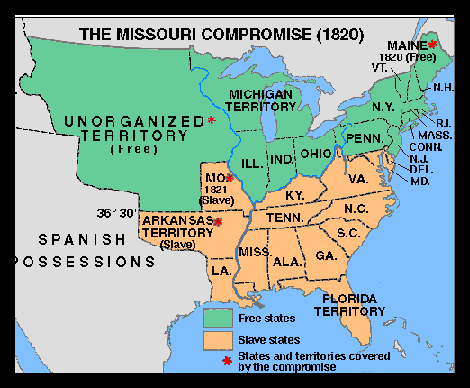
This amendment passed the House (Feb., 1819), but not the Senate. The bitterness of the debates sharply emphasized the sectional division of the United States. In Jan., 1820, a bill to admit Maine as a state passed the House.
The admission of Alabama as a slave state in 1819 had brought the slave states and free states to equal representation in the Senate, and it was seen that by pairing Maine (certain to be a free state) and Missouri, this equality would be maintained. The two bills were joined as one in the Senate, with the clause forbidding slavery in Missouri replaced by a measure prohibiting slavery in the remainder of the Louisiana Purchase north of 36°30'N lat. (the southern boundary of Missouri).The House rejected this compromise bill, but after a conference committee of members of both houses was appointed, the bills were treated separately, and in Mar., 1820, Maine was made a state and Missouri was authorized to adopt a constitution having no restrictions on slavery. However, the provision in the Missouri constitution barring the immigration of free blacks to the state was objectionable to many Northern Congressmen, and necessitated another congressional compromise.
Not until the Missouri legislature pledged that nothing in its constitution would be interpreted to abridge the rights of citizens of the United States was the charter approved and Missouri admitted to the Union (Aug., 1821). Henry Clay, as speaker of the House, did much to secure passage of the compromise—so much, in fact, that he is generally regarded as its author, even though Senator Jesse B. Thomas of Illinois was far more responsible for the first bill. The 36°30' proviso held until 1854, when the Kansas-Nebraska Act repealed the Missouri Compromise.The Missouri Compromise "A Balance of Power" March 3, 1820
The institution of slavery had been a divisive issue in the United States for decades before the territory of Missouri petitioned Congress for admission to the Union as a state in 1818. Since the Revolution, the country had grown from 13 states to 22 and had managed to maintain a balance of power between slave and free states. There were 11 free states and 11 slave states, a situation that gave each faction equal representation in the Senate and the power to prevent the passage of legislation not to its liking. The free states, with their much larger populations, controlled the House of Representatives, 105 votes to 81.
In February 1819, New York Representative James Tallmadge proposed an amendment to ban slavery in Missouri even though there were more than 2,000 slaves living there. The country was again confronted with the volatile issue of the spread of slavery into new territories and states. The cry against the South's "peculiar institution" had grown louder through the years. "How long will the desire for wealth render us blind to the sin of holding both the bodies and souls of our fellow men in chains?" Asked Representative Livermore from New Hampshire.
The South's economy was dependent upon black slavery, and 200 years of living with the institution had made it an integral part of Southern life and culture. The South demanded that the North recognize its right to have slaves as secured in the Constitution.
Through the efforts of Henry Clay, "the great pacificator," a compromise was finally reached on March 3, 1820, after Maine petitioned Congress for statehood. Both states were admitted, a free Maine and a slave Missouri, and the balance of power in Congress was maintained as before, postponing the inevitable showdown for another generation. In an attempt to address the issue of the further spread of slavery, however, the Missouri Compromise stipulated that all the Louisiana Purchase territory north of the southern boundary of Missouri, except Missouri, would be free, and the territory below that line would be slave.
Fascinating Fact: The Missouri Compromise was repealed by the 1854 Kansas-Nebraska Act and declared unconstitutional in the 1857 Dred Scott decision.