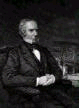
Tallmadge was born in Stanford, Dutchess County, New York, on January 28 1778. After graduation at Brown in 1798 he studied law, was admitted to the bar, and practised several years in Poughkeepsie and New York, and also gave attention to agriculture, owning a farm in Dutchess county.
For some time he was private secretary to Governor George Clinton, and during the war of 1812 he commanded a company of home-guards in the defence of New York.
He was elected a representative to congress as a Democrat, and served from December 1, 1817, untill March 3, 1819, but declined a re-election. In that body he defended General Andrew Jackson's course in the Seminole war, and introduced, an amendment to the bill authorizing the people of Missouri to form a state organization, a proposition to exclude slavery from that state when admitted to the Union. In support of this amendment General Tallmadge delivered a powerful speech, February 15, 1819, in opposition to the extension of slavery. This was widely circulated.
He was a delegate to the New York constitutional conventions of 1821 and 1846, a member of the state assembly in 1824, and delivered a speech on August 5, 1824, on the bill to provide for the choice by the people of presidential electors.
In 1825-26 he was lieutenant-governor of New York, and while holding this office he delivered a speech at the reception of Lafayette in New York on July 4, 1825.
In 1836 he visited Russia, and aided in introducing into that country several American mechanical inventions, especially cotton-spinning machinery.
From 1831 till 1850 he was president of the American institute, of which he was a founder. He also aided in establishing the University of the City of New York, which gave him the degree of LL. D. in 1838, and he was president of its council for many years.
General Tallmadge was a leading exponent of the Whig doctrine of protection to American industry, and published numerous speeches and addresses which were directed to the encouragement of domestic production. He also delivered a eulogium at the memorial ceremonies of Lafayette by the corporation and citizens of New York, June 26, 1834. General Tallmadge was an eloquent orator and vigorous writer.
Tallmadge died in New York city on September 29, 1853.