|
Lesson 6
Μιλάς Ελληνικά;
Do you speak Greek?
In this lesson you will learn how to speak about your language, your city of origin and what is the proper way to speak to people you don't know very well.
Look also Grammar 6.
Maria is having a conversation with her new friend from England.

Μαρία: Μιλάς Ελληνικά;
Do you speak Greek?
Alice: Ναι, μιλάω λίγο.
Yes, I speak a little.
Μαρία: Πώς σε λένε;
What is your name?
Alice: Με λένε Alice.
My name is Alice.
Μαρία: Από πού είσαι;
Where are you from?
Alice: Είμαι από την Αγγλία. Aπό το Λονδίνο. Εσύ μιλάς Αγγλικά;
I am from England. From London. Do you speak English?
Μαρία: Ναι, μιλάω Αγγλικά.
Yes, I do speak English.
Carol is a girl from the USA looking for a job in Greece. This is a scene from her interview in a multinational firm where she had to speak Greek.

- Μιλάτε Ελληνικά;
Do you speak Greek?
- Ναι, μιλάω πολύ καλά Ελληνικά.
Yes, I speak very well Greek.
- Πώς σας λένε;
What is your name?
- Με λένε Carol.
My name is Carol.
- Από πού είσαστε;
Where are you from?
- Είμαι από την Αμερική. Aπό τη Νέα Υόρκη.
I am from the USA. From New York.
- Μιλάτε άλλες γλώσσες;
Do you speak other languages?
- Ναι, μιλάω Αγγλικά και Ισπανικά.
Yes, I speak English and Spanish.
λίγο = few, a little
πολύ = very
καλός -ή -ό = good, well
άλλος -η -ο = another, other
γλώσσα = toung, language
When you speak to someone you don't know very well you should use the "you" of the plural.
To a friend: Μιλάς Ελληνικά;
To your boss: Μιλάτε Ελληνικά;
Languages and cities
| Country | Language | City |
| Greece | Ελληνικά | Αθήνα |
| England | Αγγλικά | Λονδίνο |
| France | Γαλλικά | Παρίσι |
| Spain | Ισπανικά | Μαδρίτη |
| Germany | Γερμανικά | Βερολίνο |
| Italy | Ιταλικά | Ρώμη |
Languages are always in plural:
τα Αγγλικά, τα Ιταλικά, τα Iσπανικά
But:
Η αγγλική γλώσσα, η ιταλική γλώσσα, η ισπανική γλώσσα.
To a friend: Πώς σε λένε;
To a stranger: Πώς σας λένε;
|
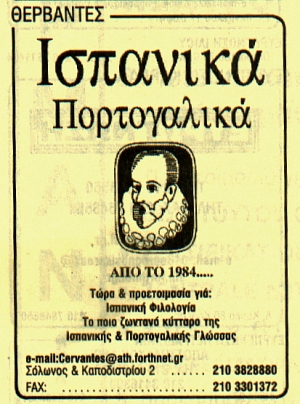
EXERCISE 1:
There is another advertisment for a language school. Try to read it out loud and answer the following questions:
What is the name of the school:
How would you say in Greek "I speak the Spanish language"?
How would you say in Greek "I don't speak the Portuguese language"?
How would you say in Greek "I speak foreign languages"?
EXERCISE 2:
You are having a conversation in Greek with a friend about which languages you speak and understand (καταλαβαίνω = I understand). Fill in the blanks to complete the dialogue. Use the form of politness (plural "you").
- Μιλάτε Ελληνικά, έτσι� δεν είναι?
- (Say yes, you speak Greek)
- Είσαστε Αμερικάνος;
- (Tell him your nationality, and say: Yoou are Greek, aren't you?)
- Ναι, Αθηναίος.
- (Ask him if he speaks English)
- Ναι, μιλάω Αγγλικά κα�ι Ιταλικά. Καταλαβαίνετε Ιταλικά;
- (Say no, you don't understand Italian. You speak English and Greek.)
- Μιλάτε πολύ καλά Ελλη�νικά.
- Say thank you very much.
EXERCISE 3:
Can you:
say where you are from (which town)?
say what nationality you are?
say what language(s) you speak?
tell someone he/she speaks English, very well?
ask someone where she/he is from?
ask someone if he/she is Greek/English, etc?
give the masculine and feminine forms to describe people from the following places: Ελλάδα, Γερμανία, Ιταλία, Ισπανία.

EXERCISE 1 ANSWERS:
Μιλάω την ισπανική γλώσσα
Δεν μιλάω την πορτογαλική γλώσσα
Μιλάω ξένες γλώσσες
EXERCISE 2 ANSWERS:
- Μιλάτε Ελληνικά, έτσι� δεν είναι?
- Ναι, μιλάω Ελληνικά.
- Είσαστε Αμερικάνος;
- Ναι, είμαι Αμερικάνος�. (or Όχι, δεν είμαι Αμερικάνος. Είμαι Άγγλος. Or whatever) Είσαστε Έλληνας, έτσι δεν είναι;
- Ναι, Αθηναίος.
- Μιλάτε Αγγλικά:
- Ναι, μιλάω Αγγλικά κα�ι Ιταλικά. Καταλαβαίνετε Ιταλικά;
- Οχι, δεν καταλαβαίνω �Ιταλικά. Μιλάω Αγγλικά και Ελληνικά.
- Μιλάτε πολύ καλά Ελλη�νικά.
- Ευχαριστώ πολύ.
καταλαβαίνω
καταλαβαίνεις
καταλαβαίνει
|
καταλαβαίνουμε
καταλαβαίνετε
καταλαβαίνουν
|
EXERCISE 3 ANSWERS:
Είμαι από το Λονδίνο. (or wherever)
Είμαι Άγγλος.
Μιλάω Αγγλικά και Ελληνικά.
Μιλάτε (μιλάς) πολύ καλά Αγγλικά.
Από πού είσαστε (είσαι);
Είσαστε (είσαι) Έλληνας / Ελληνίδα; Άγγλος / Αγγλίδα;
Έλληνας / Ελληνίδα, Γερμανός / Γερμανίδα, Ιταλός / Ιταλίδα, Ισπανός / Ισπανίδα.
|
|

|
|

