 Shuttles
In the early 1980's the space shuttle program was developed.
It was to be first program that would allow a space ship to land on a runway just like an airplane.
The shuttle is shaped similar to a plane. It has a nose, tail, and two fixed wings. Like a glider, it does not
have engines to power its flight on its own. Therefore, when it enters the atmosphere, it falls toward the ground
and must land on its first attempt. Special extra long and smooth landing strips have been constructed to prevent
any problems on the ground during landings.
The shuttle has been said to be three different types of
flying machines rolled into one. First it is a rocket. Its huge boosters propel it at high speeds into the upper
atmosphere. It is like a plane because as we noted earlier, it can glide to the ground. And it is also a space
craft because when it reaches outer space, it maneuvers by using small thrusters that send out bursts of air that
allow it to steer where it wants to go.
To launch, the shuttle is attached to a large, main tank
of fuel, mainly hydrogen and oxygen. It is also attached to two smaller booster rockets. The vast amount of fuel
in these three containers is used up in the first two minutes of flight. Fortunately, that is enough for the shuttle
to break through the strongest portions of the earth's gravitational field.
The booster rockets detach themselves from the shuttle when
their fuel is gone. They parachute back to earth and land in the ocean where workers retrieve them. They are examined,
repaired if necessary, and then refueled to be used in future shuttle launches. The main booster tank is the only
part of the shuttle launch that is not reusable. It travels too high in orbit before its fuel is gone to parachute
back to earth. It remains in orbit around the earth until it eventually enters the upper atmosphere and burns up.
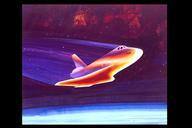
shuttle reentry
The shuttle is covered with specially made ceramic tiles.
These tiles are to help protect the ship during reentry into the earth's atmosphere. Not only can a ship be destroyed
by the extreme heat encountered in the different layers of the atmosphere, but it can also be destroyed by the
friction it creates as it rushes through the air at tremendous speeds. Just as when you rub your hands together,
you feel heat created, the shuttle rubbing through the atmospheric layers at high speeds, creates a considerable
amount of heat. So much heat, in fact, that without the ceramic tiles, the
shuttle would burn up within seconds
during reentry.
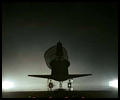 Shuttle
Endeavor landing (note parachute in back)
Shuttle
Endeavor landing (note parachute in back)
The first shuttle, Columbia, was launched in 1981 and was a great success. Other flights followed including
number seven with the first American woman astronaut on board, Sally Ride. In 1995, Eileen Collins became the first
woman to pilot the shuttle.
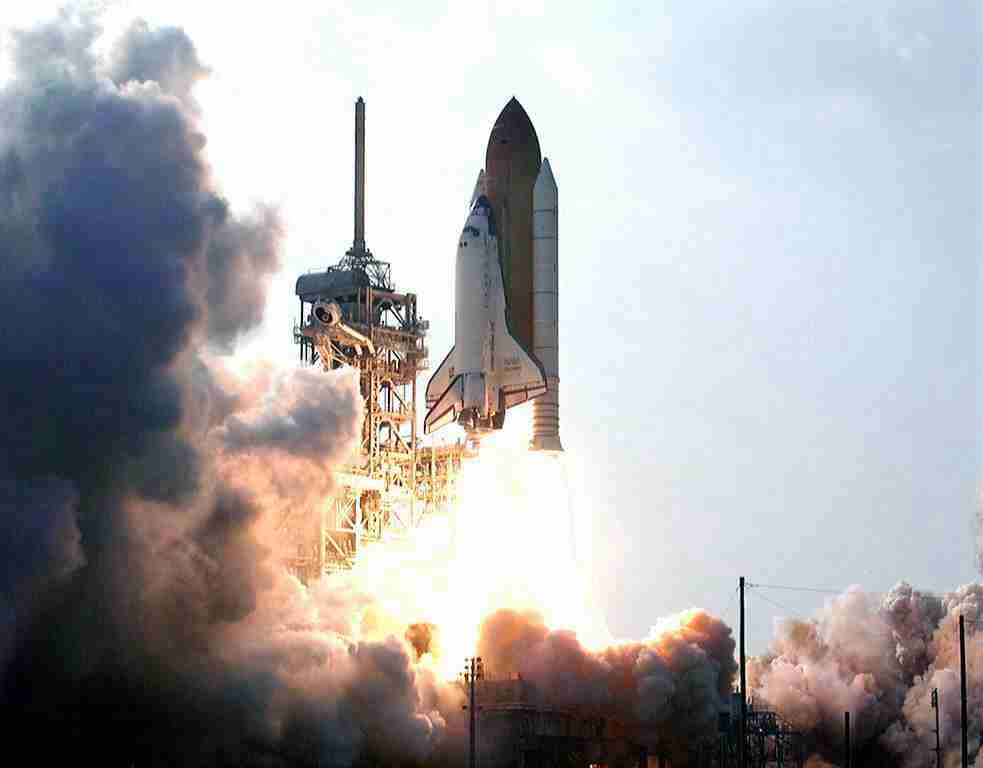
American shuttle
Russian began a space shuttle program also.
If you study the design, you will notice that it is very similar to the one the
American space agency uses. Due to finances and other problems, however, the
Russians have never launched a shuttle and still use rockets and space capsules
to go into space.
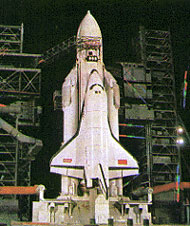
Russian shuttle
Despite the huge success
of NASA's shuttle program, on January 28, 1986,
a stunned nation watched as the shuttle Challenger exploded about one minute after take off. A faulty ring on one of
the booster rockets had allowed its fire to burn a hole into the main hydrogen and oxygen tanks. The explosion
occurred the second the flames touched the flammable gases. All seven astronauts, as well as civilian Christa McAuliffe,
who had been selected as the first teacher in space, perished.
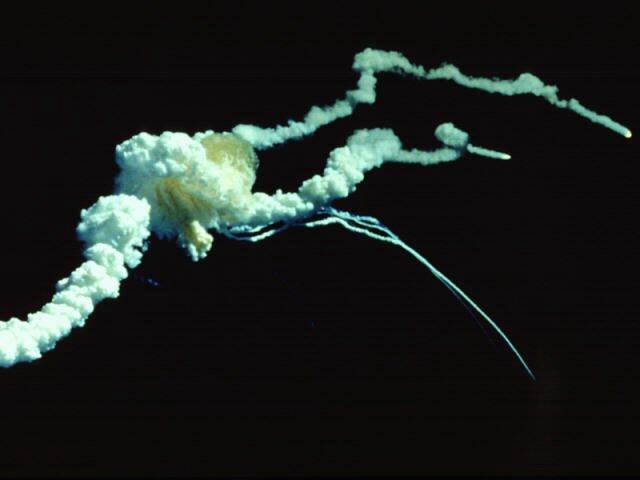
Challenger
explosion
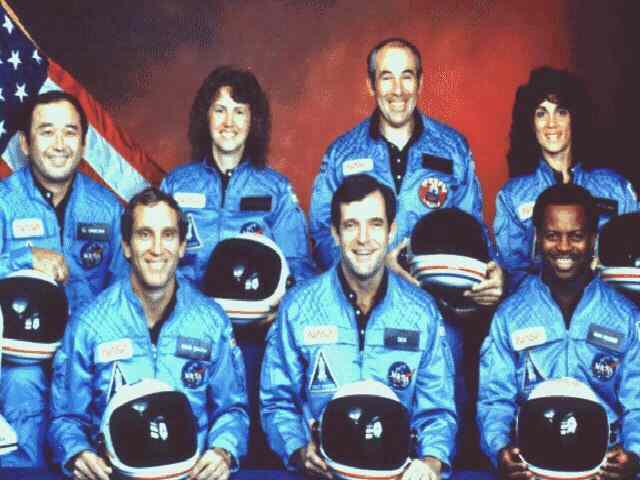
Challenger
crew
An investigation headed by former astronaut Neil Armstrong
found fault with the NASA organization for failing to provide proper quality control on the shuttles.
Flights resumed two
years later, and in 1990 the Hubble telescope (known as the HST) with its
8-foot mirror was launched.
Almost immediately after it was deployed, however, astronomers found that
they could not focus the telescope. They discovered that the primary mirror
had been ground to a wrong dimension at the Perkin-Elmer Corporation's
factory. Although the defect in the mirror was less than one-fiftieth the
size of a human hair, it caused the HST to suffer
spherical aberration
and produce fuzzy images.
Scientists came up with a replacement
"contact" lens called COSTAR
(Corrective Optics Space Telescope Axial Replacement) to correct the defect
in the HST. COSTAR consisted of several small mirrors that would intercept
the beam from the flawed mirror, correct for the defect and relay the
corrected beam to the scientific instruments at the
focus of the mirror.
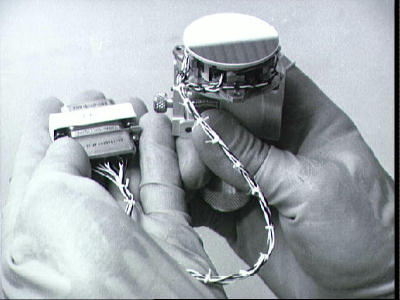
COSTAR was installed
by astronauts working from the shuttle Endeavor. It has since sent remarkable pictures of galaxies we have never
seen before.
COSTAR corrective
lens
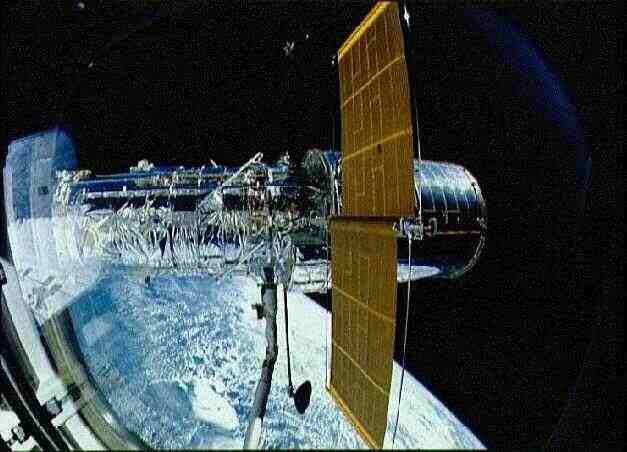
Hubble
telescope
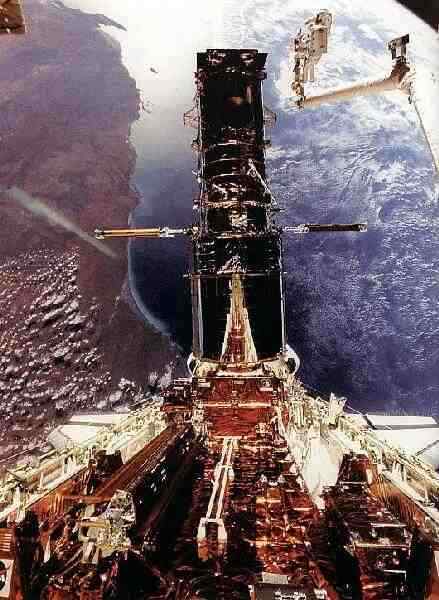
Hubble
repair by Endeavor
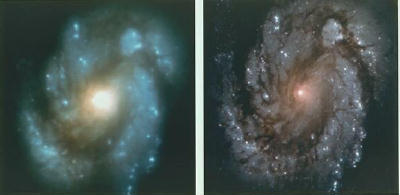
|
fuzzy HST image |
corrected HST image |
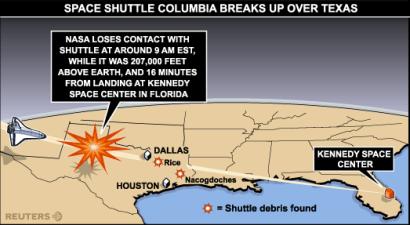
February 1, 2003, the space agency
suffered another shuttle tragedy. The stunned nation watched in horror
as the space shuttle Columbia
disintegrate as it reentered earth's atmosphere, killing all astronauts
onboard. The cause of this latest shuttle accident seems to be linked to
large chunks of foam that fell from the wings during takeoff and
possibly damaged the heat shields, which protect the shuttle from the
extreme heat during reentry.
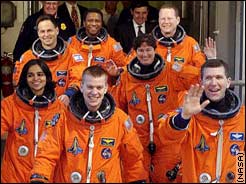
Columbia
crew
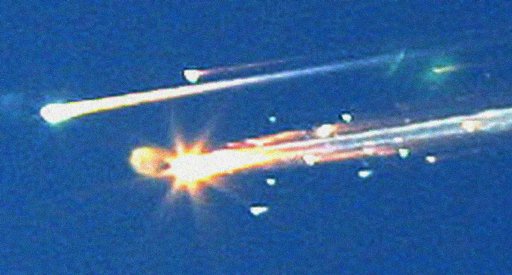
Columbia
breaks up as it reenters earth's atmosphere
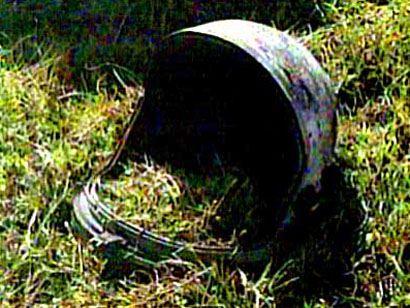
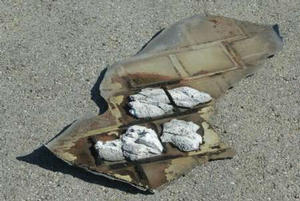
Debris from the space shuttle Columbia
rained down across the lower parts of the U.S.
Pieces as large as doors were found, as was this
charred astronaut helmet (above)
and this section of
protective tiles (below)
Shuttle
links (click
a rocket below)

Notice: You are about to leave Mrs.
Celaya's web site and the district server. Amphitheater Public Schools
has no responsibility for the content beyond this point. The
Internet is a highly volatile place and pages change rapidly. Students
are advised to proceed with caution when using the Internet and to
seek the assistance of teachers, librarians, or parents when they have
questions.
back to index
satellites
and probes
Questions and
comments: [email protected]
last revised 7/2005

