 Mercury and Gemini Missions
Mercury and Gemini Missions
A fierce competition soon developed between the two mighty nations. The U.S.S.R. had been the first to launch a satellite and an animal into space. The Americans were set on being the first country to send a man into orbit around the earth.
President Kennedy, in a speech just days before his assassination, challenged the space program to land a man on the moon "before the decade is out".
The Americans had a highly talented team of scientists. It was led by Dr. Von Braun, one of the many Nazi rocket scientists that sought admission to the United States following World War II.
Despite the impressive American team of inventors and engineers, however, the Soviets beat the United States into space when they sent cosmonaut Yuri Gagarin into orbit in 1961. They also sent the first woman into space in 1963.
Yuri Gagarin
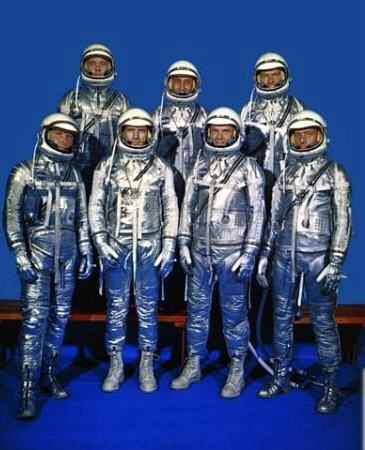
The Americans were quick to follow, however, as the first of the seven Mercury missions was launched two weeks after Gagarin's flight, and U.S. astronaut Alan Shepard became our nation's first man into space. Shepard's spacecraft, Freedom 7, was flown a total of six times in space, each time with a new name. In 1962 John Glenn, one of America's seven astronauts, became the first U.S. man to orbit the earth in Friendship 7.
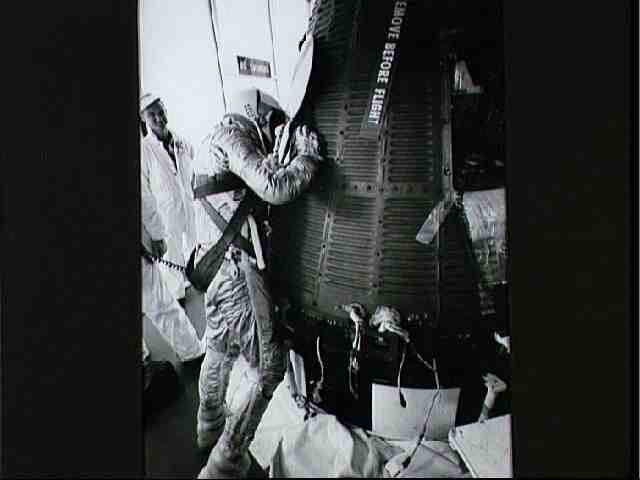
Alan Shepard with Freedom 7
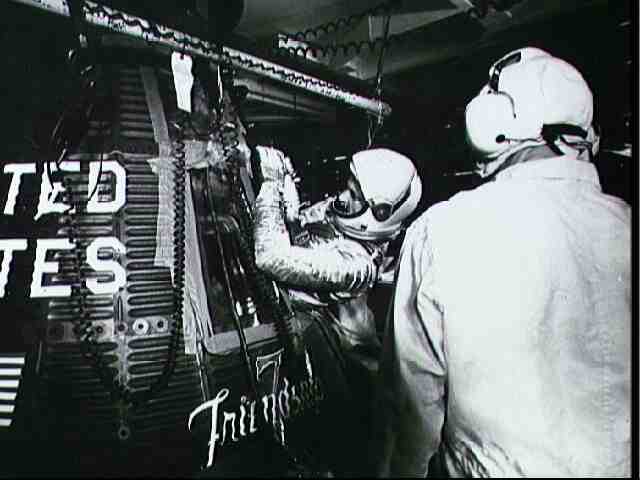
John Glenn entering Friendship 7
Although the Mercury missions on a whole were touted as a big success, there were a few problems. Gus Grissom's capsule Liberty Bell 7, inadvertently fired off the explosive hatch covering upon landing in the sea. The space capsule was so full of water by the time the rescue crews arrived, that the helicopters could not raise it. It was released from the tow rope and sank into the ocean . Gus Grissom was accused of panicking and pushing the emergency button that would blow the hatch. The mission turned into an embarrassment for NASA and Grissom, who contended, until his death several years later, that it was triggered on its own. The capsule was recently recovered from the ocean and taken to NASA. Unfortunately, the door itself was not recovered and the capsule was in such poor condition that no decision could be made as to whether Grissom removed the door or not. That is a mystery that will probably never be solved.
Scott Carpenter in Aurora 7 also had some technical difficulties. During his reentry, a navigational error occurred that caused him to land over 200 miles away from his planned landing site. He spent three long hours in a life raft before rescuers found him.
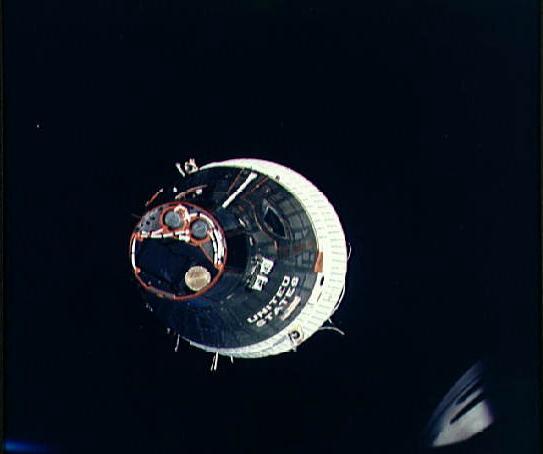
As bigger and more powerful rockets were designed, the Gemini program began in the United States. The mission of the Gemini flights was to help develop the technology to go to the moon. Space walks, the ability to dock with other ships, and the study of the effects of long-term flights on humans were studied through the flights of Gemini 1-12.
Gemini 11 splashdown
Gemini capsule
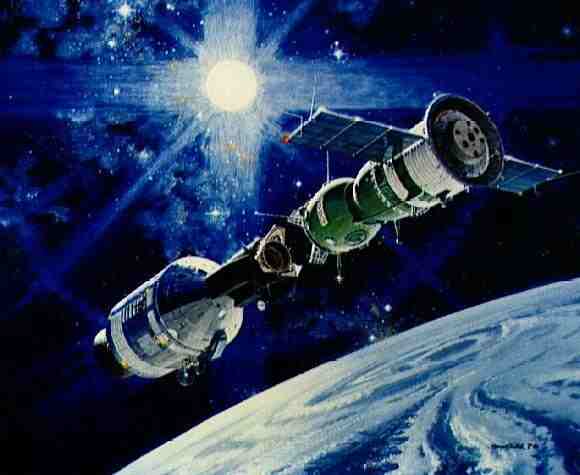
space docking
Before the beginning of the Gemini program the U.S. had only 54 man hours in space, while the Russians could boast an impressive 455. By the end of the last Gemini flight in 1966, though, the United States astronauts had logged over 2,000 hours in space, far surpassing the U.S.S.R. totals. For the time being, the United States had seemed to take the lead in the race between the two countries to land a man on the moon.
seven original astronauts in suits
Mercury links (click on a rocket below)

Gemini links (click on a rocket below)
Notice: You are about to leave Mrs. Celaya's web site and the district server. Amphitheater Public Schools has no responsibility for the content beyond this point. The Internet is a highly volatile place and pages change rapidly. Students are advised to proceed with caution when using the Internet and to seek the assistance of teachers, librarians, or parents when they have questions.
Questions and comments: [email protected] last revised 7/2005