
THE TRUTH ABOUT THE MARYS, PART FIVE
THE TRUTH ABOUT THE MARYS, PART FIVE
There is a fascinating parallel between Mary and one of her fellow-migrants to Gaul in terms both of aspersions cast on her character, and of coloration in depiction of later artists. The migrant in question is Helena-Salome.
Because of his dislike for women -- and especially educated women -- Pater had always regarded Helena-Salome as a witch. He paid no heed to the fact that she was close to Jesus' mother, and had accompanied her at the Crucifixion. As the consort of Simon Zelotes (Zebedee, also Lazarus), Helena had in fact also been the conventual (mother) of the Apostles James and John Boanerges. Unlike Mary Magdalene, who was attached to the regional order of Dan, Helena belonged to the Order of Asher, an order wherein the women were allowed to own personal property, and in which the priestesses were known in Greek, as "hierodulai" (sacred women). Helena was indeed a High Priestess of the Order of Ephesus (holding the title of "Sarah") and as such as entitled to wear a red robe (much as today's Roman Catholic cardinals are dressed from head to toe in red). Such highly-ranked women were greatly feared by Peter, for the likes of Helena were a constant threat to his own position. The Roman Church inherited that same dislike and that same fear: outside conventual orders, there are no Roman Catholic clergy today. Thus, the once venerated image of the "scarlet woman" -- the hierodulai -- was transformed and (via medieval French into English) they became harlots. Prostitutes still use this perverted Church imagery by perhaps wearing red or by displaying themselves in red light (red light districts).

The women of the Order of Dan were lay Nazarites. Mary Magdalene, as a "Miriam", was a Head Sister of the Order (the equivalent of a senior bishop) and was entitled to wear black, like the Nazarites and the priests of Isis. It is also a fact that in parallel with the early reverence for Mary Magdalene, a cult known as the "Black Madonna" emanated from Ferrieres in AD 44. Among the many Black Madonna representations that still exist, one of the finest statues is displayed in Verviers, Liege. She is totally black, with a golden sceptre and crown, surmounted by Sophia's halo of stars. Her infant child also wears a golden crown of royalty.
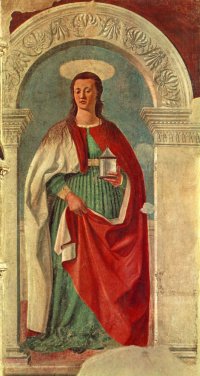
In contrast to the blackness of the Black Madonna image, it was also common for Mary Magdalene to be portrayed wearing a red clock - often over a green dress (the green representing fertility. An example is the famous "Saint Mary" fresco by Piero della Francesca, of about 1465, in the Gothic cathedral of Arezzo, near Florence. She is similarly clothed in Botticelli's "Mary at the Foot of the Cross." The red is intended (like the red of the cardinals' robes) to signify Mary's perceived high clerical status.
The concept of the red-caped women of religious rank actively infuriated the Vatican hierarchy. Despite the Church's separate veneration of Jesus' mother (especially following the Council of Ephesus in 431), Catholic bishops were determined that artists should not dignify her with the same privileged posterity accorded to the Magdalene. In 1659, Rome felt obliged to go as far as to issue a decree that all images of Jesus' mother (the "White Madonna") shoud depict her wearing "blue and white" only. This had the desired effect that Jesus' mother Mary, although exalted -- even adulated -- by the Church, was nonetheless denied any ecclesiastical recognition within the establishment.
Women were barred from ordination in the Catholic domain. And the relegation of women other than Jesus' mother from any venerable status pushed Mary Magdalene ever further into the background. By the same strategy, Jesus' own physical heirs were totally eclipsed, and the bishops were enabled to reinforce their claim to holy authority by means of a self-devised male "succession." It was not a Messianic descent from Jesus, as should have been the case, nor even a descent from the Rama-Theo (Arimathea) prince, James the Just (brother of Jesus), but a contrived "succession" from Peter, the headstrong rustic Essene who despised women!
At the same time, the early Church was having also to battle with veneration for the Universal Goddess. a veneration that was particularly strong in the contemporary Mediterranean world, and that was actually to heighten during this period of clerical squabbling over sexist issues. From prehistoric times, the Universal Goddess had appeared in many guises and had been known by mane names, included Cybele, Diana, Demeter, and Juno. But however personified, she was always identified with Isis "the Universal Mother, mistress of all the elements, primordial child of time, sovereign of all things, and the single manifestation of all."
To the ancient Egyptians, Isis was the sister-wife of Osiris, who was the founded of civilization and the judge of souls after death. Isis was the Universal Goddess, specifically a maternal protectress, and her cult spread far and wide. She was frequently portrayed holding her child, Horus, whose incarnations were the pharaohs themselves. It is a well established fact that the familiar image of the "White Madonna" is founded upon the depictions of Isis as the nursing mother. It is she too who inspired the mysterious Black Madonna, of whose image there were nearly 200 in France by the 16th century. Some 450 representations have now been discovered worldwide. Even the cherished patron goddess of France, Notre Dame de Lumiere (Our Lady of Light), has her origins in the Universal Mother.