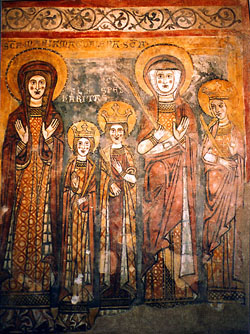
The image of the Black Madonna and her child has presented a constant dilemma for the Church -- particularly those statues at notable churches and shrines in continental Europe. In some cases they are black all over, but many have only black faces, hands and feet. It is not a question of discoloration, as some disconcerted clerics have suggested. A few have been overpainted in pale flesh tones to conform with the standard Madonna representation; some have simply been removed from the public gaze altogether. The features of the Black Madonna are in no way negroid in racial characteristics, but are quite simply black in color. Some Black Madonnas are modestly garbed (much in the fashion of traditional White Madonnas) but others are displayed in various degrees of prestige and sovereignty, having ornately decorated clothing and crowns.
The Black Madonna has her tradition in Queen Isis and her roots in in the pre-patriarchal Lilith. She thus represents the strength and equality of womanhood -- a proud, forthright, and commanding figure -- as against the strictly subordinate image of the conventional White Madonna as seen in Church representations of Jesus' mother. It was said that both Isis and Lilith knew the secret name of God (a secret also held by Mary Magdalene, 'the woman who knew the All'). The Black Madonna is thus also representative of the Magdalene who, according to Alexandrian doctrine, 'transmitted the true secret of Jesus'. The long-standing Magdalene cult was in fact particularly associated with Black Madonna locations. She is black because Wisdom (Sophia) is black, having existed in the darkness of Chaos before the Creation. To the Gnostics of Simon (Magus) Zelotes, Wisdom was the Holy Spirit - the great and immortal Sophia who brought forth the First Father Yaldaboath from the depths. Sophia was held to be incarnate as the Holy Spirit in Queen Mary Magdalene, and it was she who bore the ultimate observance of the faith.
Regardless of the prominence of the Goddess ideal, it transpired that during the rise of Orthodox Christianity all venerators of the female principle were regarded as heretics. Early Church Fathers such as Quintus Tertullian set the scene long before the days of Constantine the Great. Tertullian upheld the ruling: "It is not permitted for a woman to speak in church, nor is it permitted for her to baptize, nor to offer the Eucharist, nor to claim for herself a share in any masculine function -- least of all priestly office."
Tertullian was himself only following opinions expressed by Church leaders before him, notably Peter and Paul.
In the Gospel of Mary, Peter challenges Mary's relationship with Jesus, saying, "Would he really have spoken privately to a woman, and not freely to us? Why should we change our minds and listen to her?" Again in the Coptic tractate called Pistis Sophia (The Wisdom of Faith), Peter complains about Mary's preaching and asks Jesus to silence her, to stop her undermining his supremacy. Jesus instead rebukes Peter, and Mary later confides, "Peter makes me hesitate. I am afraid of him because he hates the female race." To this Jesus replies, "Whatsoever the Spirit inspires is divinely ordained to speak, whether man or woman." Mary had a good reason to be wary of Peter, for his attitude was made perfectly obvious on many occasions -- as in the Gospel of Thomas. Objecting to Mary's presence among the disciples, "Simon Peter said unto them, Let Mary leave us, for women are not worthy of life."
In the Gospel of Philip, Mary Magdalene is regarded as "the symbol of divine wisdom". All such texts were, however, censored and excised by the Bishops of Rome because they undermined the dominance of the male-only priesthood. Paul's New Testament teaching was expounded instead: "Let the woman learn in silence with all subjection. But I suffer not a woman to teach, nor to usurp authority over the man, but to be in silence." (1 Timothy 2:11-12)
Such authoritative directions were especially useful because they actually masked the real issue. The point was that women had to be excluded at all costs. If they were not, the Magdalene's lingering presence would be seen to prevail. As the wife of Jesus she was not only the Messianic Queen but also the mother of the true heirs. For centuries after her death, Mary's legacy remained the greatest of all threats to a fearful Church that had by-passed Messianic descent in favor of Apostolic succession.