The most active Magdalene cult was eventually based at Rennes-le-Chateau in the Languedoc region. Elsewhere in France there were many shrines set up to Sainte Marie de Madeleine. These included her burial place at St. Maximus, where her sepulchre and alabaster tomb were guarded by the Cassianite monks from the early 400s.
The Cassianite Order has an interesting history. Although St. Benedict is customarily regarded as the "father of western monasticism," he was actually preceded by John Cassian, who founded his Cassianite monastery in about 410 (albeit following innovatory communal endeavors by Martin, Bishop of Tours and Honoratius, Archbishop of Arles). The significant advance in monastic discipline made by Cassian (to be followed by Benedict and others) was its separation and independence from the organization of the episcopal Church. Cassian denounced the taking of holy orders as a "dangerous practice," and declared that monks should "at all costs avoid bishops." Initially an ascetic hermit in Bethlehem, John Cassian established his twin schools near Marseilles -- one for men, and one for women. Marseilles became a recognized conventual center, the birthplace of the Candlemas ritual which succeeded the earlier torchlight procession of Persephone of the Underworld. Similarly, the Feast of the Madonna originated at St. Victor's Basilica in Marseilles.
Another important seat of the Magdalene cult was that of Gellone, where the Academy of Judaic Studies (the monastery of St. Guilhelm le Desert) flourished during the 9th century. The church at Rennes-le-Chateau was consecrated to Mary Magdalene in 1059, and in 1096 (the year of the First Crusade), the great Basilica of St. Mary Magdalene was begun at Vezelay. It was there that St. Francis of Assisi founded the Franciscan Friars Minor (later the Capuchins) in 1217. It was also at Vezelay in 1146 that the Cistercian abbot St. Bernard of Clairvaux preached the Second Crusade to King Louis VII, Queen Eleanor, their knights, and an assembled congreation of 100,000. Indeed, the enthusiasm of the Crusades was intimately allied to the veneration of the Magdalene.
The Cistercians, Dominicans, Franciscans, and various other monastic Orders of the era thus all followed a lifestyle separate from the episcopacy of the Roman Church. But they shared a common interest in Mary Magdalene. In drafting the Constitution for the Order of Knights Templar in 1128, St. Bernard specifically mentioned a requirement for "the obedience of Bethany, the castle of Mary and Martha." It is evident, then, that the great Notre Dame cathedrals of Europe, which were wholly Cistercian-Templar instigated, were dedicated not to Jesus' mother Mary, but to "Our Lady" Mary Magdalene."
Early Christian texts describe Mary Magdalene was "The woman who knew the All"; she was the one whom "Christ loved more than all the disciples." She was the apostle "endowed with knowledge, vision and insight far exceeding Peter's; and she was the beloved bride who anointed Jesus at the Sacred Marriage (the Hieros Gamos) at Bethany.
(Author's Note: In the Gospel of Thomas (The Gnostic Gospels), Saying 113, the following is written: "Simon Peter said to them, "Let Mary leave us, because women are not worthy of life." Jesus said, "Behold, I shall guide her so as to make her male, that she too may become a living spirit like you men. For every woman who makes herself male will enter the kingdom of heaven.")
Disregarding all of this, the Roman Church chose in due course to discredit Mary Magdalene in an attempt to exalt her mother-in-law, Jesus' mother Mary. (This no surprise considering they claim that Peter was their first bishop, which is a lie.) To accomplish this, they made use of the ambiguous comments in the New Testament -- cmments that originally described the unmarried Magdalene as a "sinner" (which actually meant that she was a celibate "almah" undergoing assessment in betrothal).
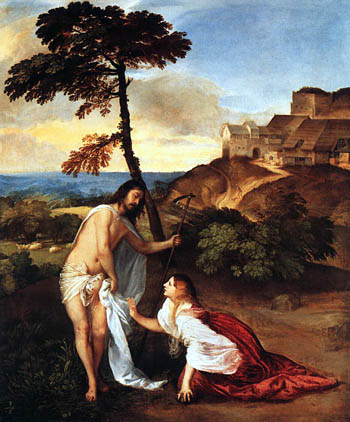
The duplicitous bishops decided, however, that a sinful woman must be a whore, and Mary was thereafter branded as a harlot! Even today, one definition of the word "Magdalene" in the Oxford Dictionary is "reformed prostitute." Many artists have nonetheless been careful to counter this Church-promoted slur by depicting Mary wearing a white blouse or cloak lined with the white silk of purity.