|
FOOD AND RESTAURANTS |
| SUSHI is Japanese most important and healthy food. Sushi does not mean raw fish, it involves vinegared Rice with many ingredients mixed like vegetables, egg, cooked or raw fish. The most simple and popular kind of Sushi is "Nigiri-Zushi"........a finger of rice topped with fish fillets. Sushi is surprisingly very filling and can make a meal in itself, a quick snack or a perfect party food. In Japan it is popular for lunch or with drinks after work. | 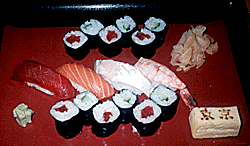 |
SUSHI BAR
The best place to enjoy Sushi is
under the eyes of the chef in a real Sushi-Ya (Sushi Restaurant). In Japan
usually the restaurants are small with a dozen of chairs, so in case you
want to enjoy the meal without any mess, reserve your table in advance.
The waiter will first give you a seat then gives a hot towel for your hands,
take order for drinks and Sushi. There is another option, you can sit at
the counter close to the kitchen desk where you can eat Sushi piece by
piece as and when it is made. And in a Kaiten-Zushi Bar (Automated Sushi
Bar) you can help yourself from the conveyor belt.
To become a Sushi Shoku-nin (Technician/Expert)
it takes years of apprenticeship, and a commitment to perfection. A chef
has to carefully choose the fish from the market, advicing, hospitality
and fierceness are all part of his tradition............with all this qualities
you will respect that chef and enjoy the excellent Sushi meal. Little
snacks and extras may appear for his favourite customers.
HOW TO ORDER SUSHI
The moment you enter a Sushi Bar
you are the guest of the chef. You can ask him "Kyo Wa Nani Ga Osusume,
Desu Ka?".......means "what is good for today?" Or you can let him choose
according to your budget. Usually for 2000-3000 Yen you get 2 pieces
of Sushi. In an Automated Sushi bar the plates are cunningly coded by design
or colour to tell you what you have eaten.
CHOOSING A SUSHI
There is no rules for eating Sushi
but the best way to start and to appreciate the subtle flavour os
Sushi is to choose something very light, white fish and later you
can move on to fatty and rich fish. But it is always advisable to take
chef's advice as to which fish are plump and in season. In case you have
restricted your diet or you are a vegetarian you can tell the chef in advance
what you cannot eat. To finish the meal sweet Tamago-Yaki (Egg Omelette)
is often eaten with or without rice, like a desert.
HOW TO EAT SUSHI
Sushi is eaten usually by Chopsticks,
but it is said that sushi tastes better when eaten by hand. Pour
a little soya sauce dip the toppings carefully hold it in your chopsticks
and just eat it. You can add root vegetables to the soya sauce or even
fish to make it taste good. But see to it that you do not add the sushi
in a lot of soya sauce, it means to drown the chef's creation and to lose
his respect.
DRINKS AND SOUP
The classic drink with Sushi in
Japan is Green Tea (Nihan-Cha), which is usually complimentary. Other alternatives
is beer and Sake (Brewed Rice Wine). Sushi bars also offers you different
kinds of Miso-Shiru (soups) to be slurped from the bowl between Sushi pieces.
Fish stock is traditional, but the elegant O-Suimono (clear soup)
will contain wheat gluten and occasionally chicken stock.
| TYPES OF SUSHI
Sushi varies from region to region. Osaka is the home for Oshi-Zushi ( vinegared rice+seafood pressed in wooden moulds) and for Bo-Zushi ( rice wrapped in fish). Sugata-Zushi is served with rice and fish with its complete head and tail. Specialties have also appeared outside Japan like California - maki where crab or fishcake is rolled inside the rice, which sometimes is coated with bright orange tobiko (flying fish roe). A classic Sushi is with Tuna fish, which is soft, Fatty with meaty taste. You can keep this for many days in soya sauce, but now usually served fresh. |
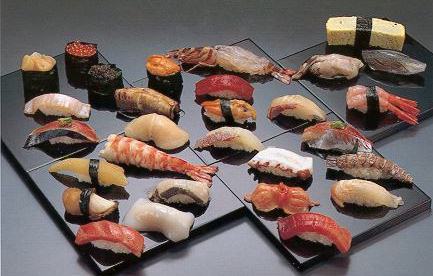 |
Tuna belly fish-most expensive,
very fatty, meltingly soft, darker in colour
Brill fish-delicate taste, very
firm when fresh
Sea bass fish-very tasty in season.
Yellowtail fish- ocean going fish,
very popular, rich and smoky taste
Prawn shell fish-usually lightly
boiled
Horse mackerel fish-good against
cholesterol, served with ginger
Mackerel fish-strong taste,
usually marinated with salt and vinegar
Squid shell fish-smooth flesh becomes
sticky on chewing, served with lemon and salt
Octopus-boiled with tea or broth,
only tentacles are used for sushi, when chewed releases full flavour.
Abalone fish- very expensive, chewy
flesh, steamed in sake or broth
Scallop shellfish- looks like a
ship's sail, served raw with lemon
Gaper shellfish-long muscular siphon
Cockle shell fish-called chicken
shell for its taste and dark pointy beak like end, very chewy
Ark fish-crisp, sweet, expensive
Fresh water eel fish-very tasty,
eaten on solar day for good health during the hot summer
Herring roe-traditional new year
fish, marinated in broth and soya sauce, expensive
Flying fish roe-tiny salty eggs
Sea urchin roe-strong taste, expensive
HEALTH
Japanese have long life then compared
to the rest of the world, this is because they eat healthy food.
Like most of the seafood sushi is rich in and high in vitamins and low
in saturated fats. Even fatty fish have fewer calories per gram than chicken,
and many actually help reduce cholesterol. Sushi is associated with Japanese
regular diet with very low rates of heart diseases. Nature's little secrets
are also used to ensure that the raw fish is safe to eat. Sushi is prepared
according to the needs of each species, and root vegetables, venegar and
the bamboo leaves decorates are all natural antiseptics.
USEFUL PHRASES WHEN YOU GO TO
A SUSHI BAR
| Oishii sushi-ya o gozonji ka?
Can you recommend a good sushi bar? |
Kai/unagai wa tabesen
I do not eat shell fish/eel |
| San-nin suwaremasuka?
Can you seat 3 people |
Watashi wa bejiterian desu
I am a vegetarian |
| Dorekurai machimasuka?
How long is the wait? |
Sabi nuki de onegai shimasu
Without root vegetables please |
| Ni-sen no omakase de
I rely on you (chef) for a bill of 2000 yen |
Gochiso-sama deshita
I am full! That was delicious |
| Sumimasen!
Excuse me! |
Tabako o sutte i desuka?
May I smoke? |
| Magura/o-cha/mizu o kudasai
I did like tea/water please |
Okanjo onegai shimasu?
May I have the bill Please? |
RESTAURANTS
BARBECUE LUNCH
If you are interested in Barbecue
lunch Visit Chinzanso Restaurant in tokyo. Experience the steaming hot
lunch of Barbecue right on your table.
TABLE D'HOTE LUNCH
Enjoy the true Japanese an
occidental lunch at the Pastel -Tei.
KABUKIZA THEATER
You can have a Japanese dinner
at Kabukiza theater
KUSHIAGE LUNCH AT GINZA ISOMURA
Enjoy Kushiage lunch in a traditional
Japanese atmosphere. Kushiage is a morsels of meat, fish and vegetables
coated with very fine bread crumbs on skewers, accompanied by soybean sauce,
salad, light pickled vegetables, rice and dessert.
|
|
 |
|
|
|
|
|
|
|
|
|
|