

2 Big Broncos Rocky Mountain Site



On-Board Air System
This is definitely one of the most significant modifications I've made to The Bronc. I struggled with a 12-volt compressor for a couple years with the small tires, and it was miserable. Even with the 10.50-31's at 16psi, it still took almost an hour to air up at the end of the trail. Now, with the 36's at 14psi, it takes less than 10 minutes to be ready to go.
In my case, the conversion was easy. I had the stock York A/C compressor on the truck and it was in very good condition. I needed to hunt down a new idler pulley, but Carquest had one on the shelf so that wasn't hard. I had thrown away the A/C hoses on the compressor (very stupid) and had to cobble together some new piping to make the air connections. I have since found a potential source for NPT fittings on this compressor and hope change to them in the near future.
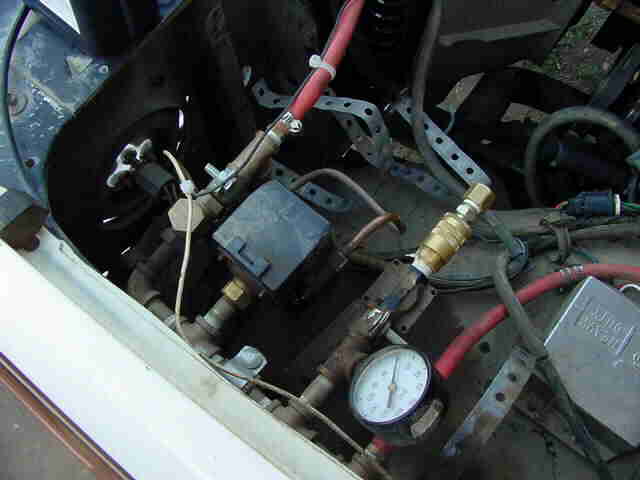 Here is the best view of the control manifold for the air system.
The entire manifold is made of 1/4" brass fittings.
Here is the best view of the control manifold for the air system.
The entire manifold is made of 1/4" brass fittings.
A very important lesson I learned was not to use PVC pipe for an air tank. I used 4-inch schedule 40 pipe rated at 265psi. So far, so good. The problem was the fittings. They hold the pressure, but evidently couldn't handle the pressure along with the shock and vibration of wheeling. The tank let me know about this problem very early one Sunday morning in downtown Boulder Colorado. Trucks a block ahead of and behind me thought that THEY had blown something up. The tank could only move 1/2 inch, but it still hit the firewall hard enough to knock fuses out of the fuse block. A lot of things were damaged under the hood including a destroyed horn. I'm damn glad I didn't mount the tank inside (not that I would have anyway).
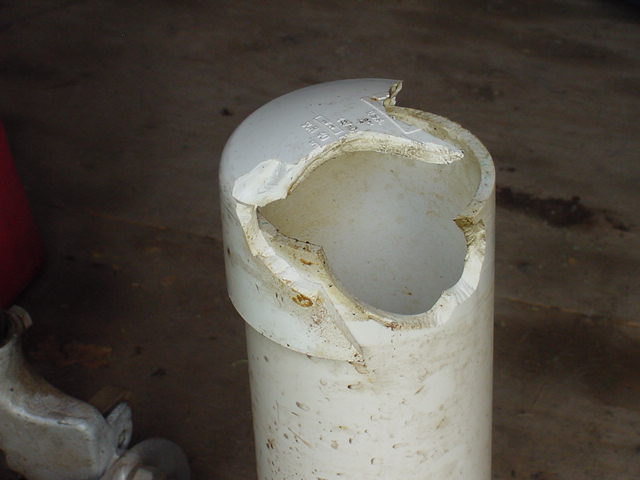 This is the end of the tank that slammed into the firewall. There
aren't any big dents, but it sure scared the hell out of me when it went.
This is the end of the tank that slammed into the firewall. There
aren't any big dents, but it sure scared the hell out of me when it went.
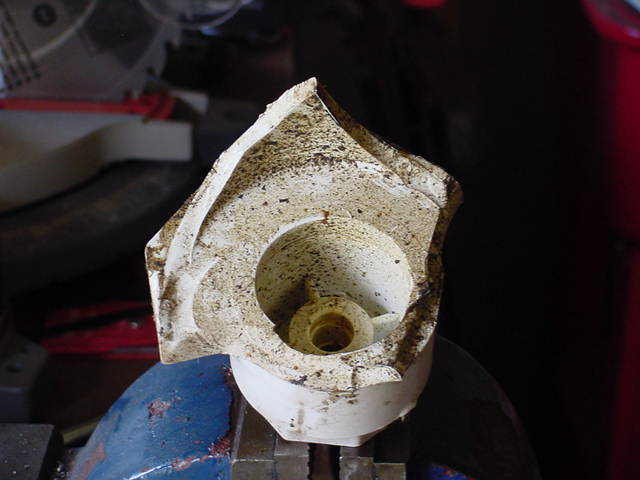 This is the end that cut loose. The sharp corners on the fittings
just gave up the ghost and turned the tank into a rocket. I still find pieces of
the tank from time to time.
This is the end that cut loose. The sharp corners on the fittings
just gave up the ghost and turned the tank into a rocket. I still find pieces of
the tank from time to time.
The air system is fairly complex. I have seen systems done that were just a pop-off valve teed to an air chuck. This works, but just isn't the optimum way to do it. My system uses a pressure shut-off with a pressure dump to reduce starting load on the compressor, a check valve to keep system pressure from backing up to the compressor, a filter for oil and water, a pop-off valve, a pressure gauge, and a large air tank. I put all these pieces together on a manifold bolted to the fender under the hood. I have a switch mounted under the dash to turn the compressor on and off. The system is setup to turn on at 95psi and off at 130psi with the pop-off at 150psi. The new air tank is a 1 1/2 gallon or so Sun Performance tank that looks very similar to an air brake tank off a big rig. Most of the components in the system are from Forney Industries. The oil/water filter is very small, so I will be upgrading that as it rises to the top of the priority list.
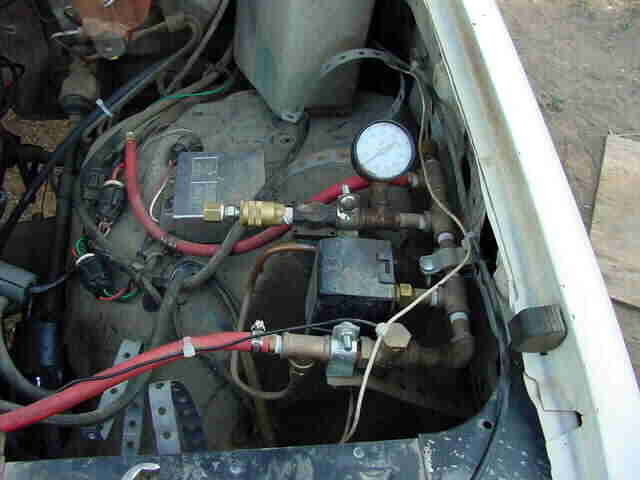 This picture was taken after the PVC air tank blew up. The loop
of plumbers strap behind the air components is where the original tank was
mounted. The plumbers strap in the foreground is where the washer tank is
currently mounted. I had to take everything out to fix all the damage from the
explosion.
This picture was taken after the PVC air tank blew up. The loop
of plumbers strap behind the air components is where the original tank was
mounted. The plumbers strap in the foreground is where the washer tank is
currently mounted. I had to take everything out to fix all the damage from the
explosion.
Finding a way to mount all the air components took some rearranging of parts on the driver's side fender. The windshield washer tank needed to be moved to the radiator support, the horn needed to be relocated below the headlight, and the ignition module needed to be moved inboard about six inches from the stock location (it was moved back to fit the new air tank in.)
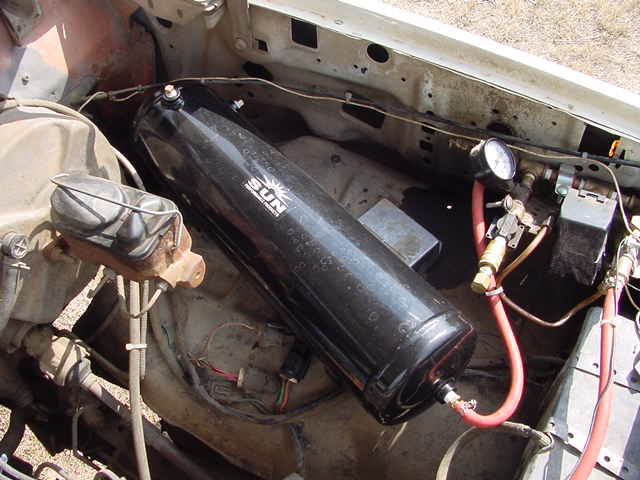 Here is the system as it sits now with the new Sun Performance
air tank. This isn't an optimum installation and will be changed in the near
future.
Here is the system as it sits now with the new Sun Performance
air tank. This isn't an optimum installation and will be changed in the near
future.