
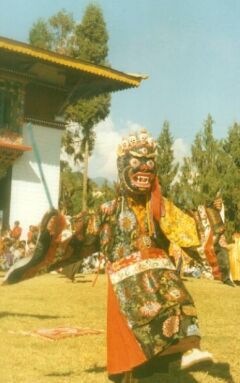
"Nath" means new, and "shar" means year in Tibetan or Sherpa language. There are festive activities at the Baudhanath and Syambunath Stupa temples in the Kathmandu valley. All the Buddhist pilgrims visit the big temples and monasteries at this time. The highlight of the family celebration is the feasting, drinking, and dancing at their homes. Prayer flags fly over houses, stupas, and monasteries. At night, hundreds of tiny trimmed butter lamps are lit, with praying and worshipping.
In finishing of the year's last night, a soup made from nine kinds of cereals is eaten. In a soup like Thukpa (traditional Tibetan soup) we put some butter, salt, chili, and coal in the dumplings. The first who gets the butter that meal is very lucky in the coming year. Whoever gets the coal, that is bad luck for him or her. This meal is a test for luck of the coming year. Some people celebrate this festival until the full moon day. Monks have a dance festival. The biggest party is on February 25 and 26, for two days. All the relatives of Sherpa people gather together to celebrate.
IIt is a time for Sherpa people to visit the stupa at Boudhanath. The stupa of Boudha, "Nath" is the Nepali equivalent to the sanscrit term "stupa," A stupa is a sacred Buddhist monument -- a three-dimensional mandala and a symbol of the universe and the mind. Spiritual practice (praying, circumambulating, reciting mantras, meditation, and doing pujas) performed in the vicinity of a stupa is thought to be especially beneficial.

Kathmandu, Nepal
The region north of Kathmandu offers a multitude of trekking destinations, all accessible without flights. The three major areas are Langtang, Gosainkund, and Helambu, which can be combined in many different ways to make treks from 7 to 16 days long. Langtang is a narrow valley that lies just south of the Tibetan border. It is sandwiched between the main Himalayan range to the north and a slightly lower range of snowy peaks to the south. Langtang Lirung (7246 meters) and Naya Kangri (5846 meters) lie to the south; and Dorje Lakpa (5955 meters) -- my favorite-named mountain -- protects the east end of the valley. The area was designated Nepal's first Himalayan national park in 1971.
This high and isolated region is inhabited by Tamangs whose religious practices, language, and dress are much more similar to those of Tibet than to the traditions of their cousins in the Middle Hills. A visit to the Langtang Valley offers an opportunity to explore villages, to climb small peaks, and to visit glaciers at a comfortably low altitude. According to legend, a lama following a runaway yak discovered the valley. Hence the name: "lang" is Tibetan for yak, and "teng" (more correctly "dhang") means "to follow". Yaks still live in the valley, but they now ahare it withtrekkers who make a 7 to 11-day round trip from Kathmandu. Because there are good opportunities for moderate climbing excursions here, you should allow a few extra days for exploration of the extensive glacier system. You can do the trek to Langtang by returning to Kathmandu via the holy lakes of Gosainkund at 4300 meters, or you can make a short trek from Dhunche to Gosainkund.
Helambu, about 75 km north of Kathmandu, is an area inhabited by Sherpas. You can include Helambu in a Langtang trek, either via Gosainkund or across the 5106-meter Ganja La. In winter, both of the high routes from Langtang are usually snow-covered and dangerous, difficult or impossible. The Helambu trek is popular because it is short, stays below 3500 meters, and is feasible all winter. It is an easy trek to organize because transport from Kathmandu to Sundarijal, the starting point of the trek, is readily available and inexpensive.
The language, culture, and dress of the Helambu Sherpas are very different from the Solu Khumbu Sherpas. The accessibility of Helambu has created an influx of tourists who have encouraged begging, the sale of "genuine antiques" aged over the family fireplace, and several incidents of thievery. It takes eight days to trek from Kathmandu to Helambu and back, or 12 to 14 days to include both Langtang and Helambu in a single trek without any backtracking.
15 Days of Trekking to holy lakes at Gosainkund
Maximum Elevation 4610 meters (15,125 feet)
A visit to the Langtang Valley offers an opportunity to explore villages, to climb small peaks, and to visit glaciers at a comfortably low elevation. Because there are good opportunities for moderate climbing excursions here, allow an extra day for exploration of the extensive glacier system. Trek back from Langtang to Kathmandu via the holy lakes of Gosainkund a 4300 meters. Thousands of Hindu pilgrims visit the lakes during a full moon festival in August. The lake is also sacred to Buddhists.
Day 2: Dhunche to Syabru
Day 3: Syabru to Lama Hotel
Day 4: Lama Hotel to Langtang Village
Day 5: Langtang to Kyanjin Gompa
Day 6: Langtang Valley
Day 7: Kyanjin Gompa to Lama Hotel
Day 8: Lama Hotel to Syabru
Day 10: Sing Gompa to Gosainkund
Day 11: Gosainkund to Ghopte
Day 12: Ghopte to Tharepati
Day 13: Tharepati to Khutumsang
Day 14: Khutumsang to Chisopani
Day 15: Chisopani to Kathmandu

9 Days Trekking
Day 1: Drive to Dunche
Day 2: Dunche to Singgompa/Chandanbari
Day 3: Chandanbri to Goshaikund
Day 4: Goshaikund to Thare pass of the Goshaikund
Day 5: Thare to Melamchigahun
Day 7: Tarkegyang to Sermathang
Day 8: Sermathang to Melamchipul
Day 9: Melamchipul to Kathmandu
Day 1: Drive to Melamchi pul and trek to Kakani
Day 2: Kakani to Sermathang
Day 3: Sermathang to Tarkegyang
Day 4: Tarkegyang to Melamchigahun
Day 6: Thare to Kutumsang
Day 7: Kutumsang to Chisopani
Day 8: Chisopani to Kathmandu via Sundrijal