








|
Association News |
| Christmas Party | 22 Dec 22H30 | Lions Club, Ste. Anne de Bellevue |
| Championship Game Party | 13 Apr 22H30 | Lions Club, Ste. Anne de Bellevue |
Your Heart:
It was three winters ago, as he was arming himself for one of his usual men's recreational hockey nights in Montreal, that Mitch Shulman donned an unusual piece of equipment.
As someone who had grown up with the fanaticism and fantasy that is our national pastime, Mr. Shulman knew enough to gird his vital parts against impact: shin pads for the lower legs and knees, shoulder and elbow pads for the upper body, a cage to protect the face and eyes against errant sticks and flying pucks. Oh, yes, there was also an armoured cup for the genitals, the piece of paraphernalia from which weekend warriors derive their identity as "jocks."
Then there was one more piece: a sensor that he strapped around his 49-year-old chest, to listen to the things Mitch Shulman's heart was saying that couldn't be heard over the din of panting middle-aged guys pretending they're still boys at play. The data screen attached to Mr. Shulman's wrist displayed its numbers silently, but he heard an alarm bell loud and clear. "In 2002, one of our friends suffered an event at the rink that ended up being diagnosed as a heart attack, and it set off a little bell in the back of my brain. I wondered what was happening to my body out there," said Mr. Shulman, who plays hockey once a week, but might see a fallen weekend warrior on any day, as an attending physician in the emergency room of Montreal's Royal Victoria Hospital.
His friend survived, but each year, 12 to 15 of the estimated 10,000 Canadian men who play recreational and pickup hockey for fun, die with their skates on. Those are cases reported from incidents at rinks. They don't necessarily include those who make it home and then collapse or have heart attacks in the night after a strenuous game.
Mainly the fatalities are middle-aged men, driven by passion for a game they remember playing as kids from sun-up to sundown. Studies show that Canadian men playing hockey easily launch themselves into a cardiac danger zone, keeping their heart rates above the target zone designated for aerobic activity for prolonged periods of time. No one opens the business pages of a newspaper and suddenly thinks he's Warren Buffet, "yet they lace on a pair of skates and think they can be Wayne Gretzky," observes Sheldon Persad, a certified strength and conditioning specialist with the Canadian Sports Centre and co-founder of Personal Best Health and Performance Inc.
So Mr. Shulman found out. "I did a normal warm-up, and I went from a resting heart rate of 70 beats per minute to 90," he recalls of his first self-test. "Then I played a shift and looked at the monitor and it said 188 [beats per minute]." According to rule-of-thumb guidelines for safe exercise, Mr. Shulman's target zone should have been around 120 to 130 beats per minute. His maximum heart rate should have been no more than 171. Yet shift after shift, he climbed out on a limb. "I didn't believe the monitor, so I tried it again. I got the same thing. Then a third time. Same again. After that, I figured it was accurate and I stopped looking. It was scary and I never told any of my fellow players to try it," he said of a league that comprises men from their 40s to their 60s, with a smorgasbord of occupations from garment industry executives to architects. "They're not all in really great shape, but hockey is their form of athletics. A couple of the guys run on a regular basis, but a third of them don't work out at all in terms of staying in shape." Mr. Shulman engaged in a little soul-salving rationalization.
"That 188 was certainly above where my heart rate should be. What saves you is that it's a short burst of anerobic activity," he reasoned. "But having said that, it's still not smart." Mr. Shulman was discovering first-hand what research doctors Sanita Atwal of Dalhousie University, Jack Porter of the University College of Cape Breton and Paul MacDonald of the Cape Breton Regional Hospital cardiology department learned in 2000 during a three-month study that focused on 113 recreational hockey players. They monitored a generally healthy group of players, ranging in age from 24 to 62. Sixty per cent exercised three times a week in addition to playing hockey. Half could be considered overweight. With our monitored subjects, all 113 players exceeded target heart rates and this was for an average of 30 minutes per game. More than three out of four players experienced heart rates above 100 per cent of their predicted maximum heart rates," the researchers wrote . Most players, about 70 per cent, also had poor heart rate recovery after exercise, they noted.
There's little wonder players' heart rates soar, given the emotion and bursts of activity in the game. Combine that with the intensity of competition and the macho sense of invulnerability men display in front of each other and you've added another danger factor. As well, most recreational teams don't have enough players to ice two or three separate lines, and you have a problem of players taking double and triple shifts. It's a recipe for cardiac catastrophe.
In the Ottawa area, where there were seven reported hockey deaths from March, 2004, to March, 2005, the Healthy Heart Hockey civic campaign was launched last February. The campaign, organized by the city and the University of Ottawa Heart Institute, emphasizes the necessity of keeping in shape year-round if one wants to play hockey in the winter. It features the slogan "Don't Deny! Don't Delay!"
"It's important to get in shape to play hockey rather than playing hockey to get in shape," said Andrew Pipe, medical director of prevention and rehabilitation at the Ottawa Heart Institute.
Those who don't heed the warnings may find themselves in for a shock -- as in an electrical zap from an automatic external defibrillator (AED). That's the kind of life-saving machine used in conjunction with cardiopulmonary resuscitation that helped revive Detroit Red Wings player Jiri Fischer two weeks ago when he collapsed and his heart briefly stopped.
Heart-healthy Hockey

Registration
Form (MS Word format)
Spare Player Recruitment Form (MS Word
format)
Hall of Fame
Statistiques/Statistics -
Joueurs/TeamMates
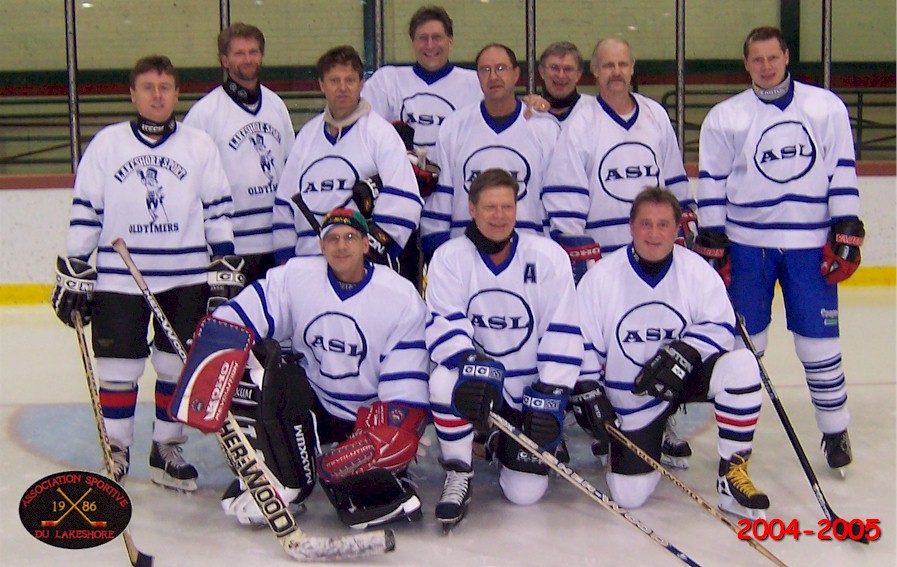
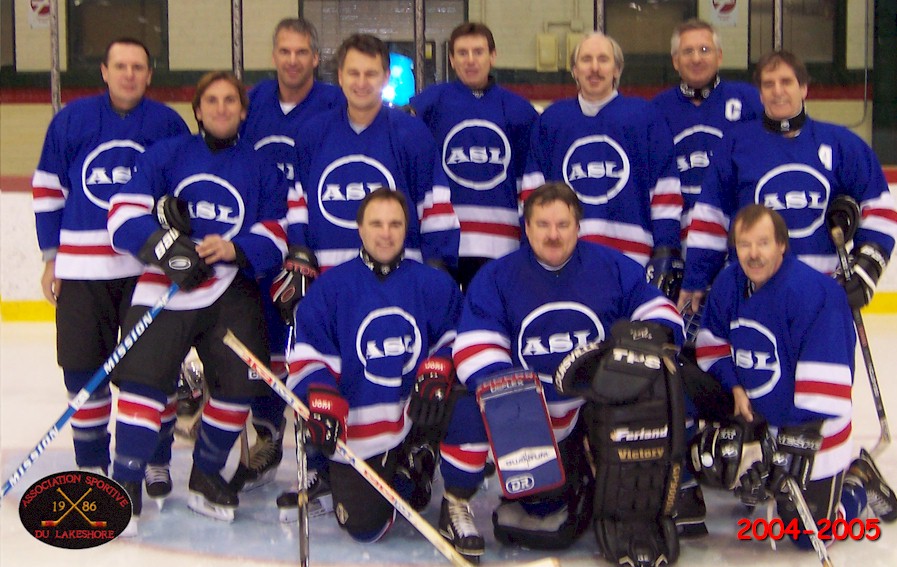
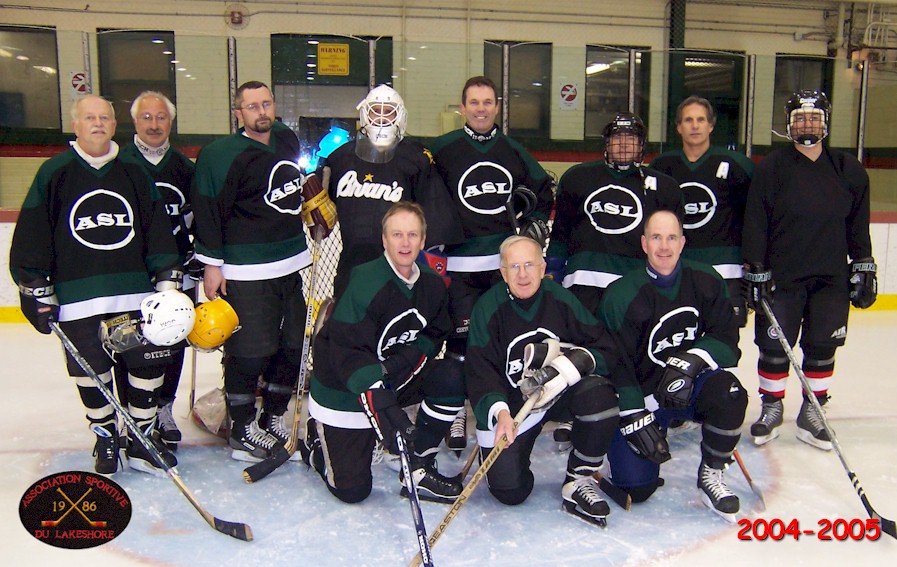
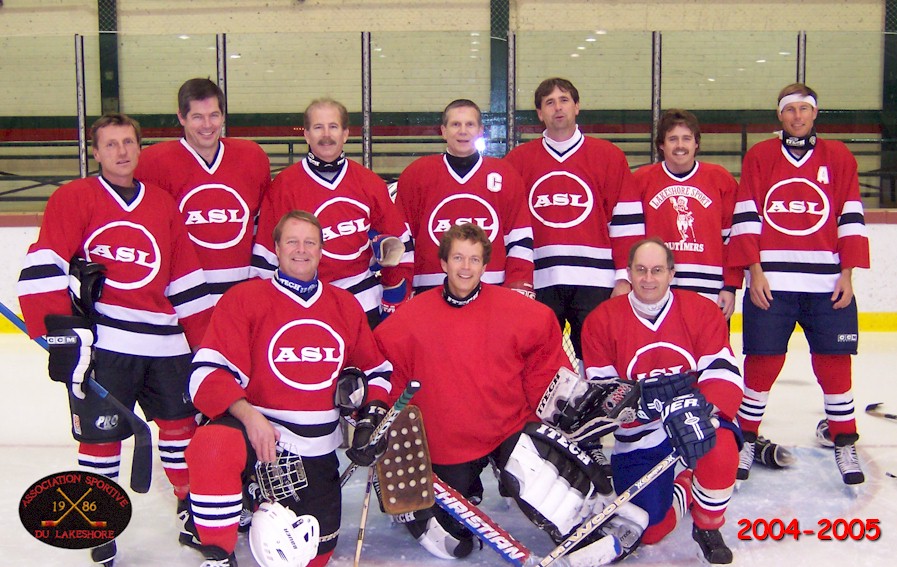
| Equipe/Team 2004-2005 |
G | Vict | Déf | Nul | Points | But Pour | But Contre |
But Pour % |
But Contre % |
Playoffs |
| 1. Fiesta-Blanc/White | 28 | 13 | 11 | 4 | 30 | 87 | 82 | 3.11 | 2.93 | |
| 3. BarCousineau-Red | 28 | 13 | 12 | 3 | 29 | 95 | 84 | 3.39 | 3.00 | |
|
2. Bootlegger-Noir |
28 | 13 | 11 | 4 | 30 | 88 | 93 | 3.14 | 3.32 | |
| 4. Paramount-Bleu | 28 | 11 | 16 | 1 | 23 | 78 | 89 | 2.79 | 3.18 |
| Players/Joueurs | |
| Bootlegger-Black | Fiesta-White |
| John Mcmahon - C | Luc Riel - C |
| Jim Wilson | Michel Peladeau |
| Glenn Chafe - E | Chris Booker |
| Gary West | Phil Handysides |
| Francois Lebuis | Brad Wilson |
| Paul Rochefort | Richard Fajzel |
| Dimitri Charitondis | Gregg Scotcher - E |
| Emile Paquin | Mario Masson |
| Doug Coleman | Rodney McCollum |
| Robert Poirier | Jack Hubert |
| Mike Lane | Jacque Albert |
| Paramount-Blue | Bar Cousineau-Red |
| John Haszczulski - C | George Fajzel - C |
| John Wundele | Eric Lillie |
| Andrew Wight | John Eke |
| Steve Ramage | Grant Smithman |
| Michel Boucher | Mike Sexton |
| Bob Burman | Robert Shum |
| Dave Crevier | Peter Webster |
| Sandy Mendolsohn | Doug Hamilton |
| Bobby Argento | Andrew Spiegel |
| Mike Zidle | David Murray - E |
| Claude Vigneault - E | Chris Hollum |
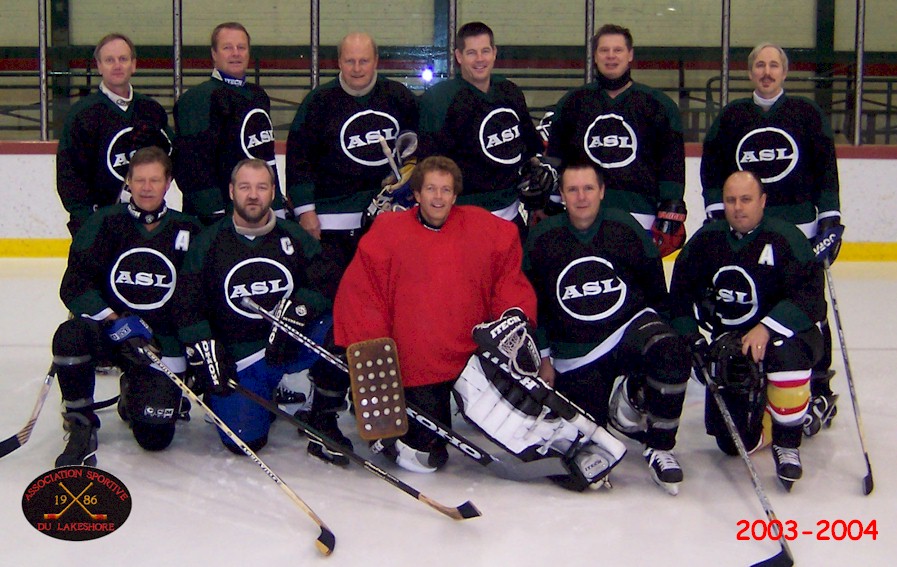
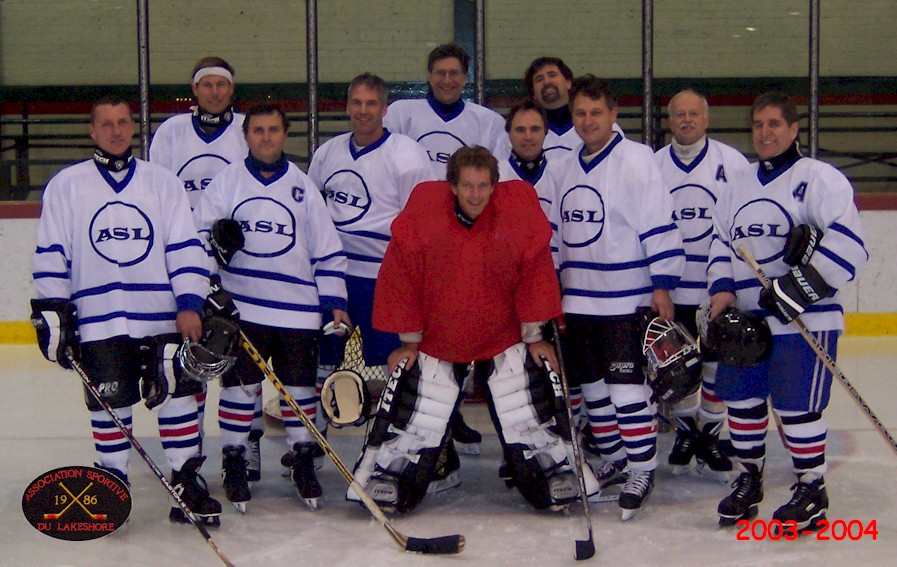
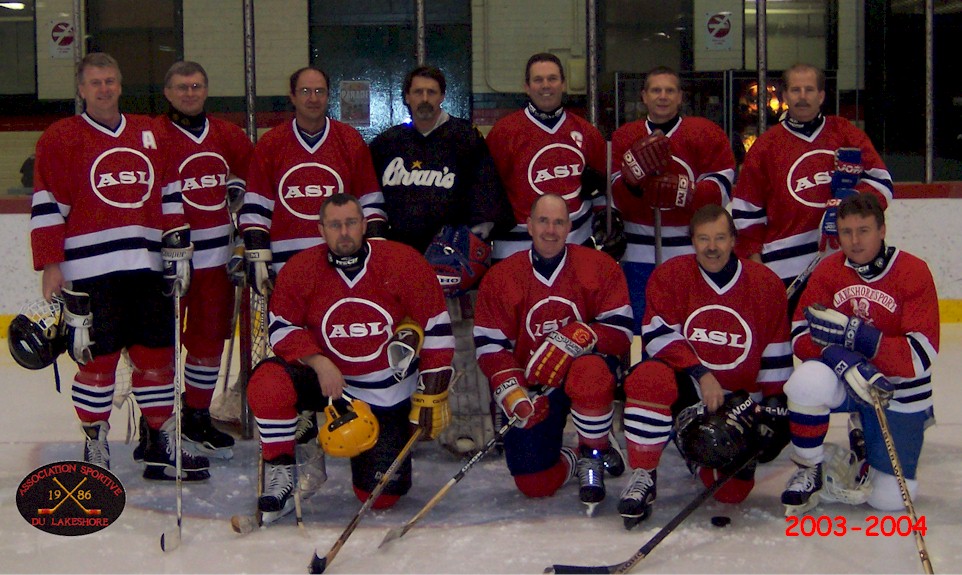
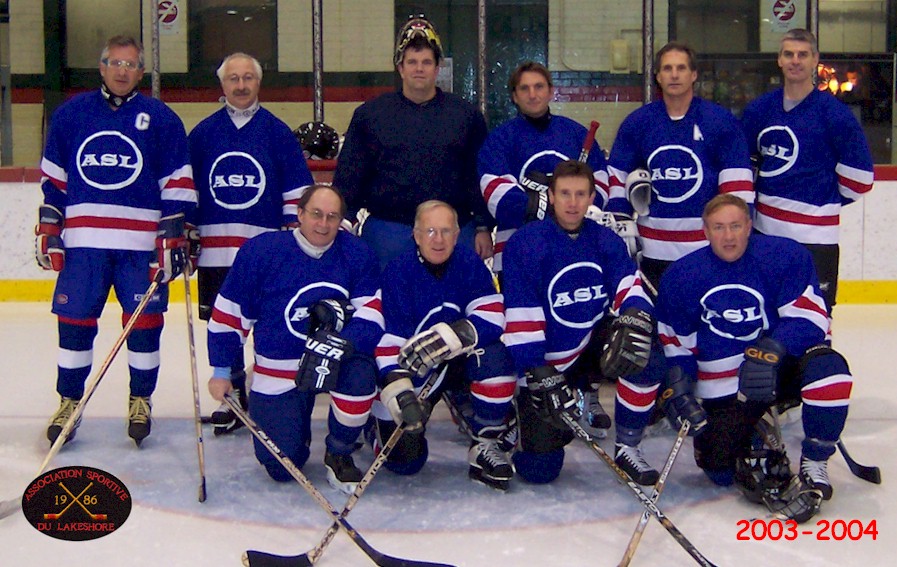
| Équipe/Team 2003-2004 |
G | Vict | Déf | Nul | Points | But Pour | But Contre |
But Pour % |
But Contre % |
Playoffs |
| 1. Fiesta-Blanc/White | 27 | 14 | 10 | 3 | 31 | 96 | 72 | 3.56 | 2.67 | 1st |
| 2. BarCousineau-Red | 27 | 12 | 13 | 2 | 26 | 83 | 101 | 3.07 | 3.74 | 2nd |
|
3. Bootlegger-Noir |
27 | 11 | 12 | 4 | 26 | 73 | 77 | 2.70 | 2.85 | 3rd |
| 4. Paramount-Bleu | 27 | 11 | 13 | 3 | 25 | 71 | 73 | 2.63 | 2.70 | 4th |
| Players/Joueurs | |
| Bootlegger-Black | Fiesta-White |
| Eric Lillie | Michel Peladeau |
| John Macmahon - C | Andrew Wight |
| Michel Boucher | Grant Smithman |
| Jim Lionidas | Mario Masson |
| Doug Hamilton | Claude Vigneault - E |
| Glenn Chafe | Steve Ramage |
| Richard Fajzel | Luc Riel - C |
| Gregg Scotcher - E | Robert Shum |
| Bob Burman | Emile Paquin |
| Peter Webster | John Eke |
| Chris Hollum | Mike Zidle |
| Paramount-Blue | Bar Cousineau-Red |
| John Wundele - E | Jim Wilson |
| Chris Booker | George Fajzel |
| Paul Rochefort | Brad Wilson |
| John Haszczulski - C | Doug Coleman |
| Mike Lane | Dave Murray - E |
| Phil Handysides | Gary West |
| Francois Lebuis | Mike Sexton - C |
| Dimitri Charitondis | Dave Crevier |
| Sandy Mendolsohn | Andrew Speigal |
| Bobby Argento | Rodney McCollum |
| Jack Hubert | Robert Poirier |
| Équipe/Team 2002-2003 |
G | Vict | Déf | Nul | Points | But Pour | But Contre |
But Pour % |
But Contre % |
Playoffs |
Paramount-Blue/Bleu |
27 | 17 | 5 | 5 | 39 | 84 | 57 | 3.11 | 2.11 | 1st |
Fiesta-White/Blanc |
27 | 12 | 11 | 4 | 28 | 86 | 79 | 3.19 | 2.93 | 2nd |
Bootlegger-Black/Noir |
27 | 9 | 13 | 5 | 23 | 88 | 86 | 3.26 | 3.19 | 3rd |
BarCousineau-Red/Rouge |
27 | 8 | 17 | 2 | 18 | 62 | 98 | 2.30 | 3.63 | 4th |
| Players/Joueurs | |
| Fiesta-White/Blanc | Bar Cousineau-Red/Rouge |
| Jim Wilson | Michel Peladeau |
| Andrew Wright | Chris Booker |
| Paul Rochfort | Michel Boucher |
| Mario Masson | Doug Hamilton |
| Jacques Albert | Ed Houlihan |
| Phil Handeyside | Gaby Jacques |
| Luc Riel | Mike Sexton |
| Francois Lebuis | René Millette |
| Emile Paquin | Bob Burman |
| Sandy Mendelsohn | Rodney McCollum |
| Robert Poirier | Chris Hollum |
| Bootlegger-Black/Noir | Paramount-Blue/Bleu |
| Eric Lillie | John Wundele |
| George Fazjel | John Macmahon |
| Brad Wilson | Gregg Scotcher |
| Dave Murray | John Haszczulski |
| Claude Vigneault | Mike Lane |
| Dave Crevier | Steve Ramage |
| Rick English | Glenn Chafe |
| Robert Shum | Grant Smithman |
| Vaugh Charlton | Andrew Speigel |
| Demetre Charitonidis | Bobby Argento |
| Jack Hubert | Mike Zidle |
| Équipe/Team 2001-2002 |
PJ/GP | G/W | P/L | N/T | PTS | But Pour | But Contre | But Pour% | But Contre% | Playoffs |
Bleu/Blue |
28 | 14 | 6 | 8 | 36 | 104 | 81 | 3.71 | 2.89 | 1st |
Noir/Black |
28 | 12 | 11 | 5 | 29 | 94 | 100 | 3.36 | 3.57 | 3rd |
Rouge/Red |
28 | 11 | 12 | 5 | 27 | 104 | 91 | 3.71 | 3.25 | 3rd |
Blanc/White |
28 | 8 | 16 | 4 | 20 | 81 | 111 | 2.89 | 3.96 | 2nd |
| Players/Joueurs | |
| White/Blanc | Red/Rouge |
| Luc Riel C | Mike Sexton C |
| Dave Crevier | Andrew Spiegel |
| Dave Murray | Brad Wilson |
| Emile Paquin | Chris Booker |
| Glen Chafe | Doug Hamilton |
| Grant Smithman | Ed Houlihan |
| Jacques Albert | Jim Wilson |
| John Haszczulski | Rene Millette |
| John McMahon | Robert Shum |
| Michel Peladeau | Rodney McCollam |
| Mike Zidle | Steve Ramage |
| Black/Noir | Blue/Bleu |
| Rick English C | Greg Scotcher C |
| Andre Charette | Andrew Wright |
| Bob Burman | Bob Poirier |
| Chris Hollum | Chris Rush |
| Eric Lillie | Claude Vigneault |
| George Fazel | Francois Lebuis |
| Mario Masson | Gaby Jacques |
| Maurice Tousignant | Jack Hubert |
| Michel Boucher | John Wundell |
| Mike Lane | Paul Rochefort |
| Sandy Mendelsohn | Ralph Consolante |
| Équipe/Team 2000-2001 |
PJ/GP | G/W | P/L | N/T | PTS | But Pour | But Contre | But Pour% | But Contre% | Playoffs |
Noir/Black |
29 | 19 | 7 | 3 | 41 | 119 | 76 | 4.10 | 2.62 | 4th |
Blanc/White |
29 | 14 | 11 | 4 | 32 | 118 | 108 | 4.07 | 3.72 | 2nd |
Rouge/Red |
29 | 11 | 15 | 3 | 25 | 110 | 119 | 3.79 | 4.10 | 1st |
Bleu/Blue |
29 | 8 | 15 | 6 | 22 | 109 | 129 | 3.76 | 4.45 | 3rd |
| Players/Joueurs | |
| White/Blanc | Red/Rouge |
| Luc Riel (C) | Bob Poirier (C) |
| Michel Peladeau (G) | Jim Wilson (G) |
| John McMahon | Chris Booker |
| Paul Rochefort | Rick Schofield |
| Doug Hamilton | Marcel Cormier |
| Mike Lane | Jacques Albert |
| Steve Ramage | Fulton Stewart |
| Mike Sexton | Dave Crevier |
| Glenn Chafe | Maurice Tousignant |
| Chris Rush | Rodney McCollam |
| Chris Hollum | Mike Zidle |
| Black/Noir | Blue/Bleu |
| Rick English (C) | Paul Power (C) |
| John Wundell (G) | Eric Lillie (G) |
| Serge Preseault | George Fazel |
| Michel Boucher | Brad Wilson |
| Emile Paquin | Claude Vigneault |
| Ralph Consolante | Ace Pitchford |
| Marc Diotte | Gary Killen |
| Bob Burman | Greg Scotcher |
| John Haszczulski | René Millette |
| Jack Hubert | Dave Murray |
| Sandy Mendelsohn | Andrew Spiegel |
Graphics