 Nordic and Norse are different
though closely related. Nordic means
‘northern’, from the root word
‘nord’ (north), and
refers to the three Scandinavian
countries: Norway, Denmark, and Sweden.
Norse specifically refers to Norwegians (nordmenn,
in its Norwegian form). Nordic and Norse are different
though closely related. Nordic means
‘northern’, from the root word
‘nord’ (north), and
refers to the three Scandinavian
countries: Norway, Denmark, and Sweden.
Norse specifically refers to Norwegians (nordmenn,
in its Norwegian form).
A Viking group often consisted of two or
more nordic groups. Seldom was there a
totally Norse, Danish, or Swedish viking
expedition. It was and still is easy to
mistake one for the other. They look the
same and their language sounds almost the
same. However, the viking attack at
Lindesfarne was likely to have been a
mainly Norwegian raid, with some Danes or
Swedes in the group. Norse vikings went
eastwards, mostly to England, Scotland
and Ireland. Vikings from Denmark went
westward and southwest, the Vikings from
Sweden usually went east and south-east,
following routes to Estonia, Poland, and
Russia.

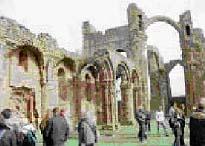 A photo
of the Ruins at Lindisfarne. A photo
of the Ruins at Lindisfarne.
Without warning, a monastery on the
island of Lindisfarne fell to the sword
of the Vikings. It was the 8th of June in
the year 793. A monk who survived the
attack wrote: “The
same year the heathens arrived from the
north to Brittany with a fleet of ships.
They were like stinging wasps, and they
spread in all directions like horrible
wolves, wrecking, robbing, shattering and
killing not only animals but also
priests, monks and nuns. They came to the
church of Lindisfarne, slayed everything
alive, dug up the altars and took all the
treasures of the holy church”.
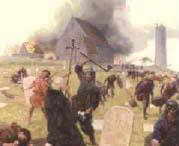 The first
recorded Viking attack was on
Lindisfarne, an island off the east coast
of England, quite near the border between
England and Scothland. The painting
“Norse Marauders Wreak Mayhem”
by Tom Lovell show what it must have been
like at Clonmacnoise, most celebrated of
Irish monasterie, Vikings hacked monks to
death, defiled sanctuaries, and robbed
churches of their treasures. Nearby
Jarrow was the and other monasteries in
England, Scotland and Ireland . Monks and
nuns were either killed or carried off to
slavery as part of many other treasures
in the churches and monasteries. The
Viking 300 years. The first
recorded Viking attack was on
Lindisfarne, an island off the east coast
of England, quite near the border between
England and Scothland. The painting
“Norse Marauders Wreak Mayhem”
by Tom Lovell show what it must have been
like at Clonmacnoise, most celebrated of
Irish monasterie, Vikings hacked monks to
death, defiled sanctuaries, and robbed
churches of their treasures. Nearby
Jarrow was the and other monasteries in
England, Scotland and Ireland . Monks and
nuns were either killed or carried off to
slavery as part of many other treasures
in the churches and monasteries. The
Viking 300 years.
From 800 to 1050 A.D., the
Vikings were supreme in Europe.. After
the attack on the Lindisfarne Monastery
in 793, viking ships went in large and
small groups across Europe for the next
200 years. The Vikings sailed up the
rivers of France and Spain, conquered
most of Ireland and large sections of
England, and took control of areas
skirting rivers in Russia and the Baltic
coast. Viking raids that were recorded in
the Mediterranean, as far east as the
Caspian Sea included an attack on
Constantinople, the capital of the
Byzantine Empire.
Eventually, the Norsk vikings gave up
plunder and began colonization of the
lands they had conquered.
Vikings
in England
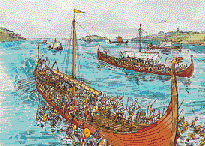
England was then a region of several
independent kingdoms that were often at
war with each other and without a unified
political and military structure. Tht
made it easy for the Vikings to raid
coastal towns and plunder the countryside.
In 873, King Alfred of Wessex won against
the Vikings at Edington but peace terms
for peace did not completely stop viking
attacks. Alfred conceded the northern and
eastern counties to the Vikings who built
new settlements and merged with the local
populations. Lincoln, Nottingham, Derby,
Stamford and Leicester became important
Viking towns within The Danelaw, or what
is sometimes called “Scandinavian
England.”. Jorvik (York) became the capital
of the Viking Kingdom that extended
through present-day Yorkshire.
In the year 1000, the Saxon King
Aethelred attacked the Isle of Man and
parts of The Danelaw, to try to crush the
Scandinavians living there. Two years
later, he married Emma, sister of Duke
Richard of Normandy. By marrying Emma,
Aethelred gained alliance with the
Normans. perhaps feeling more secure in
his new links with the Norman ruling
dynasty. Maybe Aethelred felt stronger
with the new alliance and he ordered the
massacre of all norsemen in England. It
was a big and costly mistake. Svein
Forkbeard’s sister and his brother-in-law,
Pallig, were amongst those killed. Svein
came to avenge their deaths and raided
south and east England throughout the
years 1003 and 1004. The famine in 1005
forced Svein to bring back his army.
Knut (Canute),
the First Viking King of England
Svein carried out many more raids for
several years, extracting vast amounts of
silver as ‘Danegeld’.
In 1013 he returned with his son Knut
and this time he intended to conquer
England. Danelaw was the first target.
After Danelaw, town after town came under
Svein’s control until he was
recognized as king. Aethelred escaped to
Normandy, but when Svein died the next
year, Aethelred saw a chance to regain
his kingdom. He returned from Normandy
and routed Svein’s army that had
been under the command of Knut, the son
of Svein.
Knut returned to England in 1016 and
won over Edmund Ironside, the eldest son
and successor of Aethelred, at the Battle of
Ashingdon (Ashingdown). Knut and Edmund drew
up the Treaty of Olney, which allotted
The Danelaw and the English midlands to
Knut, while Edmund retained control of
southern England. Edmund died shortly
after this treaty and Knut became the
first Viking king of all England. In 1017
Knut married Emma, Aethelred’s
widow, but she let her two sons by
Aethelred remain in Normandy. Knut had
two children by Emma--Harthacnut and
Gunhild, and two other sons--Harald and
Svein--with his mistress, Aelfgifu. When Knut’s brother, Harald, King of Denmark, died in 1018, Knut went to
Denmark to secure his hold over that
realm. Two years later, Knut laid claim
to Norway, and put his son Svein and his
mistress Aelfgifu to govern it. Late in
the 1020s, Knut who had also conquered
Scotland, was king of all England,
Denmark, Norway and part of Sweden.
It can be said that Knut was the first
king to successfully rule over a united
England, free from internal and external
strife and unrest. As ruler of Denmark
and Norway, two of the Viking homelands,
he was able to protect England against
attacks, maintaining twenty years of
badly-needed peace during which trade,
Anglo-Scandinavian art and Christianity
flourished.
Knut died in 1035 at the age
of 40 and was buried in Winchester, the
former capital of the Saxon kingdom of
Wessex. Unfortunately, Knut’s sons
could not keep their father’s empire
that began to break up after Knut’s
death. Aelfgifu’s other son, Harald,
became king of England but died in 1040.
Harthacnut then ruled for only two years
before he, too, died, leaving only the
memory of the huge taxes he forced on his
people. None of Knut’s children
produced any heirs and it was one of Emma’s
sons by Aethelred, Edward (later to be
known as ‘Edward he Confessor’,
who returned from Normandy to ascend to
the English throne in 1042.
The first and last viking empire
lasted barely 25 years and, most likely,
not many people know that a viking sat on
the throne of England. The legacy of the
Vikings did not lie in empire; it lay in
the social and political institutions,
many of which survive in Europe till the
present day.
|