
Malacañan
by
Rosalinda N. Olsen
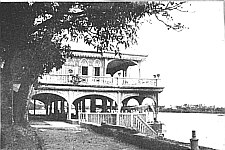
A photo of Malacañan during the earlyAmerican period
Malacañan was the villa at the Pasig River that became the official home of the Spanish governor-generals assigned to Spain’s one colony in SouthEast Asia—Las Islas Filipinas. When the Americans took over the colony, the American military governors and governors-general used the same building as their official residence. Not surprisingly, the presidents of the Philippines have used Malacañan as their residence and also the symbol of their power, prestige, and wealth.
Only one president of the Phiippine Republic, Corazon Aquino, had refused to live in Malacañan. Perhaps, former President Aquino’s main reason was that Malacañan had been the symbol of the tyranny of the 20-year dictatorship of Ferdinand Marcos. And then again, she may have viewed it as the symbol of tyranny from the time of colonial rule to the present. Interestingly, no other president after Corazon Aquino had followed that example. For the past several months, the incumbent president and the presidential candidates have been fighting tooth and nail to be the “owner” of Malacañan even for only 6 years. More, actually, if they have the power to do so.
America paid Spain 20 million dollars to own the islands and everything in it, which means that the Filipinos were bought at 2 dollars per head. When the Americans finally granted independence in 1946, no money changed hands, but the Philippine government took over most everything, except the American military bases that were on lease. From then on, he who lives in Malacañan had the power to do as his predecessors had done, from the very first Spanish colonial rulers to the last American governor-general. In short, only the names and nationality of the powerholders changed. But their identity? Their identity belongs to the same class and type The system remains the same. Less than 10% of the 85 million Filipinos own the power and wealth, while the rest climb on top of each other to get out from the bottom.
At the time Malañan was built, Intramuros or the “walled city” had become too small for the Peninsulares (Spanish born in Spain) and the Filipinos—Spaish born in Filipinas, so that suburbs grew outside the walls. Ermita was the plush suburb for the elite, many of whom were mestizos. On the other side was the old chinatown that became the center of trade for Chinese merchants. The Indio, now known as Filipino, lived where he could. Today, Intramuros has become a large open-air museum. But the elite continue to build their walled cities—Forbes Park, Dasmariñas Village, the Ayala village in Muntinlupa, and all the other villages and condominiums that effectively keep out the “Great Unwashed.”
Ironically, it is the “Great Unwashed”, often called the “masa” who become the most important in national elections, specifically to elect the one who will own Malacañan for the next six years. It is not the so-called middle class or the educated ones who determine the election outcome; it is the great mass of Filipinos, 60% of whom live below poverty level. The masa is serenaded with promises that no one believes, threatened with all kinds of catastrophes if they elect the wrong candidate, and bribed with cash and goods. And all because the candidates dream of living in Malacañan.
The Filipino is a gentle people, mild in manner and loves to laugh and dance and sing. The Filipino has proven that he is just as good as the scientists and writers and artists in the rest of the world. But like all others, he has a saturation point. That point was reached in 1986 when the Filipino said, “enough is enough.” They came on foot, in buses, in cars and some even took the plane to assemble at EDSA. For once, since 1896, the Filipinos were united with one aim—topple the tyranny of Malacañan. The world watched with awe. For one brief shining moment, the Filipino felt proud to be Filipino. Until the old discarded politicians came crawling out of the woodwork. And things settled down to the old system—a combined oligarchy and theocracy, thinly disguised as democracy.
Just as the 1896 revolution was stolen by the ilustrados from the masa, EDSA was stolen by the descendants of the ilustrados. Worse, EDSA had become a sword of Damocles over the head of the incumbent in Malacañan. This sword was used on President Joseph Estrada or “Erap” as he is more popularly known. The main charge was corruption. Fair enough. The question though is, which president has not been corrupt? Corollary to this, which government officials are not corrupt? Thanks to EDSA, it became easier to oust a president than it is to clean the government of corruption and shameless greed. Unfortunately, there is no EDSA to rid the BIR, the DPWH, the LTC and the police forces of corruption.
Unlike the 1986 EDSA, the second one ousted a duly elected president through the loud and violent antics of a couple of thousand who couldn’t wait until he finished his term of office. Who can now say that the next presidents would not or could not be ousted by another EDSA? It is sad and quite terrifying that the second EDSA had made a mockery of the will of the people expressed through relatively democratic elections. Thus, the most important question is: What system has EDSA developed to replace the corrupt and dysfunctional one?
Corruption has brought the Philippines to its present chronic misery of poverty, deprivation, and dubious morality. As the Philippines merrily waltzes to the edge of the cliff, Filipinos continue to multiply like rabbits, while opportunities for gainful employment and industrial productivity diminish just as fast. The Catholic church continue to insist that the use of contraceptive is a sin and chooses not to point out that poverty is a worse sin.
Assembling at EDSA is not the answer to ridding the country of corruption. The solution is as simple as saying “No.” No, to the policemen who collect tong and bribes. No to the politicians and government officials who would not sign a contract, a license, or a lease without bribe money. No to priests who frighten parents with the fire of hell if they use contraceptives to keep their family to a number they can support.
It is not easy to say no. I was privy to this when a policeman stopped my son’s car. My son was driving me to an important and urgent meeting. He had not violated any traffic rule but he was stopped anyway, and he quickly folded a 100-peso bill into a fold of the plastic holder of his driver’s license. I was outraged and told him to just give the policeman his license. My son said, “Mommy, you have no idea how difficult it is to get bacc the license from the police station. I’m sorry, but I have to get back to the office as soon as I drop you off, and I have no time for this nonsense.”
Corruption is nonsense? Well… yes, if one looks at it as complete lack of logic. When one looks at corruption as the easiest and quickest way to money and power, the corruption becomes a criminal type of nonsense. When presidential candidates spend millions for their campaign, nobody asks where they got those millions and nobody asks how they would recover those millions. Nobody asks because they know. Nobody asks what Malacañan is all about because they do not want to know.