


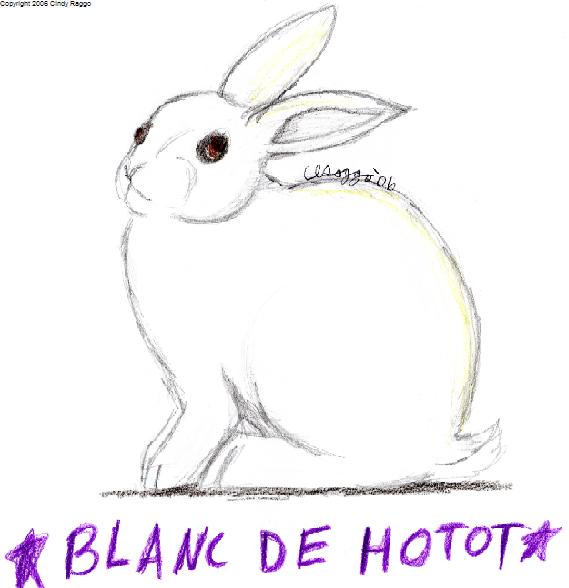
Weight: 9-10 pounds
Color: White with Black eyebands
Bred for: Meat, Show, and Pet

She started crossing Vienna Whites, white Flemish Giants, and white Checkered Giants, but without much success. After consulting Jeanne J. Lemarie, who had created the Large Russian, Bernhardt began to inbreed lightly marked Checkered Giants. The first of the Checkered Giant markings to dissapear were the flank spots. The "herringbones" - or thick bands of color going down the middle of the back - and the ear markings were very difficult to get rid of, but years of inbreeding and crossbreeding have managed to do so. The eyebands proved just about impossible to get rid of.
Several years passed, and the Hotot we know of today began in 1912.
In 1920, Bernhardt finally showed her rabbit, under the name Geant Blanc de Hotot, in the Exposition Internationale d'Aviculture in Paris.
In October 13, 1922 the Blanc de Hotot standard was accepted by the Commision des Standards de Francaise.
The first bunch of Hotots imported into the USA consisted of six well-marked Hotots and two mismarks. They were imported in 1978. The breed was accepted by the ARBA a year later. The Blanc de Hotot's official showing was in Tucson, Arizona in 1979. The first Hotots had a very beautiful, frosty white fur. After crossbreeding, however, the frostiness seems to have escaped the breed.
For years, the ARBA has been switching between calling this breed the Blanc de Hotot and the Hotot.