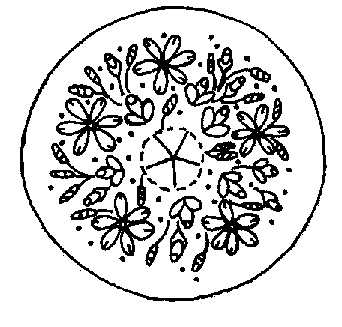
 1. CENTER ROSE. Use one strand light green for Spider
Rose, Part One. Use rose ribbon for Part
Two, Spider Rose. (NOTE: Make a French
Knot at center for this rose, rather than a Colonial Knot.)
1. CENTER ROSE. Use one strand light green for Spider
Rose, Part One. Use rose ribbon for Part
Two, Spider Rose. (NOTE: Make a French
Knot at center for this rose, rather than a Colonial Knot.)
Lightly Fray-Check® edges of fabric if desired to avoid fraying.
Use button form to lightly outline (with dots) the circle shape onto the fabric with a water-soluble pen.
Use the design drawing as a GUIDE not an EXACT PATTERN, mark placement of focal flowers, the center rose and the five daisies, onto the fabric.
Follow Order of Working below and STITCH GUIDE to stitch flowers and leaves.
When all stitching is completed, use a damp cotton swab to eliminate any pen
marks.
1. CENTER ROSE. Use one strand light green for Spider
Rose, Part One. Use rose ribbon for Part
Two, Spider Rose. (NOTE: Make a French
Knot at center for this rose, rather than a Colonial Knot.)
 2. DAISIES. Use gold ribbon for French
Knot centers. Use yellow ribbon for Lazy
Daisy Stitch petals.
2. DAISIES. Use gold ribbon for French
Knot centers. Use yellow ribbon for Lazy
Daisy Stitch petals.
 3. SMALL ROSES. Use rose ribbon for French/Colonial
Knot, and for one Straight
Stitch on each side of knot. Place a Fly
Stitch around the straight stitches.
3. SMALL ROSES. Use rose ribbon for French/Colonial
Knot, and for one Straight
Stitch on each side of knot. Place a Fly
Stitch around the straight stitches.
 4. ROSEBUDS. Here are two of many ways to make
rosebuds.
4. ROSEBUDS. Here are two of many ways to make
rosebuds.
a. Use rose ribbon for French/Colonial Knot, and one Ribbon Stitch on each side of knot.
b. Use rose ribbon for French/Colonial Knot, and for Lazy Daisy Stitch. (The Lazy Daisy Stitch should encircle the French/Colonial Knot.)
 5. LAVENDER. Use violet ribbon for Wrapped
Straight Stitch blossom heads. Use one strand light green silk thread to
Feather
Stitch the stems.
5. LAVENDER. Use violet ribbon for Wrapped
Straight Stitch blossom heads. Use one strand light green silk thread to
Feather
Stitch the stems.
6. ROSE STEMS & BRANCHES. Use one strand dark green silk thread to fill in around the roses and buds with stems and leaves in Stem Stitch and Lazy Daisy Stitch. Surround the base of each small rose and rosebud with a Fly Stitch in the dark green silk thread.
7. "FORGET-ME-KNOTS." Use blue ribbon for French Knots at various places throughout the greenery, shown on the guide with dots.
1995 © Cynthia S. Wetzel
Please remember, these instructions, diagrams and photographs are copyright protected from unauthorized reprint and distribution just like any chart pack or pattern book you would purchase in your local needlework store.