
About Us
Current Champions
Past LaCasa Saints
Puppies
Pictures
Is a St.
Bernard
for Me? (breed info)


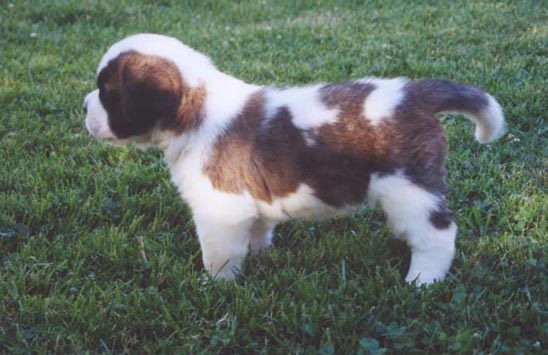
A Saint Bernard will not eat you out of house and home. The fact is that a Saint Bernard can be raised and maintained on no more food than is required for other large breeds. Since Saints are basically placid dogs, they generally require less food per pound of body weight than most smaller more active breeds.
How much do they weigh?
Saint puppies weigh about one and a half pounds at birth and grow rapidly during the first year, although, it may take as long as three years before they reach full maturity. Adult males may reach a height of 28-30 inches at the shoulder and will normally weigh between 140 and 180 pounds. Females are somewhat smaller at about 26-28 inches at the shoulder and typically range from 120-140 pounds.
Are they good with children?
Definitely. They have an understanding of a child's way and are amazingly careful not to injure a child. They are excellent baby sitters and companions. Naturally, a child must never be allowed to torment any dog, regardless of the breed.
Are they easy to train?
Bacause of the size of the animal, the Saint Bernard MUST be trained early in his life. Fortunately, Saints are eager to please and will begin responding to commands as soon as they understand what you want of them.
Do they shed?
Yes. Twice a year, usually in Spring and Fall, they lose much of their coats to help them adjust to the changing seasons. For the remainder of the year, there is seldom any annoyance from sheding.
Do they drool?
Yes, depending on the weather, the level of excitment, and the shape of the dog's jowls, most Saints will drool on occasion. Technically, there is no such thing as a dry-mouthed Saint, but most Saints do not drool to an offensive degree.
Are they good watchdogs?
The Saint's size and bark will discourage most intruders, yet he will learn to recognize your friends and receive them cordially. If an intruder gets by the size and the bark, your Saint may decide to lead him straight to the family silver since he would much prefer to be a friend to all. The one exception to this is when a member of the family is being threatened. The Saint's instinct to protect those he loves becomes very apparent at this time.
Why do some Saint Bernards have short hair?
The orginal Saint Bernards were all short haired dogs. Over 150 years ago, the monks in Switzerland found it necessary to bring some new blood into their breeding and interbred the long coated Newfoundland with their Saints. Today, the influence of that breeding is still with us, and we have both long haired and short haired Saint Bernards.
How much room do they need?
Saints, by nature, do not require acres and acres to roam. They are no so active or nervous as some breeds and are contant to remain close to home, for the most part. Consequently, a fenced yard or kennel run is enough, just so long as there is some place for regular exercise.
Should I get a male or female?
This is strictly a matter of personal preference. Both are equal in pet qualities.The male, being larger, is more impressive when first viewed. The female, however, must be considered his equal in all other respects. Modern veterinary practice recommends neutering of non-breeding animals of both sexes as a means to a healthier, better pet.
How well do they handle hot weather?
The dog will do well as long as there is a cool, dry place to nap and plenty of fresh, cool water. He will cut down both his food intake and his amount of activity during hot weather. It must be remembered that going from an air conditioned place into the boiling heat can be disaterous. Abrupt changes in temperature are extremely hard on a Saint.
(Note: Saint Bernards are prone to both elbow and hip dysplasia, the eye problems, ectropian and entropian and bloat. Purchasing a poorly bred Saint significantly increases your chances of owning a dog with one or more of these health conditions. Average annual veterinary care for a Saint Bernard runs between $100-$500 dollars).
More Breed Info
The Saint Fancier
The "Fancier" is the official publication of the St. Bernard Club of America (SBCA) and is and excellent resource for current Saint Bernard information. In order to apply for membership in the SBCA, you must be subscribe to the Fancier for two years. The subscription chairman will be listed on the SBCA website: www.saintbernardclub.org.
Saint Bernards from the Stoan perspective
A book written by Stan Zielinski, it gives a wealth of information from a breeder /judge who has produced over 150 AKC titled dogs since 1967. A "must have" for up to date Saint info. You can order it direct from the publisher by calling 1-800-777-7257 or you an look for it at www.amazon.com or www.barnesandnoble.com.
Perhaps by now you are thining about purchasing a Saint Bernard.Congratulations! A Saint is a perfect family dog: gentle, yet powerful enough to pull a sled or give a prowler second thoughts. Saints are wonderful with kids - serving as combination baby sitters and playmates. Those of us who own them find they are true to their name - SAINTS.
BUT.............although we believe the Saint Bernard approaches being the perfect dog, SAINTS ARE NOT FOR EVERYONE. The ownership of any dog involves responsibilities and this is particularly true of the giant breeds. YOU, AS A SAINT BERNARD OWNER, HAVE THE OBLIGATION OF CARING FOR AND CONTROLLING A DOG WHICH WILL PROBABLY OUTWEIGH YOU AND IS CERTAINLY GOING TO BE STRONGER THAN YOU ARE. Unless you take this responsibility very seriously and are willing to put the time, energy and thought needed into raising your dog properly, your Saint will be a burden instead of a joy.
So, before you go any further, here is a list of things to consider. This is not meant to frighten you but rather to to make certain you understand what is required of you as a Saint owner.
Are you willing to give your dog regular discipline and basic obedience training?
We believe that any dog, especially a large dog, needs regular day to day discipline. Every dog must grow up knowing he has limits of behavior, that he must respect people and property and that he is, after all, a dog.
Will you see to it that both the kids and the dog treat each other properly?
Although Saints make excellent pets for families with children and although they are sturdier and more patient than most other breeds, they are not punching bags and are NOT meant to be tormented or harrassed anymore than is any other living thing. By the same token, the playful pup should not be allowed to jump onto the kids, pull their britches or steal their toys. Too often, when the puppy still looks like a fuzzy toy, these antics are cute, but they aren't so funny when the dog hits 100 pounds.
DO NOT let children ride dogs!
Are you willing to invest the time necessary to raise your Saint?
Saint Bernards need human companionship and attention. If your idea of a dog is to tie him to a stake in the backyard and feed him once in a while, do yourself a favor and don't buy a dog. He'll be miserable, you won't have any fun and the dog will turn into a problem instead of a pet.
All Saints need regular grooming. This should be part of his routine from the time you get him home. Regualr brushing will reduce the dog hair problems, help eliminate any doggy odors and reduce the chances of skin problems. If you don't know how to groom a Saint, check with your breeder or veterinarian.
Are you willing to provide a godd home for your Saint?
Although a Saint is happy to live in the house with the rest of the family, there are times when you will want to keep him outside. A fenced in yard or pen will be ideal when you are not outdoors with him. A SAINT SHOULD NEVER BE ALLOWED TO RUN LOOSE. His size may frighten some children. His big feet and inquisitive nose can be disasterous to a neighbors flower bed. He has no fear of cars and could easily become a casualty. A loose dog is an open invitation to dognappers. Your Saint respresents a substanial investment - one which you should protect.
If your Saint is to live outdoors, be sure that he has a well insulated dog hose which is clean and draft free, shady retreat, fresh drinking water always available and some protection from insects.
Will you provde proper veterinary care for your dog?
Your Saint will require some routine health care. Dogs are subject to many of the same diseases as man, plus some of their own. In addition to your regualr visits to your veterinarian for immunizations to protect against various diseases, a regualr checkup by the veterinarian is certainly desireable for you dog. Preventative medicaiton againts heartworms can also be provided by your vet. (A year round necessity in the South and other areas that are not cold enough to kill mosquitoes in winter time). Your veterinarian should also be contacted whenever you see any signs of illness or abnormal behavior.
Are you sure that all of the family will share in this venture?
It is a big mistake to buy a dog for the kids when it requires management by responsible adults. It is also unfortunate for a Saint to go into a home where it is resented by one family member who might have preferred another breed.
UNLESS YOUR ANSWERS TO ALL OF THESE QUESTIONS ARE AN UNQUALIFIED YES, WE URGE YOU TO CONSIDER SOME OTHER BREED OF DOG.
You may think it is strange that we seem to be discouraging you. In a way, we are, but only because we want to be sure that Saints only go to people who will care enough to be suiteable owners for Saint Bernards. A fine dog, like a child, does not raise itself........so please take the time to consider carefully whether you have both the time and the interest to devote to your Saint.
