
The frequency can be chosen using different primary tank parameters. It is better to not use resonance, trying to match the LC impedance with the source, to get a good power transfer.
The stability of the arc in the spark gap is obtained using graphyte electrodes (Tesladownunder was right), 2 mm air gap between electrodes. If we use an inductive ballast on the LV side of the MOTs, the current will be limited to a safer value and we don't need quenching.
Strange thing: when I run the dual MOT supply unloaded, the arcs in the gap start at 2 mm, at full voltage applied (220 vac in), but when I have the primary tank connected, the gap arc at 80-90 vac input. I think that the presence of the primary cap help the ignition, because it charge at peak voltage. I am sure that will work OK even with a single MOT at 220 vac in. The gap works nice up to 150-170 vac input to MOTs (increasing the input, the arcs in the gap will become hoter and hard to quench).
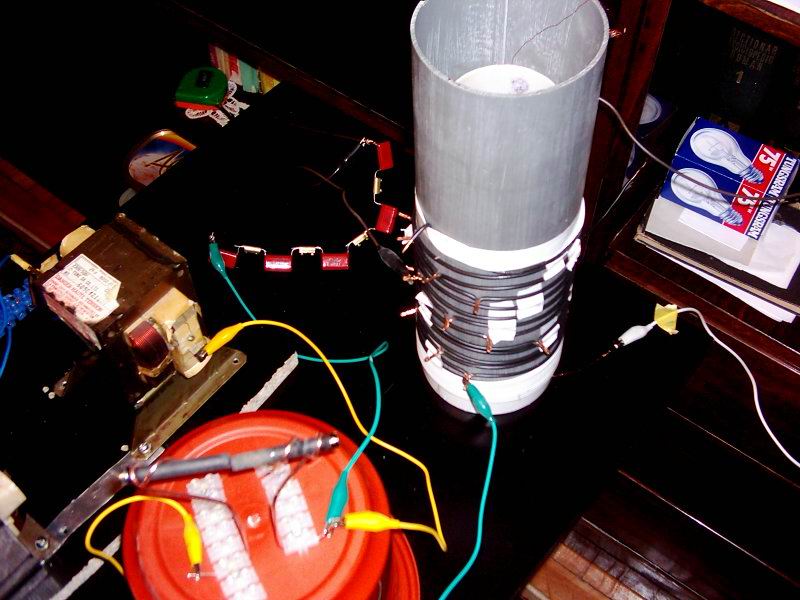
My setup:
- 20 nF @ 10 kV polipropilene cap
- adjustable 2 mm spark gap with graphyte electrodes in parallel with the MOT PSU output.
- air core step up transformer . Primary (10 turns of insulated wire on a 11 cm diameter PVC pipe), secondary (960 turns with 0.25 mm magnet wire on a 7.5 cm diameter PVC pipe, inside the primary form). The primary and secondary are high coupled with respect of the pri-sec insulation.
SETUP
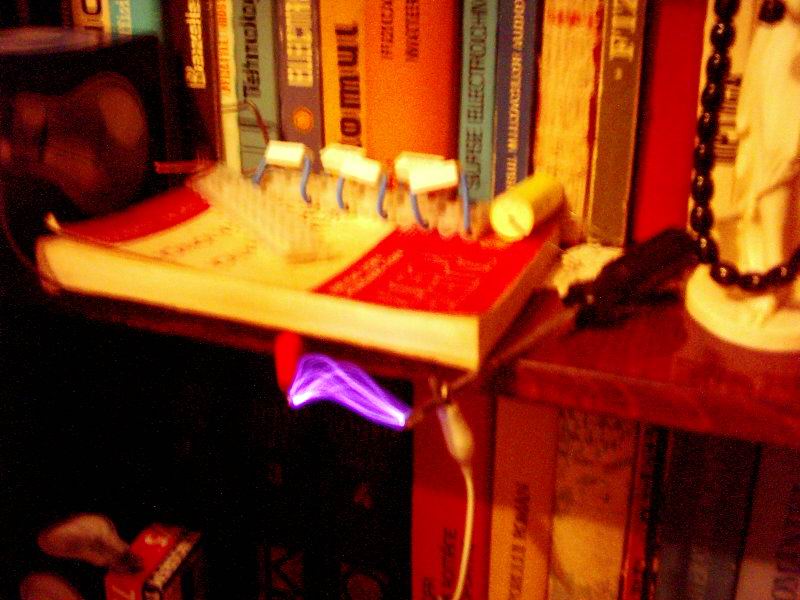
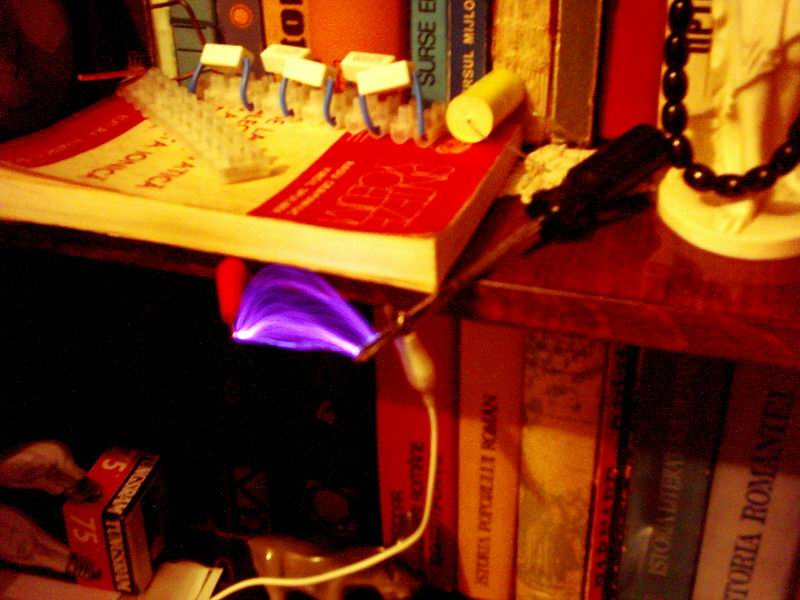
- impossible to rectify. I can not use it for multipliers because the very high voltage output. I can not decrease the input voltage either because the gap will stop working under 70 vac. The voltage and the frequency are too high to supply a TC too.
But there are some good news:
- the small voltages from MOTs can be used with a spark gap with graphyte electrodes and a good inductive ballasting on the LV side, to power little TCs (in the place of the step up transformers).
- with an air core transformer, the small voltage from a MOT can be increased to high values, with a simple setup, making a nice LV, low freq/ HV, high freq converter.
- we can stack together a few air core step up transformers (secondaries in serie) to get some long, healthy AC arcs. They are a better solution than the ignition coils (air core doesn't saturate, separate connections for priomary and secondary, better insulation between pri and sec, oil eventually).
