Derivative Difference Minimization Program
DDM version 1.7
(Last update: 13/05/2009)
Reference: L. A. Solovyov, Full-profile refinement by derivative difference minimization.
Journal of Applied Crystallography 37 (2004) 743-749.
DDM program is designed for crystal structure analysis from powder diffraction data by making use of either Rietveld or Derivative Difference Minimization (DDM) method. In the DDM method the refinement is aimed not at minimizing the absolute difference between the experimental and calculated profiles but at minimizing the oscillations (or curvature) of the difference curve. The squared values of the difference curve derivatives are used in DDM as a measure of the difference curvature. The main advantage of this method is that it does not require the background line modeling or approximations. Eliminating the systematic errors caused by inadequate background definitions, DDM allows structure refinement with increased stability and precision.
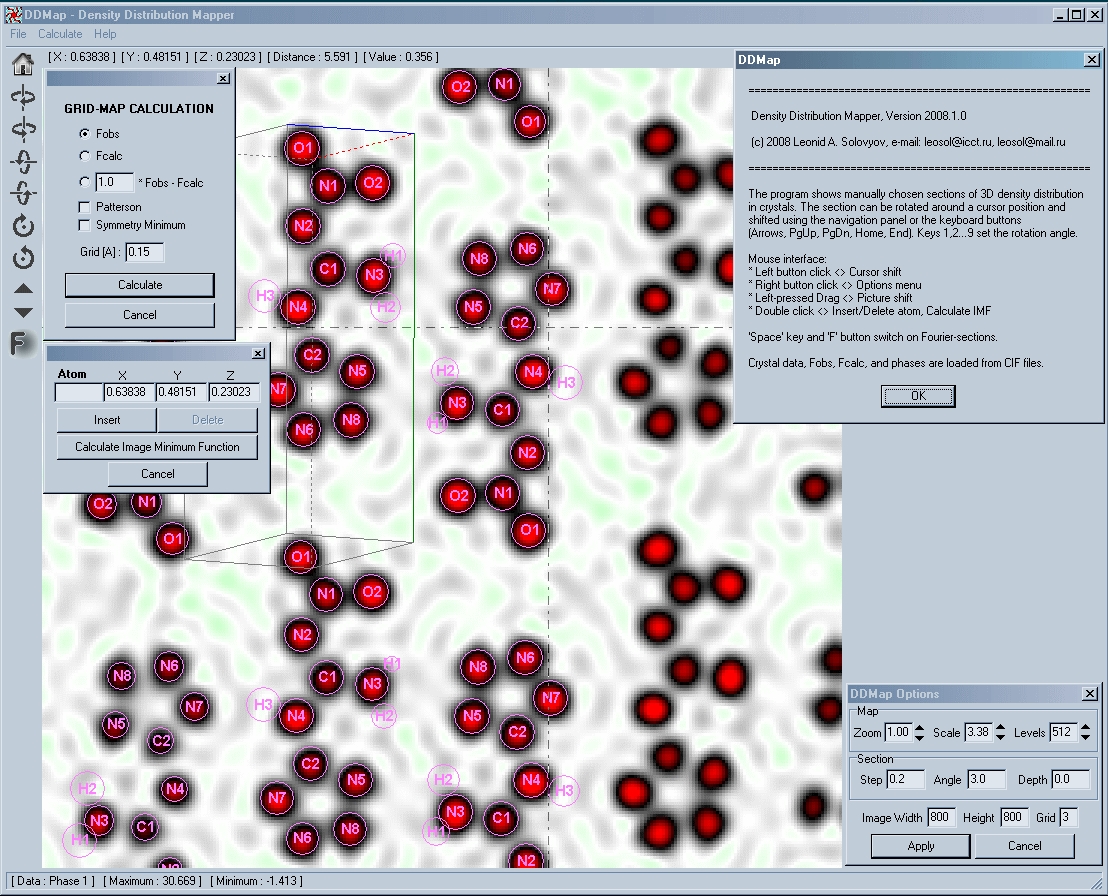
The program suite includes a configuration for the Programmer's File Editor (PFE) which facilitates integrating DDM with graphical utilities such as WinPLOTR and a structure viewer within the PFE shell. See DDM brochure. The current release includes DDMap utility that reads crystal data and structure factors from CIF file, calculates Fourier and Patterson maps including the Symmetry and Image minimum functions and allows viewing manually chosen sections of the 3D density distribution. The structure model may be built and modified within DDMap.
Recent studies where DDM was applied:
O. Ersen, J. Parmentier, L. A. Solovyov, M. Drillon, C. Pham-Huu, J. Werckmann, P. Schultz,
Direct Observation of Stacking Faults and Pore Connections in Ordered Cage-Type Mesoporous Silica FDU-12 by Electron Tomography.
Journal of the American Chemical Society 130 (2008) 16800-16806.
O.V. Belousov, Yu.V. Saltykov, L.I. Dorokhova, L.A. Solov'ev, S.M. Zharkov,
The dependence of the PdCl42-/Pd0 electrode potential on the dispersity of metallic palladium.
Russian Journal of Physical Chemistry A 82 (2008) 647-650.
O.V. Belousov, L.I. Dorokhova, L.A. Solov'ev, S.M. Zharkov,
Change in the particle size of highly dispersed palladium black in hydrochloric acid solutions at elevated temperatures.
Russian Journal of Physical Chemistry A 81 (2007) 1303-1306.
J. Parmentier, L.A. Solovyov, F. Ehrburger-Dolle, J. Werckmann, O. Ersen, F. Bley, and J. Patarin,
Structural Peculiarities of Mesostructured Carbons Obtained by Nanocasting Ordered Mesoporous Templates via Carbon Chemical Vapor or Liquid Phase Infiltration Routes.
Chemistry of Materials 18 (2006) 6316-6323.
F. Kleitz, T. Czuryszkiewicz, L. A. Solovyov, and M. Linden,
X-ray Structural Modeling and Gas Adsorption Analysis of Cagelike SBA-16 Silica Mesophases Prepared in a F127/Butanol/H2O System.
Chemistry of Materials 18 (2006) 5070-5079.
M. Jaroniec L. A. Solovyov,
Improvement of the Kruk-Jaroniec-Sayari method for pore size analysis of ordered silicas with cylindrical mesopores.
Langmuir 22 (2006) 6757-6760.
M. Jaroniec, L.A. Solovyov,
Assessment of ordered and complementary pore volumes in polymertemplated mesoporous silicas and organosilicas.
Chemical Communications (2006) 2242-2244.
T.-W. Kim, L.A. Solovyov,
Synthesis and characterization of large-pore ordered mesoporous carbons using gyroidal silica template.
Journal of Materials Chemistry 16 (2006) 1445-1455.
L.A. Solovyov, A.M. Astachov, M.S. Molokeev, A.D. Vasiliev,
Powder diffraction crystal structure analysis using derivative difference minimization: example of the potassium salt of 1-(tetrazol-5-yl)-2-nitroguanidine.
Acta Crystallographica B 61 (2005) 435-442.
D.S. Jacob, S. Makhluf, I. Brukental, R. Lavi, L.A. Solovyov, I. Felner, I. Nowik, R. Persky, H.E. Gottlieb, A. Gedanken,
Sonochemical synthesis and characterization of Ni(C4H6N2)6(PF6)2, Fe(C4H6N2)6(BF4)2, and Ni(C4H6N2)6(BF4)2 produced in ionic liquids of 1-butyl-3-methylimidazole with hexafluorophosphate and tetrafluoroborate.
European Journal of Inorganic Chemistry (2005) 2669-2677.
T.-W. Kim, R. Ryoo, K.P. Gierszal, M. Jaroniec, L.A. Solovyov, Y. Sakamoto, O. Terasaki,
Characterization of mesoporous carbons synthesized with SBA-16 silica template.
Journal of Materials Chemistry 15 (2005) 1560-1571.
L.A. Solovyov, O.V. Belousov, R.E. Dinnebier, A.N. Shmakov, S.D. Kirik,
X-ray Diffraction Structure Analysis of MCM-48 Mesoporous Silica.
Journal of Physical Chemistry B 109 (2005) 3233-3237.
Kleitz, L.A. Solovyov, G.M. Anilkumar, S.H. Choi, R. Ryoo,
Transformation of highly ordered large pore silica mesophases (Fm3m, Im3m and p6mm) in ternary triblock copolymer-butanol-water system.
Chemical Communications (2004) 1536-1537.