
Lay of the Land
This text describes the geography and political situation of the continent Mizcathar as of 1307 A.F. (game year). With the War of Shadows just beginning and Oroth making his bid for freedom. (For those reading the summaries, this is right in the break between the first and second sections of the campaign).
Extremely General:
The
area that War of Shadows covered was basically one continent (of four),
on a small earth-like planet. The other continents are not even known
by name, only by direction: Northern, Southern, North-Eastern. Ancient
elven scripts refer to the central continent as Mizcathar, but no one bothers
with such formality. The continent roughly conforms to the shape
of an upside down L (|--).
The peoples of Mizcathar are heavily concentrated along bodies of water. Away from the oceans and rivers, almost no human life can be found. There are certain exceptions. The race known as Desert Runners live in the Sandy Wastes. Orcs and Dwarves actually seem to avoid the water to some degree, taking over areas avoided by humans. However, in the arid plains to the east of the Dragonfall mountains (which cover about half of the area of the continent), no true civilization exists.
Civilized Lands:
Three
areas of civilization prevail on the continent. The central area,
named so because the campaign spent almost all of its time there and the
fact that it is roughly central, is a triad of human nations surrounded
by nonhuman kingdoms on three sides. Milandar, Alia, and Salidar
are nestled between the Windknife Mountains (to the west), the Dragonfall
Mountains (to the east), the Elven Fores/Feywood (to the north), and the
sea (to the south). This area is were the two parts of the "L" meet.
The Eastern Lands are a strange and fractured land, which the party had contact with, but rarely visited. This area is extremely difficult to visit without magic, as it is seperated from the central region by about a month of arid terrain, controlled primarily by primitive, non-human tribes. Places of interest include Suzerin, a land populated solely by dragons and their prey; Kalissa, a jungle ruled by a friendly serpent goddess and a wantonly decadent population; and Larn, a nation whose disbelief in magic is strong enough that the Weave in that area has started fraying and falling apart.
The Northern Lands is actually one kingdom, Alarak. They've successfully isolated themselves from the troubles of the outside world and have begun focusing on internal problems. Their dissadents form the Iron Legion, their army's crack troops, and the Daemon Hunters, a group of highly trained warrior-mages that abandon their life and their identity to pursue evil in all its forms.
Civilizations of the Central Region:
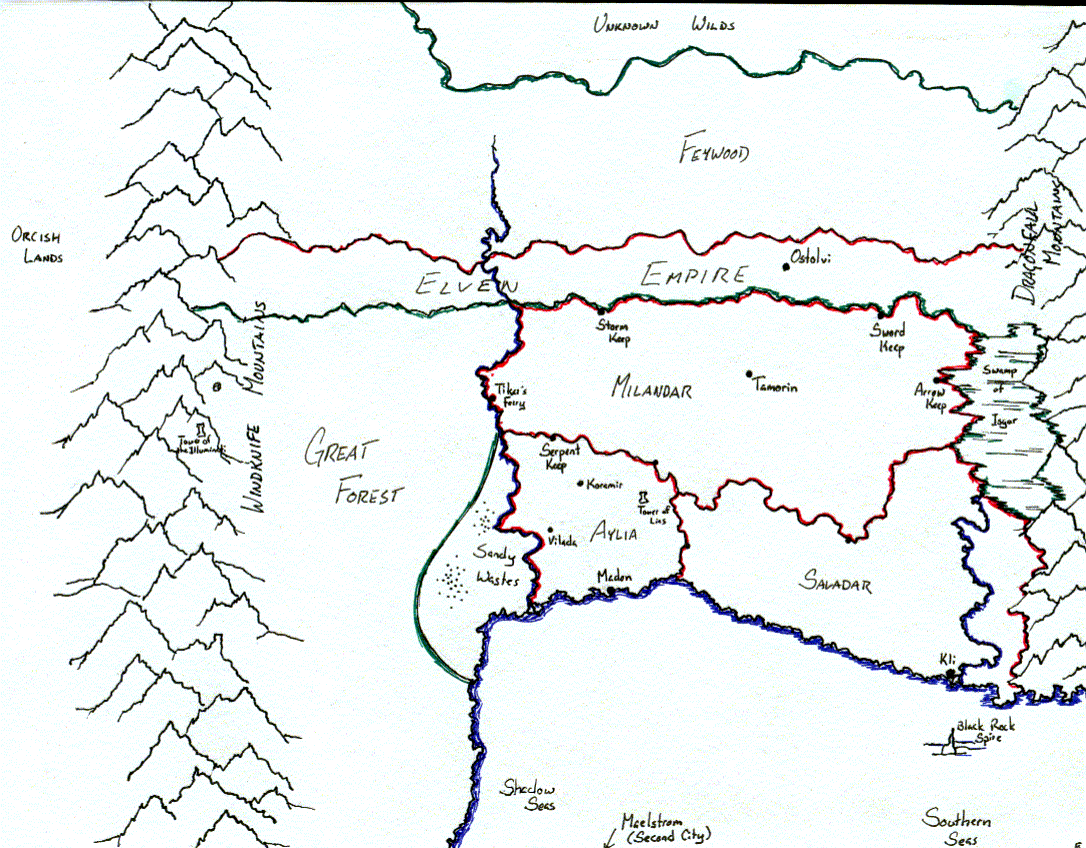
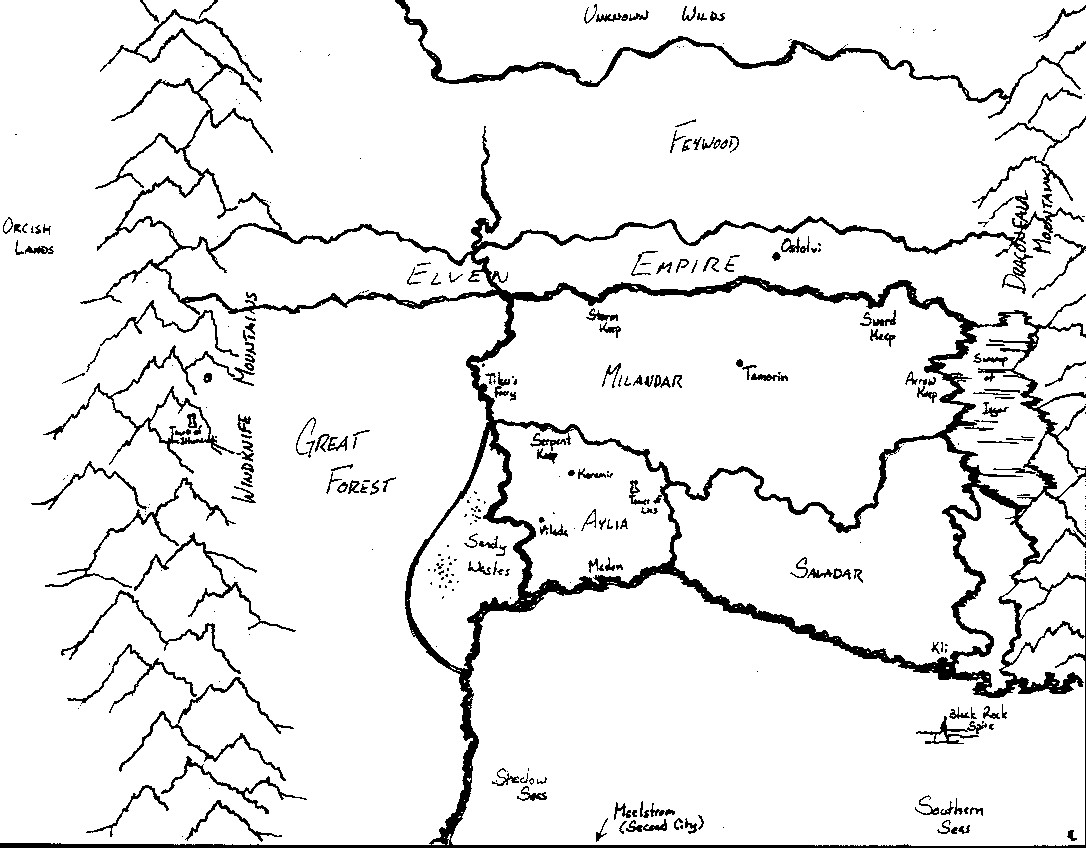
Map - (Color / B&W)
The
star of the central region is Tamorin. Its grey stone walls and magnificent
castle have rendered it impregnable to attack for generations. Its
grand temple is the home of the church of Ompos and also serves as the
center for the priesthood of Benes. Even though the populace outside
its walls are quite unwilling to accept new ideas, the city itself has
become quite cosmopolitan.
Milandar fills a roughly circular region around Tamorin, abutting Tikar's River/The Great Forest to the west (falling just short of the Windknife Mountains), the Swamp of Isgor to the east (blocking access to the Dragonfall mountains entirely), The Feywood to the north, with Alia and Salidar to the south. For now things have quieted down, by Milandar is used to being attacked from all sides. When war began with the elves and Milandar's military began buckling, Alia and the Orcish tribes both jumped on the opportunity and assaulted Milandar. For this reason Milandar has forts dotting all of its borders. The most famous of these are Fort Storm, Sword Keep, and Arith Taval (Arrow Keep in the old tongue). Closer to Tamorin, forts become less common and are replaced by small villages focused on farming, the major product of Milandar.
Alia, which usually refers to itself as the Three Empires, has been Milandar's rival for longer than the elves can remember. Alia is snuggled in between Milandar and the Windknife mountains. For generations the gentry worshipped Gomora, goddess of lies and deceit. However, during the War of Shadows, a group of Oroth's supporters within the government staged a coup and took over, enforcing Oroth worship as the state religion. Leading this movement are the Draken Knights, the core of Alia's military might. Most of the population isn't more offensive than Milandar's peasants, but the leadership is almost universially corrupt and backstabbing.
Salidar is a nation focusing so closely on trade that it barely seems to exist as a state. Hugging the coast to the southeast of Milandar, up to the Dragonfall mountains, Salidar controls the only decent ports. The guildmasters run the country, in name and truth. There is no noble class beyond the nobility of wealth. Salidar seems strangely able to get foreign goods, but no one is entirely sure from where (the best guess is sailing to the Eastern Lands) such as silk, ivory, and perfumes. They also have the market cornered on high technology, crossbows and the like. Salidar has no official religion, but worship of Tralakan, god of wealth, has begun taking off.
The Elven Empire suffered a series of terrible sleights by the agents of Milandar (kidnapping and killing the Elven King, kidnapping an ambassador and forcing him to sign a treaty, sabotaging a magical item to be used in the defense of the elven capital Ostolvi). Long ago they ruled almost the entire continent. Then, wracked by internal dissent they collapsed and pieces of their empire were snatched up by "lesser races." Now they only occupy their original home, the Feywood, stretching from Windknife to Dragonfall Moutains. They've declared a war of vengence upon Milandar and are ravaging Milandar's northern border. The elves, far more mystically adept than the average human, sneak across the border in small groups of war mages and archers. From their they destroy villages, burn homesteads, and assault minor forts. Unfortunately, they don't have the numbers to defend their land and attack the major forts at the same time.
The dwarves have never been particularly interested in what was going on with the surface world. They have more than enough problems to keep them busy. The drow, and occasionally the Illithids, attack them from below on a regular basis. The dwarven council is currently deliberating whether to close their doors to the surface world to protect them from the disaster the oracles see in the near future. Salidar is sending lobbyists, but its hurting more than helping. The only reason Salidar cares is because the dwarves are the sole source for quality metal.
Orcish clans dominate the lands west of the Windknife mountains, but are taking advantage of Milandar's weakness to rampage through the Great Forest and on to loot previously well defending villages. When not pillaging and destroying, orcs are reasonably civil. Their society is based on a loose clan structure upheld through brute force and the powers of the shamans. A few of the more powerful clans are Shadowdeath (orc spiritsummoners), Flameaxe (ogre ragers), and "The Thunderhammer Confederacy" (a loose body of three clans bent on ravaging Milandar).
The Desert Runners control the Sandy Waste with an iron fist. No one survives the wastes, but very few are stupid enough to enter in the first place. How the Desert Runners survive is a complete mystery. Even if they are entirely superior to normal humans, surely they need water. Little is known of their culture or their cities, if any exist. The only illumination provided by the ancient legends is that great stone monoliths dot the landscape of the Sandy Wastes, relics of a kingdom from long before the War of Reckoning. In fact, it was the only human kingdom to stave off elven forces while their empire was at its peak.
Major Landforms:
The
Windknife Mountains follow the north-south arm of the L all the way from
ocean to ocean. It is a thoroughly inhospitable climate, with little
food or water and freezing tempratures. Even the orcs avoid it, although
they have to pass through the mountains to raid Milandar. A few secretive
orginizations make their homes here as well, to avoid notice. Along
with the Illuminati (Gerald's group of Mentalists) and a monastary of Benes,
their is rumored to be an assassins enclave deep within the mountains.
Common encounters include Griffins, Orc raiding parties passing through
to Milandar, and Taelak (a race of gangly humanoids with buldging eyes
and dangerous claws).
Running roughly parrallel to the Windknife Mountains, the Dragonfall Mountains are home to the dwarven enclaves. However, one would never guess it walking around on the surface. Aside from guarding the great doors into each hall, they pay the surface no attention. Wyverns and goblins wander free on the surface, hunting out what meager existence they can from the rocks. The Dragonfalls are significantly more hospitable than their counterpart, but are still not a pleasant place to live. The Dragonfalls are smaller and less cragy, making travel easier, although there isn't much of anywhere to travel to. In certain areas great stone pillars and archs have formed. These can be used to channel great magical energies, but often warp its effects in a seemingly random manner.
Feywood stretches from Windknife to Dragonfall in a single, continuous mass of trees. Even clearings are rare, except when created by the elves (who use their magic to urge the trees out of the way instead of killing them). The forest itself is deep and widely unpopulated. Even at the height of the Elven Empire, one could walk from one end of the forest to the other and not see a sign of habitation. Now elves inhabit only a relitively narrow band in the southern part of the forest, mostly in scattered villages. Even the capital, Ostolvi, can be passed within a few hundred feet of without noticing anything amiss. The southern part of the forest are kept mostly clear of malevolent creatures, but spirits such as dryads, nymphs, and pixies often pester elves and others alike. The further north one gets, the more dangerous the creatures tend to become, include forest drakes (unintellegent relatives of the dragons), giant animals, and occasionally elven undead. Strange things can be found in the northern stretches of forest, relics from the ancient elven empire and weapons from their wars against the humans.
The Great Forest is formed by the rain flowing back from the Windknife mountains. The forest is actually quite small, compared to the Feywood, only a days travel across in some parts. It runs from the southern end of the Windknife mountains to where the Feywood meets the Windknifes. A strange order of unknown origin guards the forest, doing their best to keep it safe from orcs and humans alike. This group consists of rangers and druids, almost all humans. They control the northern parts of the Great Forest, but about halfway down Alia they hit a stumbling block at Spiderhaunt, the playground of an ancient elven mage. Unfortunately the orcs have been burning and destroying sections of the forest in an attempt to reduce the druid power, with some success. In order controlled Forest, most encounters are with members of the Order, forest animals, spirits (as with the Feywood, but much less common), and the occasional orish war party. The Spiderhaunt is populated by spiders of every immaginable type and is avoided by the sane and insane alike. The section further south than the spider haunt, basically the southern pennisula, is occupied by tribes of goblins and lizard men ruled over by a green dragon. It is said this dragon has the ability to warp their form to his choosing.
The Swamp of Isgor, or simply Isgor, is in a way its own nation. It is entirely controlled by the Dragon of Isgor, who answers to no other name. She lords over scattered groups of trolls and Zzalax (the lizard men's name for themselves). They worship her as a god and do her every bidding. Mostly this means not bothering her and making sure no one else bothers her. She is a very old dragon and mostly wants to sleep and ponder the nature of things, or the nature of her horde. Her worshippers and her spawn keep most intruders far away from her lair. And few can survive encounters with the denizens of the swamp she does not command, such as Mgarl, the Tentacled One. However, every so often a Knight of the Star gets it into his head that he has to slay the dragon. Sometimes they even make it to her lair, but that battle has never went well for the knight.
It is said, the Sandy Wastes were once a great human kingdom, with magic beyond the means of modern men. However, in the distant past something happened. No ones sure quite what, but in the space of a few days, there was no trace left of the civilization but their monoliths and a vast scorched wasteland. As the years progressed, sand began to dominate the ash, but patches of charred earth are still revealed now and again. Very rarely do people see reason to enter the Sandy Wastes. The natives are extremely hostile, the environment is deadly, and any creature that can survive with the Desert Runners around is something to fear. Still some go to the desert with hopes of unraveling the secrets of the Monoliths or just exploring. No one entering the desert for more than a day has returned for almost a hunded years.
The
Central Plains are the hub of human civilization in this region.
All three human nations rest in the plains, with Alia and Salidar getting
soil thats slightly off. Sandy and rocky respectively. Milandar
really got the upside on this one. Regardless of that, the plains
form a shallow basin between the mountains and provide something of a complacancy.
"Well, it could be a lot worse. Look at all these terrible places
around me." is a common train of thought amoung peasants in this area.
This is one of the major tools used to create the fuedal system seen in
Tamorin and Alia. Most encounters in the plains are with humans,
travellers or isolated homesteads. The more the war heats up, drawing
forces out of the interior, the more monsters will come out of hiding and
begin attacking the populace.