In their hunting days, the Navajos had worn clothing made of animal skins and plant fibers. They both wore sandals, leggings and woven-fiber yucca blankets. The Hopi had taught them how to weave cotton and wool. They stopped using the woven fiber (yucca) clothes. In the late 1800s women wore Europeans looking clothes. The Indians copied their clothes and bought cloth from traders. Both men and women wear a velveteen blouse held in at the waist with a belt of silver disks, called conchas. Men wore cotton pants. The women's cotton and rayon skirts are long and full. Both men and women twist their long black hair into a knot at the back, called a chonga. Men tie a kerchief about their heads. For warmth women often wore mantas tied over their shoulder and around their waist. Mantas were hand woven rectangular pieces of cloth.
The Navajos learned silverwork from the Mexicans. Their jewelry is decorated with native turquoise stones.
For more information on clothes:
REGIONAL OVERVIEW OF NATIVE AMERICAN CLOTHING STYLES
: Southwest Region
Regional Overview of Native American Clothing and Regalia
Map of North America with Native American Varieties of Moccasins
NATIVE AMERICAN CLOTHING Overview of Footwear: Moccasins
NATIVE AMERICAN CLOTHING Leather Bags and Pouches
Tanning Deer Hides and Small Fur Skins
|
Shelters:
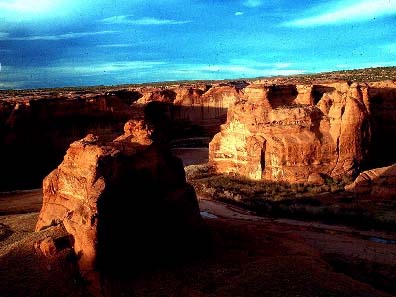
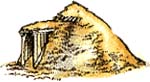
The Navajos traveled most of the time. They did not build villages. Each family had winter and summer homes, called hogans, along the route. The hogans were made of logs, earth, and rocks. Hogans were cone or dome shaped round houses built at the base of cliffs or canyons. They made trips to the mountains to get pinon pine trees to frame their hogan, which they covered with mud and clay. Years later the hogans were coved with stone or adobe rather than the bark. The doorways of hogans always faced east.
Hogans were built far apart because food and later grazing land was spread over a wide area. When it was very hot some families left their hogan and moved into temporary homes that they made of pointed timbers pushed into the ground and covered the roof with sage and desert brush leaving the sides open.
|
Transportation:
After the Spanish brought horses to the area the Navajo used them for transportation.
Literature - To understand more of the culture of the Navajo people read an original story by clicking on the following site.
Site for Literature:
Erwin Tso - Din storyteller
The Navajo Today
2000 Population
In the 1990 US census there were 225,298 Navajo living in the United States.
Social Studies- Reservation Locations:
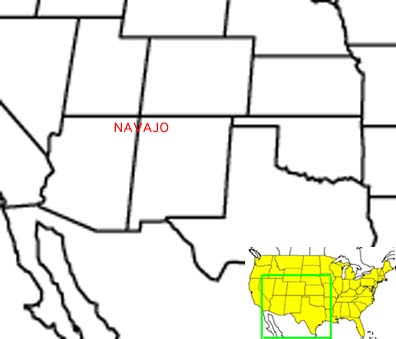
Many of the Navajos live on the Navajo Indian Reservation that is located in Arizona, New Mexico and Utah. This reservation is the largest in the United States. New Mexico also has 2 smaller reservations. They are the Canoncito and Ramah.
All of the Navajos do no not live on reservations.
Site for school on a reservation or in the area that has Native American Students:
Dilcon School is a Kindergarten through Eighth grade facility located on the Navajo reservation
For more information on the Navajo:
Encyclopedia Britannica: Navajo
Navajo Sites