Solar, Wind and Tidal Powered Cell.
Made by Abhishek Dey Das and Aveek
Mukherjee for Kendriya Vidyalaya Science Exhibition.
Introduction
Today’s
world is useless without energy. The trains, planes, computers and other
modern gadgets and devices require electricity, the concept of
which has been prevalent since 150 BC when the Hero Reaction was
performed. Our cars, buses and modern means of transport all require
petroleum to run. Most of these are run on conventional sources of energy
because it is cheap and easily available. But the de-merits brought in the
train of conventional source of power is often overlooked.
So what
exactly are the de-merits of using a conventional source of energy? Let’s
take a glance……
De-merits of Diesel Power:
1)the cost of fuel is high.
2) comparatively high plant costs per kilowatt.
3) Site should be near sources of fossil fuel,
Health Hazard due to exposure to Total Petroleum Hydrocarbons (TPH):
Health effects from exposure to TPH depend on many factors. These
include the types of chemical compounds in the TPH,
how long the exposure lasts, and the amount of the chemicals contacted.
Very little is known about the toxicity of many TPH compounds. Until
more information is available, information about health effects of TPH must
be based on specific compounds or petroleum products that have been studied.
The compounds in different TPH fractions affect the body in different ways.
Some of the TPH compounds, particularly the
smaller compounds such as benzene, toluene, and
xylene
(which are present in gasoline), can affect the human central nervous
system. If exposures are high enough, death can occur. Breathing
toluene at concentrations greater than 100 parts per million (100 ppm) for
more than several hours can cause fatigue, headache, nausea, and drowsiness.
When exposure is stopped, the symptoms will go away. However, if
someone is exposed for a long time, permanent damage to the central nervous
system can occur. One TPH compound (n-hexane) can affect the central
nervous system in a different way, causing a nerve disorder called
"peripheral neuropathy" characterized by numbness in the feet and
legs and, in severe cases, paralysis. This has occurred in workers exposed
to 500–2,500 ppm of n-hexane in the air. Swallowing some petroleum
products such as gasoline and kerosene causes irritation of the throat and
stomach, central nervous system depression, difficulty breathing, and
pneumonia from breathing liquid into the lungs. The compounds in some
TPH fractions can also affect the blood, immune system, liver, spleen,
kidneys, developing fetus, and lungs. Certain TPH compounds can be
irritating to the skin and eyes. Other TPH compounds, such as some
mineral oils, are not very toxic and are used in foods.
One TPH
compound (benzene) has been shown to cause cancer (leukemia) in people.
The International Agency for Research on Cancer (IARC) has determined that
benzene is carcinogenic to humans (Group 1 classification). Some other
TPH compounds or petroleum products, such as benzo(a)pyrene and gasoline,
are considered to be probably and possibly carcinogenic to humans (IARC
Groups 2A and 2B, respectively) based on cancer studies in people and
animals. Most of the other TPH compounds and products are considered
not classifiable (Group 3) by IARC.
Usually
coal used to produce electricity could be of any type. Types such as
bituminous coal may contain fossil of ancient animals and may be lost while
making coal. But that’s not the greatest immediate threat to us. Let’s
take a look at the graph below:
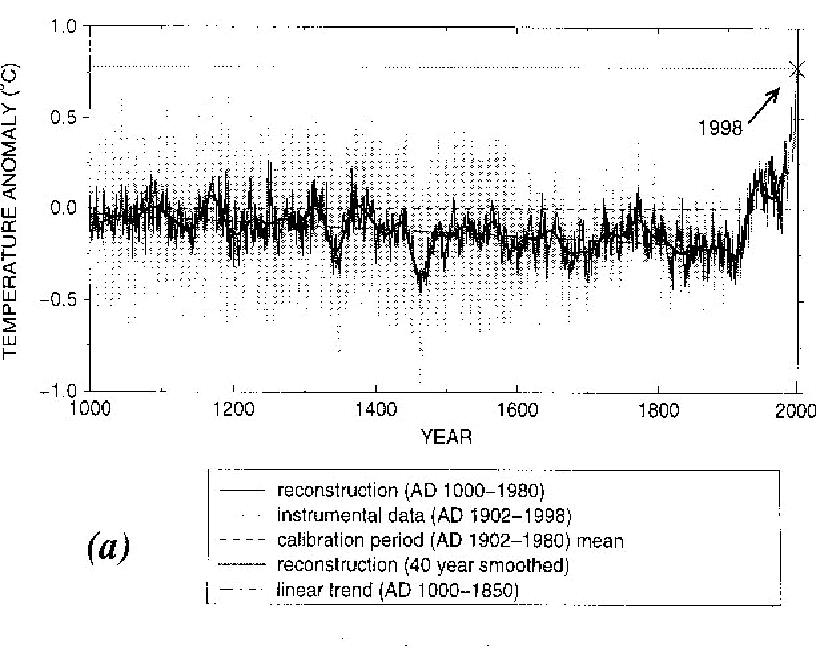
The graph
shows the average temperature of the northern hemisphere over the past 1000
years. During the first 800 years, the graph shows a gradual decrease, which
is thought to have been caused by the way the tilt in the Earth's axis
changes in relation to the Sun and the Earth's orbit around the Sun. The
last 100 years show a sudden increase in temperature which is attributed by
many to greenhouse gases.
Global
warming is usually caused by green house gases such as water vapor, carbon
dioxide, methane, and then other lesser greenhouse gases (in the decreasing
order of their magnitude). Since in a fossil fuel powered form of
electricity, coal is burnt to heat water so that it can turn a turbine,
there should be no problem in guessing from where all the green house gases
come from. Let’s look at the temperature variation curves for the last 140
and 1000 years.
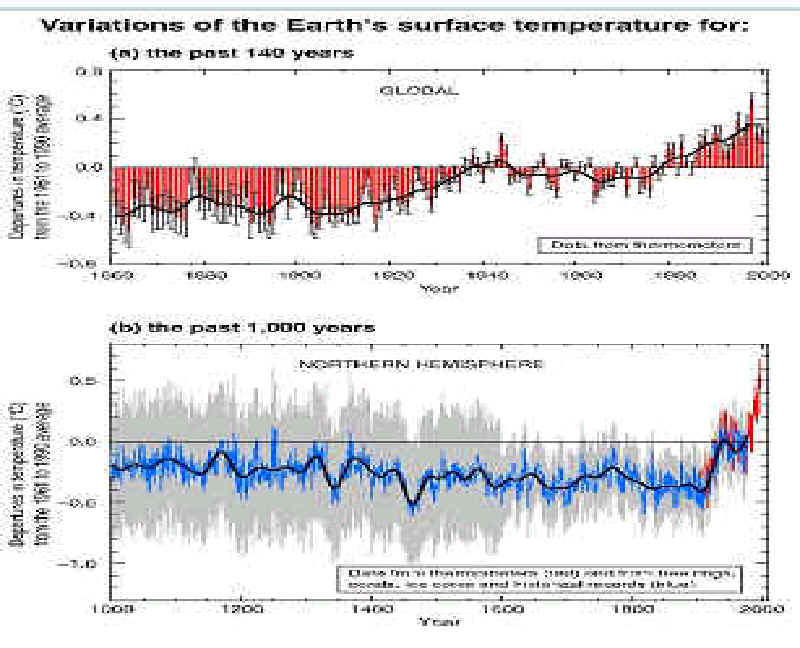
These
graphs show a very discernable warming trend, starting in about 1900. It
might seem a bit surprising that warming started as early as 1900. How is
this possible? The reason is that the increase in carbon dioxide actually
began in 1800, following the deforestation of much of Northeastern American
and other forested parts of the world. The sharp upswing in emissions during
the industrial revolution further added to this, leading to a significantly
increased carbon dioxide level even by 1900.
Thus, we
see that Global Warming is not something far off in the future - in fact it
predates almost every living human being today.
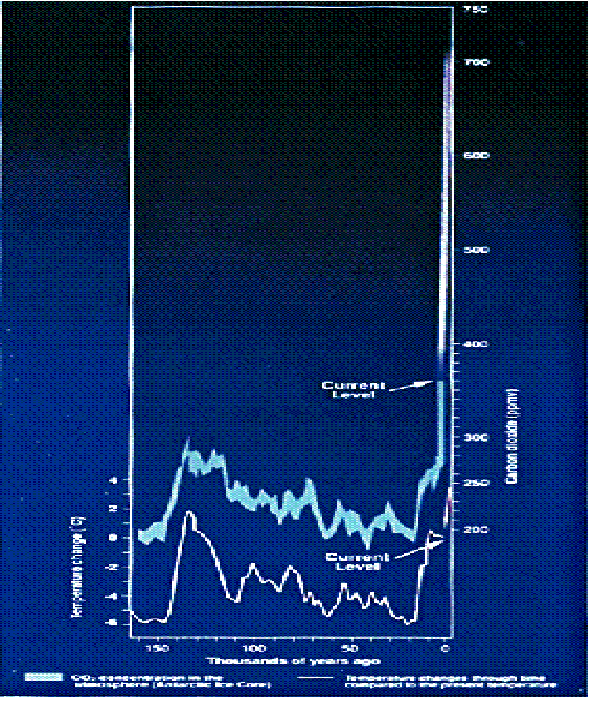
Let’s
take a look at another graph showing the in pour of CO2 (carbon di oxide)
and one of the primary factors of which is
burning of coal to produce electricity.
The solution to all the above problems is of course a non-conventional source
of electricity. Our country has been
blessed by many sources of non-conventional energy, which if properly
trapped can work wonders. To name a few, there are solar energy, tidal
energy, bio-gas energy, wind energy and others. Efforts have already been
made and is even being made on a daily basis to utilize these to the
fullest. But no single conventional energy can provide or supply electricity
continuously twenty-four hours a day because there might be not enough wind
to rotate the blades of a wind-mill or no solar energy at night. So, the
most prudent possibility is then to go back to the conventional fossil fuels
for electricity.
Our project
deals with making electricity from non-conventional sources and supplying
the electricity continuously for twenty-four hours. Electricity generated
from a single source will never be able to do this, so the next possibility
is to combine different sources. That will allow supply of power for the
whole day and we would be looking towards a greener, better and pollution
free world.
SWT includes
Solar, Wind and Tidal Powered Cells all combined together.
Solar Energy
Converting
Photons to Electrons
The solar
cells that you see on calculators and satellites are photovoltaic cells or
modules (modules are simply a group of cells electrically connected and
packaged in one frame). Photovoltaics, as the word implies (photo = light,
voltaic = electricity), convert sunlight directly into electricity. Once
used almost exclusively in space, Photovoltaics are used more and more in
less exotic ways. They could even power your house. How do these devices
work?
Photovoltaic
(PV) cells are made of special materials called semiconductors such as
silicon, which is currently the most commonly used. Basically, when light
strikes the cell, a certain portion of it is absorbed within the
semiconductor material. This means that the energy of the absorbed light is
transferred to the semiconductor. The energy knocks electrons loose,
allowing them to flow freely. PV cells also all have one or more electric
fields that act to force electrons freed by light absorption to flow in a
certain direction. This flow of electrons is a current, and by placing metal
contacts on the top and bottom of the PV cell, we can draw that current off
to use externally. For example, the current can power a calculator. This
current, together with the cell's voltage (which is a result of its built-in
electric field or fields), defines the power (or wattage) that the solar
cell can produce.
That's the
basic process, but there's really much more to it. Let's take a deeper look
into one example of a PV cell: the single crystal silicon cell.
Silicon in
Solar Cells
Silicon has
some special chemical properties, especially in its crystalline form. An
atom of silicon has 14 electrons, arranged in three different shells. The
first two shells, those closest to the center, are completely full. The
outer shell, however, is only half full, having only four electrons. A
silicon atom will always look for ways to fill up its last shell (which
would like to have eight electrons). To do this, it will share electrons
with four of its neighbor silicon atoms. It's like every atom holds hands
with its neighbors, except that in this case, each atom has four hands
joined to four neighbors. That's what forms the crystalline structure, and
that structure turns out to be important to this type of PV cell.
We've now
described pure, crystalline silicon. Pure silicon is a poor conductor of
electricity because none of its electrons are free to move about, as
electrons are in good conductors such as copper. Instead, the electrons are
all locked in the crystalline structure. The silicon in a solar cell is
modified slightly so that it will work as a solar cell.
Our cell
has silicon with impurities -- other atoms mixed in with the silicon atoms,
changing the way things work a bit. We usually think of impurities as
something undesirable, but in our case, our cell wouldn't work without them.
These impurities are actually put there on purpose. Consider silicon with an
atom of phosphorous here and there, maybe one for every million silicon
atoms. Phosphorous has five electrons in its outer shell, not four. It still
bonds with its silicon neighbor atoms, but in a sense, the phosphorous has
one electron that doesn't have anyone to hold hands with. It doesn't form
part of a bond, but there is a positive proton in the phosphorous nucleus
holding it in place.
When energy
is added to pure silicon, for example in the form of heat, it can cause a
few electrons to break free of their bonds and leave their atoms. A hole is
left behind in each case. These electrons then wander randomly around the
crystalline lattice looking for another hole to fall into.
These
electrons are called free carriers, and can carry electrical current. There
are so few of them in pure silicon, however, that they aren't very useful.
Our impure silicon with phosphorous atoms mixed in is a different story. It
turns out that it takes a lot less energy to knock loose one of our
"extra" phosphorous electrons because they aren't tied up in a
bond -- their neighbors aren't holding them back. As a result, most of these
electrons do break free, and we have a lot more free carriers than we would
have in pure silicon. The process of adding impurities on purpose is called
doping, and when doped with phosphorous, the resulting silicon is called
N-type ("n" for negative) because of the prevalence of free
electrons. N-type doped silicon is a much better conductor than pure silicon
is.
Actually,
only part of our cell is N-type. The other part is doped with boron, which
has only three electrons in its outer shell instead of four, to become
P-type silicon. Instead of having free electrons, P-type silicon
("p" for positive) has free holes. Holes really are just the
absence of electrons, so they carry the opposite (positive) charge. They
move around just like electrons do.
So where
has all this gotten us? The interesting part starts when you put N-type
silicon together with P-type silicon. Remember that every PV cell has at
least one electric field. Without an electric field, the cell wouldn't work,
and this field forms when the N-type and P-type silicon are in contact.
Suddenly, the free electrons in the N side, which have been looking all over
for holes to fall into, see all the free holes on the P side, and there's a
mad rush to fill them in.
Before now,
our silicon was all electrically neutral. Our extra electrons were balanced
out by the extra protons in the phosphorous. Our missing electrons (holes)
were balanced out by the missing protons in the boron. When the holes and
electrons mix at the junction between N-type and P-type silicon, however,
that neutrality is disrupted. Do all the free electrons fill all the free
holes? No. If they did, then the whole arrangement wouldn't be very useful.
Right at the junction, however, they do mix and form a barrier, making it
harder and harder for electrons on the N side to cross to the P side.
Eventually, equilibrium is reached, and we have an electric field separating
the two sides.
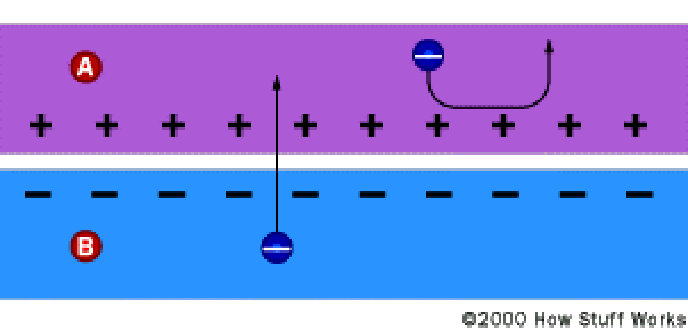
The effect
of the electric field in a PV cell
This
electric field acts as a diode, allowing (and even pushing) electrons to
flow from the P side to the N side, but not the other way around. It's like
a hill -- electrons can easily go down the hill (to the N side), but can't
climb it (to the P side).
So we've
got an electric field acting as a diode in which electrons can only move in
one direction. Let's see what happens when light hits the cell.
When Light
Hits the Cell
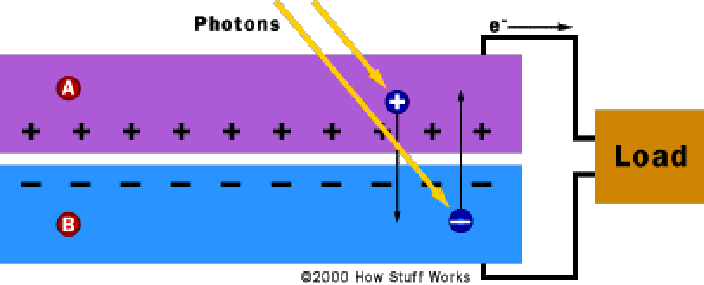
When light,
in the form of photons, hits our solar cell, its energy frees electron-hole
pairs.
Each photon
with enough energy will normally free exactly one electron, and result in a
free hole as well. If this happens close enough to the electric field, or if
free electron and free hole happen to wander into its range of influence,
the field will send the electron to the N side and the hole to the P side.
This causes further disruption of electrical neutrality, and if we provide
an external current path, electrons will flow through the path to their
original side (the P side) to unite with holes that the electric field sent
there, doing work for us along the way. The electron flow provides the
current, and the cell's electric field causes a voltage. With both current
and voltage, we have power, which is the product of the two.
How much
sunlight energy does our PV cell absorb? Unfortunately, the most that our
simple cell could absorb is around 25 percent, and more likely is 15 percent
or less. Why so little?
Energy Loss
Why does
our solar cell absorb only about 15 percents of the sunlight's energy?
Visible light is only part of the electromagnetic spectrum. Electromagnetic
radiation is not monochromatic -- it is made up of a range of different
wavelengths, and therefore energy levels. (See How Special Relativity Works
for a good discussion of the electromagnetic spectrum.)
Light can
be separated into different wavelengths, and we can see them in the form of
a rainbow. Since the light that hits our cell has photons of a wide range of
energies, it turns out that some of them won't have enough energy to form an
electron-hole pair. They'll simply pass through the cell as if it were
transparent. Still other photons have too much energy. Only a certain amount
of energy, measured in electron volts (eV) and defined by our cell material
(about 1.1 eV for crystalline silicon), is required to knock an electron
loose. We call this the band gap energy of a material. If a photon has more
energy than the required amount, then the extra energy is lost (unless a
photon has twice the required energy, and can create more than one
electron-hole pair, but this effect is not significant). These two effects
alone account for the loss of around 70 percent of the radiation energy
incident on our cell.
Why can't
we choose a material with a really low band gap, so we can use more of the
photons? Unfortunately, our band gap also determines the strength (voltage)
of our electric field, and if it's too low, then what we make up in extra
current (by absorbing more photons), we lose by having a small voltage.
Remember that power is voltage times current. The optimal band gap,
balancing these two effects, is around 1.4 eV for a cell made from a single
material.
We have
other losses as well. Our electrons have to flow from one side of the cell
to the other through an external circuit. We can cover the bottom with a
metal, allowing for good conduction, but if we completely cover the top,
then photons can't get through the opaque conductor and we lose all of our
current (in some cells, transparent conductors are used on the top surface,
but not in all). If we put our contacts only at the sides of our cell, then
the electrons have to travel an extremely long distance (for an electron) to
reach the contacts. Remember, silicon is a semiconductor -- it's not nearly
as good as a metal for transporting current. Its internal resistance (called
series resistance) is fairly high, and high resistance means high losses. To
minimize these losses, our cell is covered by a metallic contact grid that
shortens the distance that electrons have to travel while covering only a
small part of the cell surface. Even so, some photons are blocked by the
grid, which can't be too small or else its own resistance will be too high.
Finishing
the Cell
There are a
few more steps left before we can really use our cell. Silicon happens to be
a very shiny material, which means that it is very reflective. Photons that
are reflected can't be used by the cell. For that reason, an antireflective
coating is applied to the top of the cell to reduce reflection losses to
less than 5 percent.
The final
step is the glass cover plate that protects the cell from the elements. PV
modules are made by connecting several cells (usually 36) in series and
parallel to achieve useful levels of voltage and current, and putting them
in a sturdy frame complete with a glass cover and positive and negative
terminals on the back.
Next Page>>