
Created� �������� : 11 may 20001
Last updated� : 12 may 2001
Classification : General procedure
Copyright ���� : Restricted freeware
Status : Being created, updates imminent.
Comments : Copyright photo's still needs acceptance

In this particular field of small craft sailing all boat types are equal and sometimes the newest and best boat is the worse to sail. Many small craft can be seen to sail through a surf. Most common are Beach catamarans and small monohulls like the 420 and 470 and skiffs like monohulls like the 49-er and laser 2000. Each type of craft wil require its own specilized methode of negociating the surf. My personal experience is limited to beach catamarans, so this document will only deal with the methodes used on these craft. I would very much like to expand this document to dinghies and skiffs, but I need an experienced sailor of those types for that; any offers are very welcome.
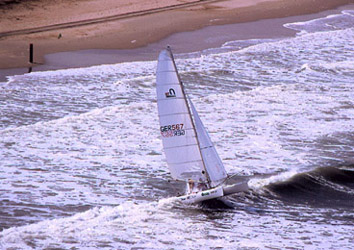
The effect that a shoreline has on a wave travelling towards a shoreline can be described in general by :
* The wave is slowed down. This is caused by the fact that waves travel slower in shallow
water than the do in deep water.
* The direct effect of slowing down a wave is that is that its wave length is shortend, thus
the waves are closer together.
* The direction in which the wave is travelling is skewed towards the the shoreline. The end
result is that waves are always hitting the beach perpendicular the shoreline.
* The perfect cycloidal wave shape is altered in to a more rounded off pyramid shape which
sides are getting more and more steep untill the wave eventually looses stability and breaks
up in foam and falling water. A wave in this final stage, curling up crashing into itself, is
often called a breaker.
All these effects are caused by the sea bed rising up to surface level thus decreasing water depth. Additional effects can be caused by undercurrents, nearby jetties, and many other factors. Even though the effects of these factors can be small when compared to the first four effects, not being aware of them can bring a sailor into a tight spot.
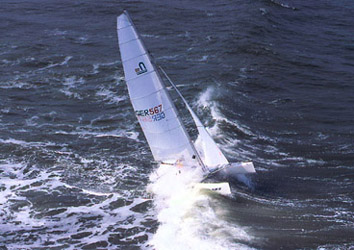
In general the difficulties or problems are :
* You're starting out in shallow water, thus you rudders are trailing behind your craft in a
position that makes steering with your rudders very heavy and cumbersome.
* Boarded catamarans are unble to set their boards fully thus further limiting your steering
ability. The steering of a boarded cat with your rudders is fully determined by the having
rudderblades set as well as your boards. Setting one without the other is useless.
* The powerfull waves in the surf are hammering you and your boat and are preventing you
from doing complicated boathandling or picking up speed. The last is further limiting the
steering effect of your rudders.
* The height difference between the trough and tip of wave, much exaggerated by the
shortening of the wave length, is lifting one side of your catamaran while lowering the
other side, thus possibly tipping you and your boat over.
* When goin out and a wave is steep enough it will push you and your boat a meter or two
back. This can lock up your kickup rudders between the underground and your sterns and
and break them. The same can happen with pivoting boards. Both daggerboards and
pivoting boards will also suffer when being pushed away sideways.
* When sailing back to the shore and you're surfing of a wave too fast, then your bows can
burry themselfs into the underground due to an extremely shallow trough. This alsways
ends up in a cartwheel or a lighting fast 180 degree turn mostly with damage to crew and
craft.
* When landed on the shore an oncomming wave can smash into your sterns and break your
rudder hardware
* Prior to setting off the bows need to be pointed into the direction of the surf. Holding
down the craft can now be a tough job when a strong (gusty) wind is blowing from the
land to the sea.
* Stepping of the boat and holding her down right after comming to a full standstill after
landing can be a tough job too when a strong (gusty) sea breeze is blowing.
It will be clear enough that there are more than enough problems to be faced and tackled when sailing the surf and that the circumstance are severly limiting actions to choose from and the time to do them in. And this is even made more extreme by the fact that errors are often heavily punished and that it is very difficult to build up "surf time". The best approach will therefor be to familiarize yourself with the general behaviour of the surf by studying it and to determine proven methodes of surf sailing for your particular type sailing craft as discovered by others. Some of those methodes are described here.
* Boat speed is very important if not all important.
* Runner up is proper (weight) balance.
* Third is "a little bit of steering"
* Fourth. ... There is no fourth factor; your time is up and you have no attention span left.
All other things, and ALL others things are meant here, are set on the beach and left as is untill you're free of the surf or have landed.
Things like properly set your main traveller, downhaul or jib are done on the beach and not in the surf. Being forced to do this in the surf means that you've made an error on the beach and are paying for it in the surf.
Which elements should be handled by
The skipper :
* The mainsheet (not the traveller)
* The joystick (is far perferred over the tillers or crossbar bar)
* The position of his weight on the craft
The crew :
* The position of his weight on the craft
* The centre- or daggerboards (mostly exclusively the luff board)
* His eyes and mouth. To warn off swimmers, other boats or his own skipper.
On solo boats all these must be handled by the skipper.
It needs to be underlined for extra clearity that (setting the) the rudder is NOT named in the list above. Nor is sheeting the jib. These both are often done by inexperienced crews and can easily do more harm then good. At best these activity waste valuable time or effort.
The first "setting your rudders" is at best a nice to have but mostly useless for it is very likely to kick-up anyway at the next sandbar anyway. And it is creating over dependence on rudders for steering. Not to mention that some cleating mechanisms are difficult to engage. One should learn to work the sails in combination with rotating the trailing rudderblades to steer the boat through the surf. The last methode is the only methode to steer over a semi submerged sandbar (without stepping of the boat). This can not be underlined enough. Leaving the rudders cleated in their "Save" and "Out of the water" position is just as big a "don't" as prematurely setting them.
Secondly, don't adjust the jib unless to avoid a total calamity. When a skipper is using his mainsail (mainsheet) to steer the boat than the thing NOT to do as a crew is to (un) sheet the jib. It is the position of both sails relative to eachother that steers the boat and two sailors holding the same tiller doesn't work either. And a properly set jib is preventing the boat from rounding up into a forced tack.
Another obvious big "don't" in the surf is performing complex manouvres. In order of magnitude of "DON'T" :
* Tacking
* Gibing
* Sailing around a swimmer or pedestriant walking on a sandbar.
* Giving right of way to another boat.
* Changing course relative to the wind (The chosen and set course when leaving the shore)
It seems very obvious to all but it is surprising how many sailors "give it a go" anyway; this despite many warnings.
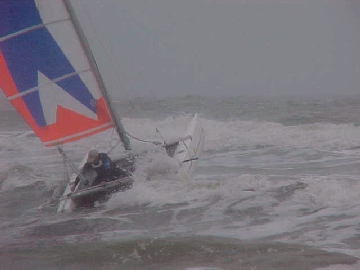
Study the surf, try to determine where the sand bars are and especially where the gaps between them are. Determine on which spots the waves break. Do the wave start breaking on one end and slow break all the way to the other side or do they suddenly break as a whole ? Determine the direction the waves travell outside the surf. What is the wind direction. Look for jetties and concentrations of other shoreline users. Look at other boats leaving and how much time they need to arrive at the danger spots and how much time they need to cross these areas. With this information you will have a pretty good idea of to expect and what needs to be done at which particular spot. Talk about it with your crew, so that you'll know what each one knows what he can expect from the other. Don't plan however, nearly all plans fail after the first wave. Keep is general. Decide on with tack you'll sail the surf and the whole the surf.
Step 2 : Prepare the boats.
Prepare the boat. The boat is already rigged, preparing it means tidy things up and setting control lines. Lay in the area where the water occasionally washes around the boat. The bows are still facing the wind. Uncleat the rudders from their secure positions. Lay the joystick on the "luff side to be" of the boat. put the boards in their wells. Set all trimming lines for the intended sailing course with the exception of the downhaul. That one is left free and only set right before leaving to prevent dancing of the boat in heavy wind. Set the main traveller somewhere halve way between a close reach and broad reach setting. The idea is to sail with alot of twist in your mainsail. This way you'll have the most power with only little (forward and sideways) heeling and you're able to luff by sheeting in and bear off by sheeting out. On which side of halve way you place it is determined by the sailed course. Unfurl the jib and set both travellers of the jib for the intend course. You set them both just in case a tack is forced on you. Imagine when "the other one" is set for a broad reach and a tack is forced on you. You'll be in irons right smack in the middle of the surf, probably sailing backwards. Luffing the jib as a remedie is no alternative. Set the downhaul. Walk the boat a little bit further into the water turn it away from the wind just a little and set the jib. Don't let it float. Do a quick scan of the surf.
Step 3 : setting off
Walk to your positions. Crew on the luff side and on the outside of the boat, either near the bridles or forebeam. The skipper is also on the luff side just before the rearbeam. The skipper picks up the joystick and the mainsheet in one hand and never let them go from now on. His most forward hand is free to push. Do one very last quick scan, choice a the right time to start and push the boat around and into the water. Beware of the the sails kicking in once you bear away further. The crew lets the forebeam pass and jumps on the boat back and buttocks first and turns around so that he faces forward. He immediatly moves forward right up too the forebeam. The skipper does the same. Don't step on or kneel on to the boat, you're in danger of falling off when the boat jumps up of speeds up. Once on the boat it is accpetable to go onto your knees for extra flexibility. Trade off is however an increased risk of sliding off.
Step 4 : Sailing the surf
Sheet in al little, power up, push the luff board down about 10 inches and pick up as much speed as you can. Keep looking at the oncomming waves and decide if you can make it or not. Maintain speed or slow down accordingly. A wave just before breaking is most dangerious. A breaking wave with allready a large amount of foam looks dangerous but is almost harmless. Blast through the last. Make sure that both bows hit a wave almost simultaniously. When this forces you to sail a very close hauled reach, only steer up before a wave hits and bear away right after hitting it. In short start sailing S curves through the trough and over the wave. The trick is to steer up in such a way that the impact of the wave is minimized and the end result is that the wave has pushed you back on your old heading. This can be done quite well. When you master this you'll only have to perform one slow steering manouvre while crossing the trough. Once again, use both your mainsheet and joystick simultaniously to steer the boat. Keep looking ahead and just let your rudders trail behind you through the water. Your crew should push your board down just a little more when you're sure that their is enough water below the luff hull for the rest of the way. When it does hit bottom, then crew repositions himself a bit order to lift your luff hull just a little. Your crew can now pull the board a little up or you can gamble that is was just a small sandbar and let it be. Your crew is doing the most repositioning on board. It is his task to use his weight to counter the effects of waves and wind. As a side task he has the setting of the luff board. The skipper doesn't touch this one. He only handles the joystick and the mainsheet. Never ever sit aft on the boat as a skipper, you have a joystick so move forward.
Step 5 : finishing the job
Once you have cleared the surf you slowly head up leaving your sails as they were. The sails will most likely be in parking configuration. Keep your rudders rotated. When done right you'll end up in parking the catamaran. this is the time for the crew to set the daggerboards first and for the skipper to set both rudders properly. Keep your rudder rotated through out these actions. Bear off when everything is fixed and set. Speed up so that your rudders start working properly. Sheet your traveller to its required position. Crew is allready hooking himself onto the trapeze by now. Sheet in, crew moves out, you hook on and sheet in while you move out. And off you go !!!
This concludes the basic procedure for sailing through a surf. The next paragraphs will elobarate on tricks, points of caution, consequences of failing to following the layed down procedure and general comments with respect to certain designs.
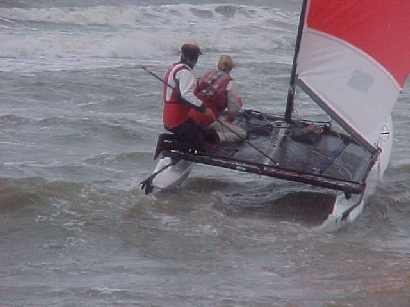
* The main traveller is set right, the mainsail is sailed with alot of twist.
* The skipper is handling both mainsheet and joystick in combination with eachother.
You can he has just pulled on the mainsheet while turning his rudders to luff the boat.
* Both the skipper and crew are facing forward anticipating the next wave and how to
cross the sandbar in front of them.
What is the crew on the Hobie 16 doing wrong.
* The lee rudder is still cleated in its save position. This is called the "luff rudder variant"
of the ideal procedure described in this document. It is not totally wrong but it would
have been wiser to uncleat it too and gain extra steering by letting both rudders trail
behind the boat.
* The would do better to sit on the boat and not kneel to way he is doing right now. A
big wave crashing into him will likely throw him of the boat leaving his crew alone in
the surf. The best position is to sit rather forward on the trampoline with the right leg
stretched and the left leg folded under the right leg. This he is sitting rather firm and is
still able to get up on one knee in order to move around on the boat.