| Sail force vectors while sailing. |
| Introduction |
| This particular HTML page is intended as an overview on which forces are produced by sails on a sailing craft. This also incorporates how these forces change when speeds or angles of attack change. No assumptions what so ever are made about the kind of sailing craft that is analyzed here. This means that it is applicable to all sail crafts that produce direct thrust by passive manipulation of airflow around them. Under this definition fall : both soft and hard yachtsails, landyacht sails, surf sails, rotary tube sails (Magnus effect) and even to a large extend power kites. Windmills or transmission based devices like the Darrieux rotors are not included. The differences between the different sail craft is only in the magnitude and ratios of the produced vectors (forces); the directions are the same for all. So the vectors (forces having a working direction as indicated by an arrow) are correct for all craft except in their magnitudes and ratios. Knowlegde of the behaviour of these vectors is very helpfull at understanding what sheeting policy is best for your particular sail craft and understanding it well will help improving your sailing skills. I refer to sailcraft specific documents or webpages when accurate magnitudes and ratios are of interest. Especially ratios can have a big impact on the actual behaviour of a particular sailing craft. |
| Document data By : Wouter Hijink Created : 26 april 2001 Last update : 23 july 2001 Classification : General overview Copyright : Restricted freeware Status : Added paragraph on using the WB-sails Ltd ; SailpowerCalc applet Comments : Exists only as a HTML webpage. |
| Related links |
 |
| Understanding the drawings |
| The drawings are largely self explanatory. However a few comments about the presentation could be very helpfull. The intermitted line consisting of dots and stripes is used to represent the course sailed relative to the wind. This does not always have to be course that is steered. On a landyacht these two will probably be the same, but boats always experience a sideways slipping. So with boats the line represents the course which is actually travelled when adding the forward motion and the sideways motion. The wind is represented by the vertical black vector. The airflow caused by the forward motion of the craft itself is represented by the other black vector which always lies along the intermitted line. These two together will result in the actual airflow over the sails. This actual airflow is represented by the blue vector and is the same in direction and magnitude for all sailing craft. The little yellow line is used to represent a sail sheeted at a unspecified angle or a kite flying under a particular angle relative to the travelled course. And the two red vectors which complete the drawings respresent the Lift vector and the Drag vector. The lift vector is always perpendicular to the actual airflow and the Drag vector is always parallel to the airflow and pointing in the same direction as the airflow is flowing. This is true to a basic scientific convention and is the same for all aerodynamic devices of which a sail is just one particular implementation. This means that this too is the same for all sailing craft. Often the two vectors called aerodymamic Lift and aerodynamic Drag are broken down in components that lay along the intermitted line and other components that are perpendicular to this intermitted line. These conponents are vectors themselft and can be added to arrive at two new vectors which represent thrust and a another sideways force that causes the heeling on most sail craft. Once again the differences between different types of sailing craft is solely in the magnitudes of the two red vectors and there for in the ratio between the two. The magnitudes are determined by two parameters called C lift and C drag and a equation containing the density of air, the surface area of the sail device the constant 1/2 and the velocity of the airflow squared. In most implementations of "sails" all parameters or variables but C lift and C drag are constant and the same for all sailing craft. And this is also why the document is classified as a General overview. It needs to be underlined however that the C lift and C drag are rarely constant under changing conditions and can differ alot from one sailing craft to another |
| A closed hauled course, going windward under an angle |
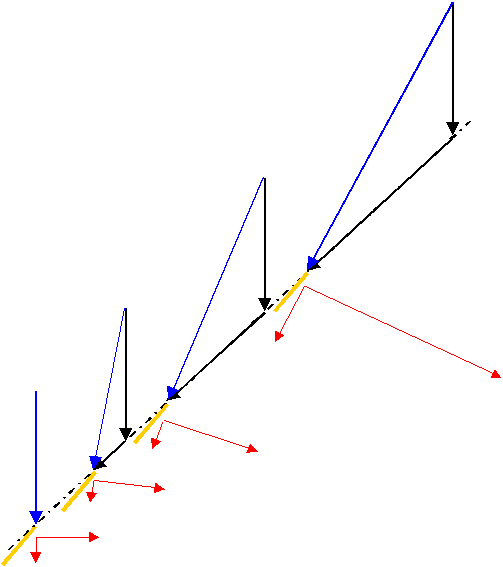 |
| It will be evident from these drawings that on this particular course a sailcraft produces only a little thrust when compared to the total sideways pointed force. It can also be seen that with increased speed both vectors increase in magnitude when compared to the same vectors at lower speeds or the craft. The vectors also rotate backwards with increased speed. These two tendencies results directly in a speed where, when both the drag vector and lift vector are split up in a thrust component and a sideways component, the craft is experiencing zero thrust. This because the drag vector's thrust component is cancelling out the thrust component of the lift vector. It can be show mathematically that a low craft speeds the total produced thrust is increasing. Thisis caused by the increased velocity of the airflow. This component is squared in the equation relating these parameters and variables to actual produced thrust. The squared velocity of the airflow is in the beginning increasing more rapidly than the other parameters are decreasing. However at higher speeds this situation is reversed. The squared airflow is still increasing rapidly but the decreasing parameters are decreasing even faster. The end result is a decrease of thrust at higher speeds while the same thrust was first increasing at lower speeds. True wings of aeroplanes experience something else to. They experience a decrease of magnitude of the lift vector, even all the way up to 0, when the angle of attack of the airflow is decreasing into smaller and smaller angles or even zero or negative angles. The drag vector often levels of at some magnitude. This phenomenon could limit the top speed of a sail craft even more where it not that most sail craft sails never experience these small angles of attack. Only exception are sailing craft that move faster or even considerably faster than the wind is blowing. Some land and ice yachts might well fall into this category but other sailing craft, including fast crafts like catamarans, mostly don't. The drawing is representing the last catagory of sailing craft, so the decrease of the magnitude of the vectors at small angles of attack is not depicted. |
| On a screaming reach, the wind is comming in at a 90 degree angle |
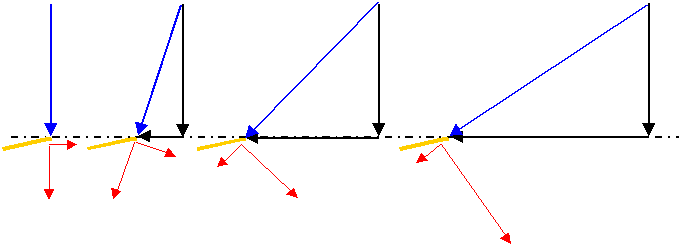 |
| This is the course, together with the "little over 90 degrees" course, that often enables the craft to reach its highest speeds. Only exception on this rule of thumb are craft that use specialized sails for downwind or broad reach sailing. High performance skiff genakers like the ones of the Australian 18 ft. skiffs are an exmaple of this. However for normal sailboats, landyachts and kite surfers, this is the prefered course. The drawing is pretty straight forward. The only two points that need to be mentioned are as follows : At low speeds most sail craft sheet their sails at such a great angle of attack that the drag vector has a way higher magnitude that the lift vector has. Is this bad ? Not really, at low speeds the drag vector is allmost perpendicular to the intermitted line and therefor only results is very small negative thrust components (= craft experienced drag). Later on where the craft's speed has increased sufficiently to present smaller angles of attack to the sails, then the sails will behave very much like they would on a closed hauled course. With the absence of the drop off of thrust which is encountered on a close hauled course. The drop off still occurs but only at very high speeds. The drop off only starts at speeds as high as 2 to 2,5 times the speed of the wind. To my knowlegde only modern landyachts and ice yachts are capable of reaching these speed ratios. This course is known for it higher speeds due to the fact that the vectors are both rotated more forward than on a close hauled course and thus result in higher thrust vector magnitudes at given speeds. The broad reach or downwind courses have the drawback of having angles of attack which are too high over a wide speed range which more than cancels out the positive effect of even more forward rotation. The reach is just a course which strikes an optimum between several positive and negative effects which are competing with eachother. |
| Broad reaching and going downwind, trying to overcome the thrust dip |
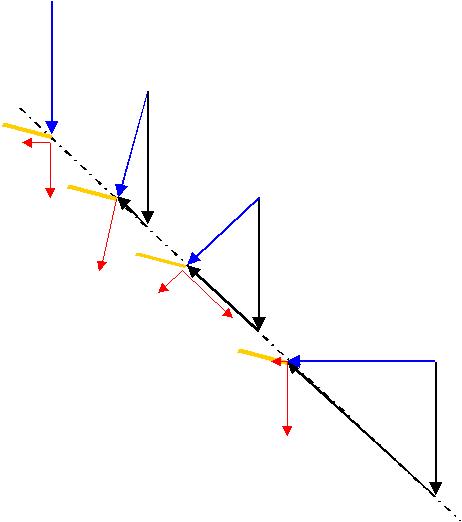 |
| This is a funny course for it contains a few surprising features. All course that have a greater angle than 90 degrees with respect to the wind have a thrust dip. A thrust dip is a name for the phenomenon that from speed zero the thrust decreases untill a certain craft velocity and only then starts to rise. It is dependend on the course and design of the sail wether the dip is very pronounced or shows it self only by a total thrust that stays more or less constant over a particular speed range. Anyways, the problem is that craft's total drag (NOT sail induced drag) nearly always increases considerably while the thrust doesn't. On a downwind courses (at or near 180 degrees) the thrust pit is not a pit anymore but a continious slope downward. In this particular situation, the thrust is at its maximum at standstill and then only decreases in a downward curved line proportional to the speed of the craft squared.Guess what speeds you'll reach on this course without an extra huge and specialized downwind sail. It is however possible to reach high speeds on broad reaches, but this all comes down to how capable you and your craft are in overcomming the thrust dip and maintaning the acquired speed (thus preventing falling back into the dip). But let us start at the beginning. The thrust dip. This dip is mainly caused by a decrease in total airflow over the sail. The decrease is in turn caused by the fact that the wind vector and the vector representing the airflow caused by the forward motion of the craft are in pointing more or less in opposite directions. You'll find that when compared to the other courses that on broad reaches the sum of these two vectors (which is another vector) is in magnitude less than the wind vector alone. Thus the total resulting airflow has been decreased. When the craft is sailing straight downwind than the magnitude of the wind vector is decreased by exactly the magnitude of the forward motion vector. On broad reaches, where you go downwind under an angle, the decrease is some (non constant) percentage of the forward motion vector. The maximum total decrease is also limited to some value. This is the bottom of the pit. But let us first finish the straight downwind analyses before we start discusssing the broad reaches. As stated, the magnitude of the wind vector is decreased by exactly the magnitude of the forward motion vector". When you realize that the produced thrust is directly related to the total experienced airflow squared, than you'll also see why the thrust is continiously decreasing with respect to increased craft velocity. The characteristic of a variable that is squared is in turn is responsible for the increasing downward curve ot the total thrust graph. In this situation the total drag experienced by the craft will soon be equal to the thrust that the sails produce and then its maximum speed on this course will have been reached. Higher velocities than the wind speed are impossible by definition.. When sailing downwind under an angle the thrust's continious downward slope is transformed in a thrust dip. It's still a problem but it is theoretically possible to overcome the dip and reach higher speed, even higher than the wind velocity. The drawing is depicting this. The condition that determines wether or not this happens is that the total drag experienced by the craft is less than the produced thrust in the speed range where the dip exist. A trick often used by the sailors is to start out on a reach till the craft has reached the velocity which is higher than speed range of the dip and than bear off to the broad reach course. Thus effectively steering around the dip. This trick works well on craft that have a rather low upward sloping total drag graph, i.e. landyachts and hyfrofoil boats. "Normal" boats however have a total drag graph thats strongly curves upward with increasing speed, so this trick will only have a marginal effect if any at all. Now lets assume that we start out at some broad reach and keep our heading while we speed up. I will also assume that craft is thus drag efficient that it is able to overcome the thrust dip. We can now distinguise three important stages in the speedrange on this course . First the speed range : zero till the velocity where angle of attack is 90 degrees. This is depicted in the drawing by the first two vector diagrams. It can be clearly seen that in this speedrange it is the sail drag vector that is producing the thrust and NOT the lift vector. In fact, the lift vector is producing negative thrust, which better known by the name "lift induced drag". This is caused by the fact that the sail is experiencing angles of attack that are greater than 90 degrees or the fact that the leading edge is now at the back of the sail. Sheeting the sail out more will lower the velocity where angle of attack is 90 degrees and narrow the speedrange where this phenomenon occurs. Secondly, the speed range where the speed of the craft is higher than the velocity where the angle of attack is 90 degrees and lower than the velocity were the angle of attack relative to the travelled course is 90 degrees. This speed range runs from the second to the third vector diagram in the given drawing. In this speed range both the drag vector as the lift vector are producing thrust, there is no sail induced drag in this situation and spinakers (not genakers) are at their best in this region. A funny thing in this speed range is that the lift vector is producing a negative heeling force which actually is called righting force. So in short, "only thrust and very little heeling" if it were not for the decrease in airflow than this speed range would have been ideal. Sadly the impact of the decrease in airflow, which is at its maximum at the velocity were the angle of attack relative to the travelled course is 90 degrees, is big and often more than enough to turn this would be ideal situation into a thrust dip. To bad. Thirdly, the speedrange of the speeds higher than the velocity were the angle of attack relative to the travelled course is 90 degrees. Here the sails behave very much the same as they would in the low speed ranges on a reach and a close hauled course albeit that the craft is already moving with a considerable speed. A genaker headsail is intend for usage in this speed range. |
| Extra Comments, the C lift and C drag graph and leaving general validity of the presented info |
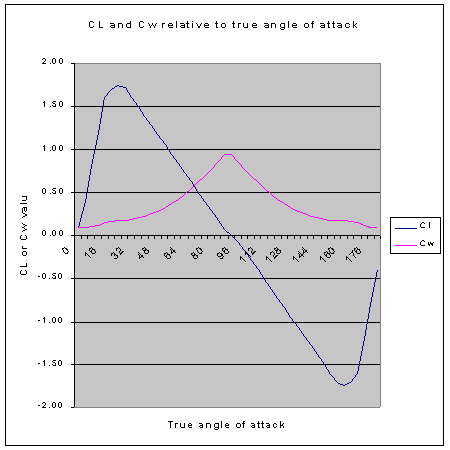
| With this paragrah were leaving the concept of general validity of the presented information. The data presented from now are specific for a sailboat with a full soft sail. The information as presented should be taken as an example and illustrates the final steps to arrive at your own graphs depicting the behaviour of your own particular type of sail craft. For C lift and C drag you can use the following graph as a lead. The graph itself is a rough approximation for a high aspect sailboat sail with a considerable camber (fullness). |
 |
|
| Created by : Wouter Hijink, 26 april 2001 |
| The airflow squared graph, values are fully independend of sail craft design |
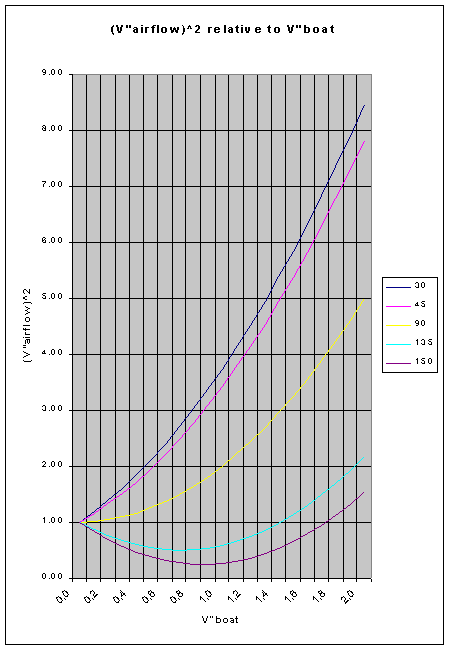 |
| The graph will once again by largely self explanatory. The legend on the right hand side of the graph gives the line colours with respect to the travelled course relative to the direction of the wind.This does not have to be the same as the course the sailcraft is steering, you'll have to account for drift and water currents. A simple piece of lightweight thread mounted on your craft in uninterrupted airflow will show you the travelled course relative to the wind. The values given are fully independend of particular sail craft designs for it only input parameter were the angle of the travelled course and the velocity of the wind and sail craft. Both the aerodynamic Lift vector and Drag vector of the sail are directly proportional to these values. To arrive at thrust and heeling vectors, you'll only need to take into account both C lift and C drag and split both vectors up in components parallel and perpendicular to the steering course of the boat respectively. The first is another multiplication, the last involves making a scalled drawing and creating followed by measuring the components using a ruler. |
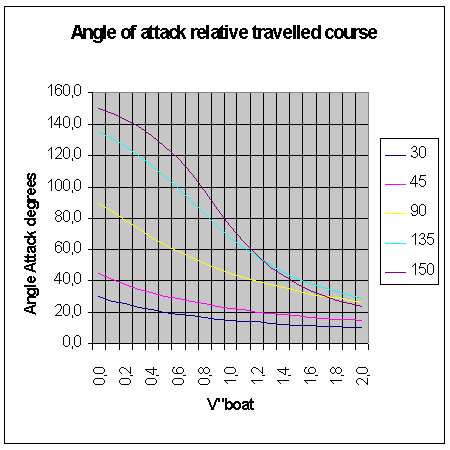 |
| Angle of attack relative to travelled course, needed for determining C lift and C drag |
| This graph is also fully independend of the particular sailcraft design for this graph has been created with these same parameters as the "airflow squared" graph. This graph in itself is not of paramount interest as the "airflow squared" graph is, however it is needed for determining the values for C lift and C drag and is very helpfull for determining your travelled course velocity by just looking at your wind direction tell-tale or wind vane. For the last you'll need a compass on board and know the compass direction of the wind. You can transform the graph into a polair graph and mount it under your wind vane and you'll be able to determine your craft's velocity (relative to wind speed) on a certain course in just one view. A great trainings tools right ? Now you can scientifically determine wether you're making pogress or not. Beware of water currents and tides though, for these offset the travelled course relative to the wind. |
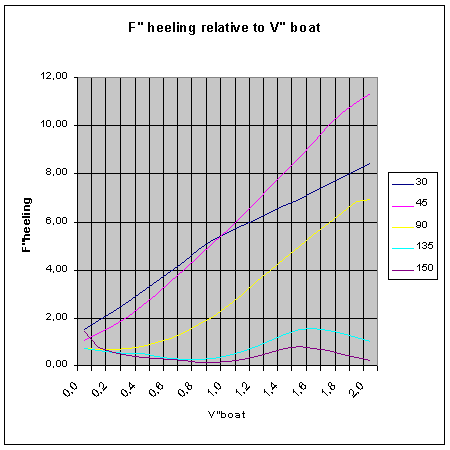
| As stated, the magnitudes of the vectors and the ratio between them determine to a large extend the behaviour of a particular sail design and the behaviour of a sailing craft as a whole. These magnitudes are in turn determined by the parameters C lift and C drag, the variable "velocity of resulting airflow" squared and the constants "sailarea and "density of air". The mangitudes of the Lift and Drag vector is proportional to these five factors. The eqaution is magnitude (lift or drag) = 1/2 * density air * airflow squared * sail area * aerodynamic parameter C (lift or drag) When just looking at your own craft and only at the changes of behaviour and not at absolute values than you can suffice by just looking at the three factors C lift , C drag and airflow squared; for the other factors will stay constant. When one of three factors is doubled than its related vector is doubled too. The rest of the necessary information can be derived out of scalled vector drawings and measuring dsistances with a ruler. Mind you, the given drawings in this document are not fully to scale. This is all the information you need to make approximating behaviour graphs of your own sailing craft. For C lift and C drag you can use the above graph as a lead. The graph itself is a rough approximation for a high aspect sailboat sail with a considerable camber (fullness). When you plot all the measured points in a graph you'll end up with a thrust graph much like this (same goes for heeling) : |
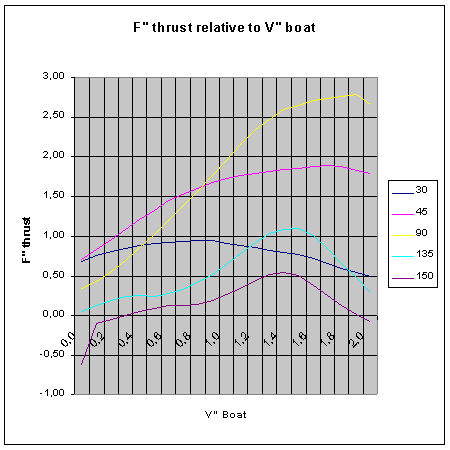 |
| The graphs are made with the assumption that the sailor sheets its sail at a particular angle for his intended end speed and doesn't fine tune it when picking up speed. Result is that he is sailing backwards on the 150 degrees course and that he is very slow of the mark at 135 degrees. The thrust dip is very visible in the graph of 135 course. All graphs tip down at the end because the sheet angle set by the sailor was not intended for these high craft velocities, besides at this point the maximum allowed heeling force is preventing the sailor to sheet more optimally. He even may have to sheet out more and thus spilling thrust even more. The sudden bend in the graph of the 30 degree course is caused by the angle of attack which is passing over the C lift maximum value and into the region of small angles where C lift decreases again. In short the sail cannot by sheeted optimally anymore without a device that is able to sheet the sail to the luff side of the boat. Most boats don't have this device. |
 |
| Understanding the graphs |
| The graphs presented in this document are made in MS Excel 97 after running the parameters through a set of formulae. The presented variables and axis are modified to present true general behaviour independend of windspeed, particular sailarea and design specific characteristics. The truelly travelled course velocity (V boat) is devided by the wind velocity (V wind) to arrive at V" boat. The truelly encountered sail forces (magnitudes of the vectors) are devided by the amount of lift force the same sail would produce when the craft is motionless at the same wind velocity and is operating with the parameter C lift = 1. The last is often 9/10 to 2/3 the value of the true C lift when motionless and when the mainsail is sheeted normally.. |
| Extra Comments, the C lift and C drag graph and leaving general validity of the presented info |
| The WB-sails SailpowerCalc applet, a webtool to give you a general idea of the forces involved. |
| At link http://www.wb-sails.fi/news/SailPowerCalc/SailPowerCalc.htm you will find a java applet that calculates the forces and heeling moments created by a sailsetup (your sails ?). The company WB-sails does alot of experiments on sail design and is involved in a continous and long lasting research of sails together with the university of Helsinki (Finland). This java applet is a spin of that research. How to use the applet for your own boat ? In order to do that you'll need this document you've just read, because you'l need the following input values : |
| Luff main Foot main Hoist or draw height jib foot jib LP percentage Apparent windspeed Apparent windangle Given heel of the mast/sail |
| Measure it on your boat. Measure it on your boat Measure it on your boat Measure it on your boat I have no idea what this. default is 100% Go to the 1st graph of this document and look it up Go to the 2nd graph of this document and look it up Estimate this with respect to windspeed using your experience. |
| The applet will update itself after you press <TAB> to go to another cel. Ignore the Empirial system cels when using the metric system and vice versa. Keep the rest at default. Don't forget to use a point to indentify decimals. Example one and a halve meters = 1.5 and not 1,5 ! Also do a final check on the calculated sailarea. Catamaran sailors or when calculating sails which are more rectangular than triangular should tweak the first two values a bit to get the sailarea close enough without offsetting the input values too much. Results will be less accurate but this close enough. One remark, I can't explain the results it produces, And it does gives of some weird results. So I can't vouche for the truthfullness of the given results. Good luck ! |