| When are you in danger of a capsize or a pitchpole |
| Document data |
| By : Wouter Hijink Created : 5 august 2001 Last updated : 12 august 2001 Classification : Math. analysis Copyright : Restricted freeware Status : Quick 'n dirty, needs styling but is accurate Comments : used in F16 HP project |
| Related links |
 |
|
| Created by : Wouter Hijink, 5 august 2001 |
| Introduction This page is an investigation into the thrust and heeling forces that can be encountered on a high performance sailcraft. The results shown are exact for a genakerless catrigged beach catamaran which normally has a maximum sheeting angle of their boom of 35 degrees or less. Dispite this the results are generally applicable to all sailing craft. The graphs might moves up or down or be stretched or compressed for different designs and so too will the graphs for drag and max H/P ratio. The results were generated by an complex excel spreadsheet which used only the sheeting angle data series, dataseries given C lift and C drag, wind velocity and boat velocity. The correct use of this data is governed by the alogoritmes of this excel sheet; these alogoritmes also limit things like thrust when a physical contrained is encountered. Righting or anti-pitching moment is NOT included as a physical constraints. A good read-up to this document is the "General behaviour of thrust and heeling forces" document which can be found on this same page. It is adviced to read that document first before reading this one. |
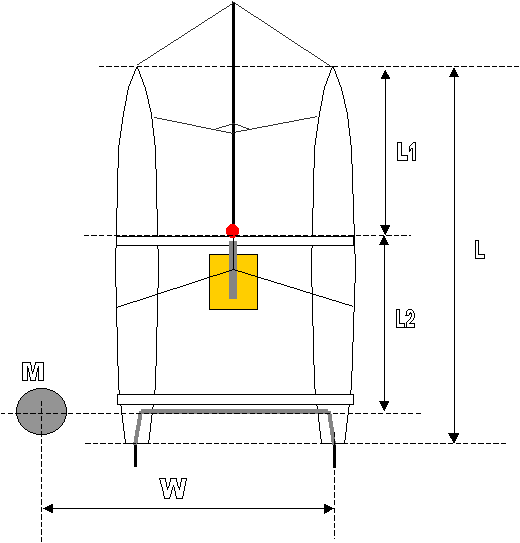 |
| Heeling and Pitching moment Now look at the drawing of a catamaran and its dimensions. The red dot represents the centre of bouyancy of the hulls when they're in their optimal attitude. This point will be on the centreline of the platform and somewhere halveway between bow and stern. With heeling it will reposition itself towards the leeward hull and maybe a little fore or aft. In the extremes it will be on the centreline of the leeward hull and about halveway or a little aft of that. The first is evident for the luff hull is completely out of the water and does contribute any bouyancy in that attitude. The last is less evident but still very logical. High speeds require low drag and this implies low wavemaking drag, this in turn implies the smallest bow wedge and stern wedge to allow for a good water flow around the hull. The optimal hull shape for this will have the centre of bouyancy about halve way or a little aft of halve way. This assumption is supported by the fact that in very ligth air the crew need to sit in front of the forebeam to hold the boat in the optimal attitude. In that case the crew is a little in front of the bouyancy point in order to counteract the weight of the mainsail and boom. So the bouyancy point maybe be assumed to be about the forebeam which is often halveway between bows and sterns o a catamaran. Now lets do a little mind experiment. Assume the crew is sitting in fron tof the forebeam in the light air in which there are sailing in order to hold the boat in the optimal attitude. Now the wind picks up and slowly increases to infinate strength. The crew must slowly move back in order to keep the boat at the optimal attitude. The reason for this is that the sailforce component in the direction of the centreline has a lever called mast and is producing a moment that is trying to push the boat over it's bows; pitching it. This moment is called picthing moment. At a certain point there is no hull left on which the crew can move back and so the maximum anti-pitching moment has been reached at wich the boat can still be kept at the optimal attitude. Any more pitchmoment and the boat will either pitchpole or sail bowdown which is often very draggy and therefor undesired. In our mind experiment the maximum pitching moment is fully counteracted by the repositioning of the crew and nothing else. Using this we can calculate the size of the maximum pitching moment. It is directly related to the distance L2 the crew has moved back and the total weight of the crew Now lets continue our mind experiment. We all know that when the wind picks up and the sail produce more power that the crew must move outward and will finally end up double trapezing. The boat will capsize when this is not done. In light air the crew will be on the lee hull doing the wildthing and move towards the luff hull when the wind picks up and finally go on the wire and trying to be as tall as possible. This is done to counteract the heeling moment or capsize moment. Also in this case the attitude of the boat is kept the same, so the capsize moment is fully counteracted by the repositioning of the crew again although this time from a base value created by the selfrighting moment of the boat.This allows us to calculated the maximum counteractable capsize moment in much the same way as we did with the pitching moment. Distance W is the measure here. Centre of gravity of a crew can be assumed to be at 1 mtr. from their feet. And the selfrighting moment of a catamaran is Weight boat * 1/2 * beam. A keel less monohull can be assumed to have zero self-righting moment. Both capsize moment and pitching moment are produced by the same set of sails and are therfor coupled. In a document "General behaviour of sailforces" is graph developed giving the relation between the thrust and heeling forces. It will be evident that both have the same mast leverage so the ratio between the capsize moment and pitching moment will exactly be the same. These two maximum allowable moments limit the maximum sail thrust that can be developped. Trying to produce more will either lead to a pitchpole or a capsize. Which of the two will limit the thrust ? This can be assessed by looking at the ratio "capsize moment" / "pitching moment" = ratio heeling / pitching wit respect to then maximum ratio of Anti heeling / Anti pitchpole moment a crew can create. Sailing on any (part of the) course that has values smaller than this ratio than the crew is in danger of pitchpoling when the winds are strong enough. Sailing on any (part of the) course that has values greater than this ratio and the crew is in danger of capsizing when the wind is strong enough. When the actual ratio is alot more than the line of max anti heeling / anti pitchpoling than the boat on that course is alot more likely to capsize than pitchpole when the wind is strong enough. And vice versa. |
 |
 |
 |
| Comments accompaning the graphs The rig on this virtual catamaran is assummed to be very efficient and the used aerodynamic constants reflect this. max C lift = 1,75 at an angle of attack of 24 degrees and max C lift / C drag = 10 in the range of angels of attack 0 - 24 degrees. This is quite high but it seemed to be a good approximation at the time. At the moment I have not enough accurate data to develop a new and better approximation. The setup of craft and crew is assumed to be such that they optimally sheet their sails when no physial constrained is encountered. This implies that the sails are nearly always sheeted at 24 degrees of true angle of attack and that the crew can produce infinite amount of righting moment and anti-pitching moment. So the boat is always fully powered up with respect to the given windstrength. The drag curves drawn in the thrust graph are assumed to be true for a wind strength of 20 knots. The drag curves are therefor NOT independed of the windstrength as the sailforce graphs are. The drag curves are the A*v^2 line and the planing line. Both drag curves are approximated for a very light beach catamarans like the A-cat, M18, M20 and the to be F16 HP. The line for the ratio H/P is the maximum ratio a 150 kg's crew on a 5 mtr. long and 2,5 mtr. wide, 100 kg heavy catamaran can produce. This graph does NOT give the speeds at which a crew will capsize or pitchpole, it is important to remember this. It gives the ratios at which a craft will pitchpole before it will capsize (values lower than the given line) and the ratios were the craft will capsize before it pitchpoles (values above the line). So the line gives the exact values at which a pitchpole and capsize will happen simultaniously when the crew overpowers the boat. The sudden downward correction in the thrust graphs is caused by a rapid decrease in C lift constant because the angle of attack has become alot smaller than the optimal dome around 24 degrees. The huge ratios of heeling to thrust for the 150 degree to wind course is caused by the fact that the sail experiences so big true angles of attack (150 degrees or more) that it is actually producing negative lift induced thrust. It is the drag induced thrust part of the sail that is actually high enough to produce a little forward thrust after the negative thrust has been deducted. Nevertheless both the lift and drag are creating relatively large side forces causing a considerable heeling moment. Deviding these high heeling forces by the small thrust forces resulted in very high ratios at low speeds. At higher speeds the angles of attack drop well below 150 degrees and the lift will be thrusting in the right direction again. This phenomenon was not expected by me at all and I had to analyse it before concluding that it is actually very logical. This in turn shows that the model as put into the excelsheet is good and producing more than I put into it. Also very notacible in the graphs are the broadreaching powerdips as discussed in the "General behaviour of sailforces" document. Putting a genaker on the beach catamaran will change the graphs a bit in several aspects due to the interaction between the sails but the biggest change will be that the graphs for 135 and 150 course will be multiplied by a factor of 2 to 3 with respect to their vertical axis. |