 |
|
|
|
|
|
|
|
|
|
|
|
|
|
|
|
|
|
|
|
|
|
|
|
|
|
|
|
|
|
|
|
|
|
|
|
|
| Sulfur fullerenes. |
|
|
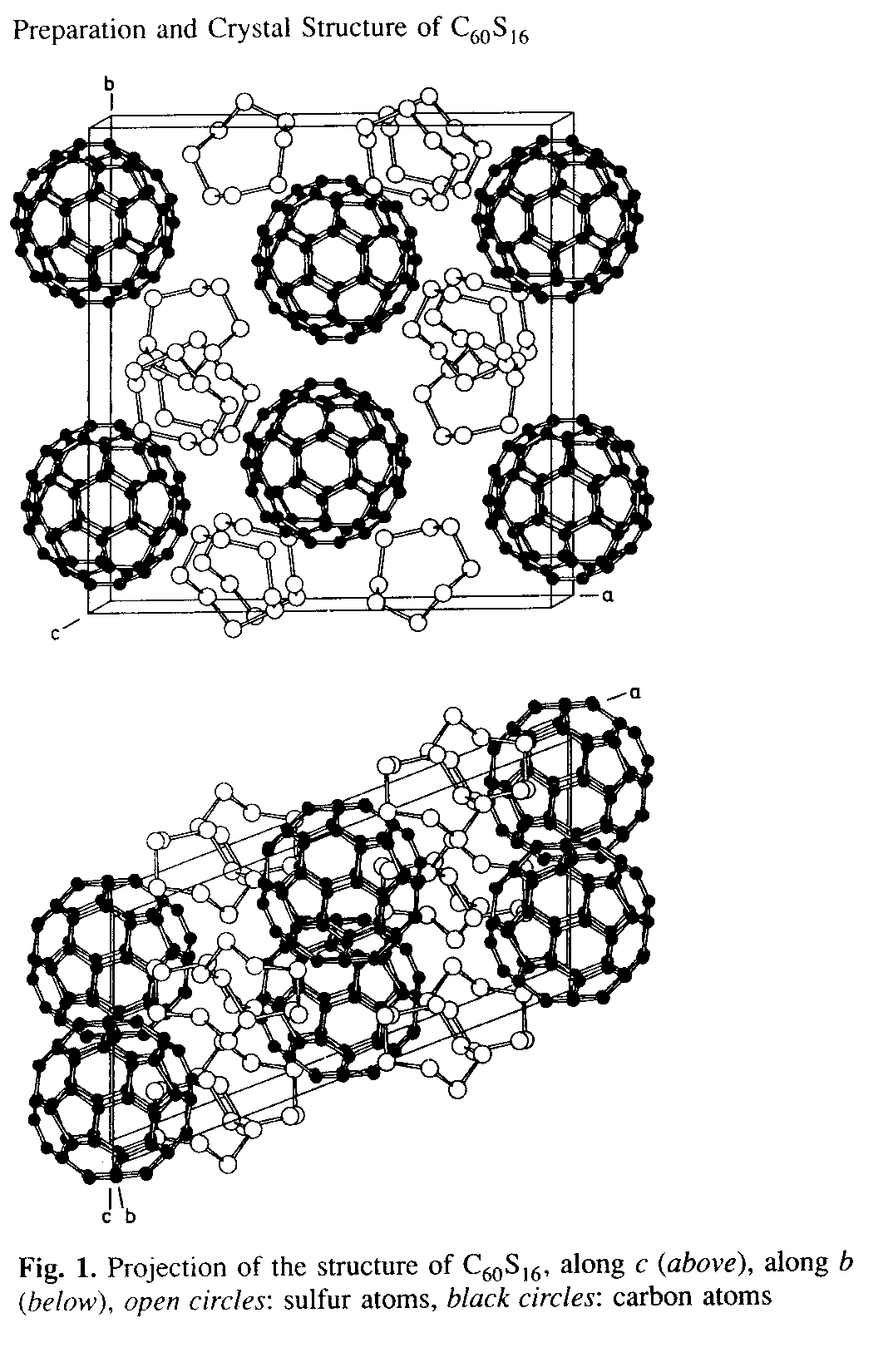
| Compared to other groups of fullerene compounds, relatively little attention has been paid to compounds of fullerenes with sulfur. The properties of these compounds are determined by the strong tendency of sulfur to form Sn rings (n=6-20). In most modifications, sulfur form S8 rings, which are maintained also when sulfur is dissolved in organic solvents such as CS2. S8 rings are also present in the vapor during sublimation and vaporization of most sulfur modifications or of melts thereof. Hitherto, all known fullerene-sulfur compounds consist of fullerenes and S8 rings which are weakly bonded to each other with van der Waals bonds (see e.g. ref. [1-3]). For example, Roth and Adelmann have synthesized and determined the structure of C60S16 grown from a solution of C60 in a mixture of CCl4 and CS2 [1]. The C70S48 and C76S48 compounds have also been synthesized and their structures have been determined [2-4].; The structure of the C60S16 is shown in Fig.1; |
|
|
| Theoretical predictions have shown that a phase with atomic sulfur connected by covalent bonds to two carbon atoms of C60 (similar to well known C60O phase) may exist [6]. So far, all attempts to synthesize this compound have failed. Nevertheless the recent success in synthesis of the dimeric C120SO compound have showed that covalent bonding of sulfur to carbon atoms of the C60 cage is possible, although attempts to synthesize C120S2 failed [7]. |
|
|
|
 |
|
|
|
Figure 1 Crystal structure of the C60S16 |
|
|
|
 |
|
|
|
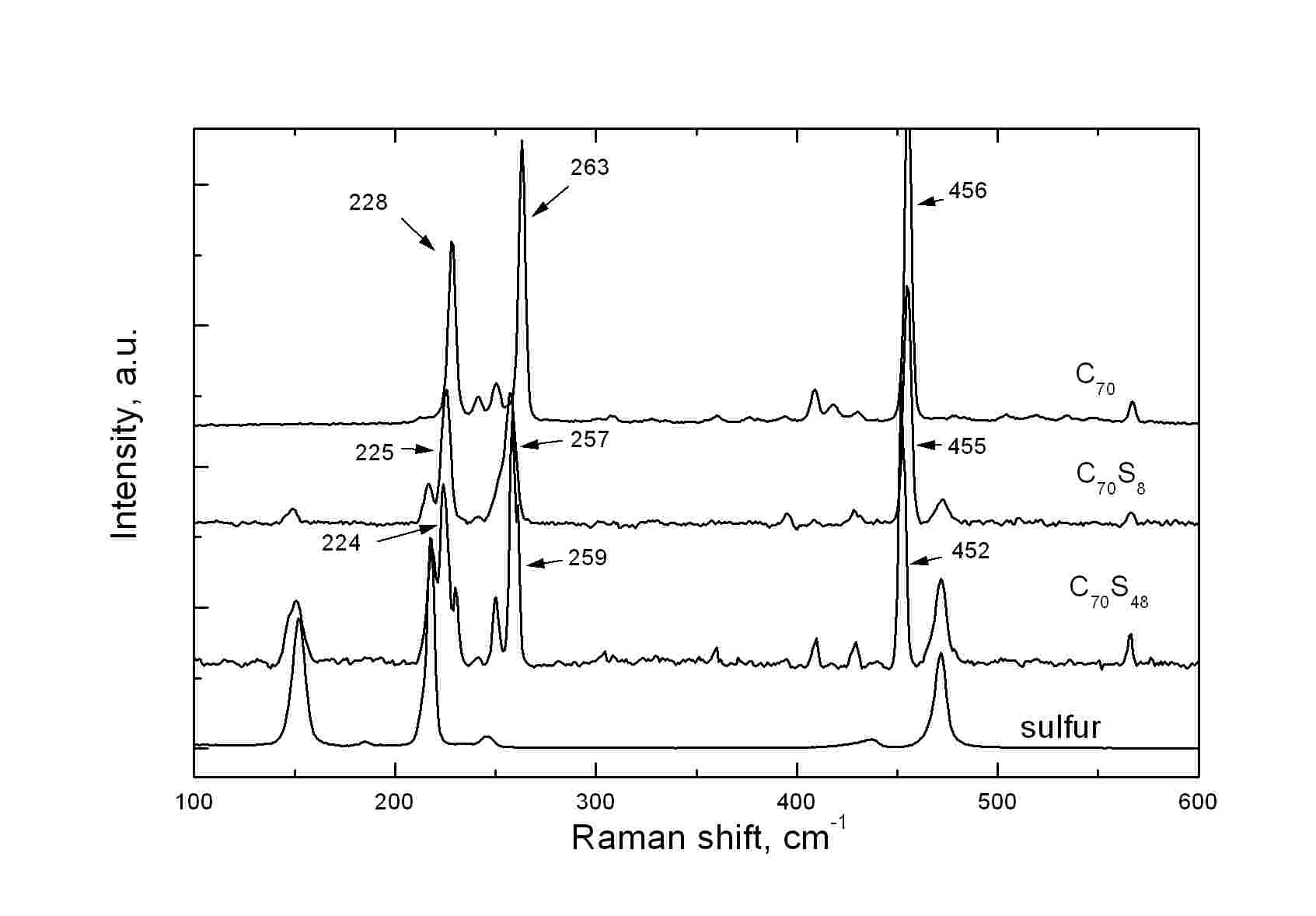
Figure 2 Raman spectra of new phase C70S8 compared to C70S48, C70 and pure sulfur
C70S48 material is extremely easy to prepare: you just take saturated sulfur solution (in large excess) and add C70 solution. Almost immediately red platelets of C70S48 will precipitate. Slow crysttalization from mixed solution of C70 and sulfur produced completely different results. Black crystals which have grown up after several weeks of crystallization appeared to show completely different composition. Chemical analysis suggested that it is C70S8. Less sulfur was observed also using raman spectroscopy (See Fig.2 below). Powder XRD allowed to solve structural cell and parameters, but exact single-crystal analysis appeared to be more difficult due to strong disorder in C70 molecules position, although positions of sulfur ring were located easily.
One more interesting thing about C70S48 and C60S16. According to Raman and NMR fullerene molecules rotate free in these structures, but at the same time positions of all carbon atoms were found from single-crystal XRD. How can it be? Following publication presents some results on this subjest:
|
|
|
|
PDF file here |
|
|
|
|
|
|
|
Below there are two of my papers related to sulfur fullerenes. |
|
|
|
Abstracts and full texts of following papers available:
A.V.Talyzin, L.-E. Tergenius, U.Jansson, "Single crystal growth of C70S8 -a new phase in the C70-sulphur system", J.Cryst.Growth, 213, 63, 2000. |
|
|
|
Abstract and PDF |
|
|
|
A.Talyzin, U.Jansson, ;Preparation and characterization of C60S16 and C70S48 thin films,1999, 350, 113. |
|
|
|
Abstract and PDF |
|
|
|
|
|
|
|
1. G. Roth and P. Adelmann, Appl. Phys. A, 56, 169, (1993). |
|
|
|
2. G. Roth and P. Adelmann, J. Phys. I. France ,2, 1541, (1992). |
|
|
|
3. H.B. Burgi, P. Venugopalan, D. Schwarzenbach, F. Diederich, C. Thilgen, Helv. Chem. Acta, 76, 2155, (1993) |
|
|
|
4. R.H. Michel, M.M. Kappes, G. Roth, P. Adelmann, Angew. Chem. Int .Ed. Engl, 33,1651, (1994) |
|
|
|
5. F. Diedrich, R. Ettl, Y. Rubin, R.L. Whetten, R. Beck, M. Alvarez, S. Anz, D. Sensharma, |
|
|
|
; F. Wudl, K.C. Khemani and A. Koch, Science, 252, 548, (1991). |
|
|
|
6. Z. Slanina, S. Lee, J. Mol. Struct.(Theochem), 339, 83, (1995). |
|
|
|
7. S. Giesa, J.H. Gross, W.E. Hull, S. Lebedkin, A. Gromov, R. Cleiter, W.Kratchmer |
|
|
|
Chem. Comm., 465, (1999). |
|