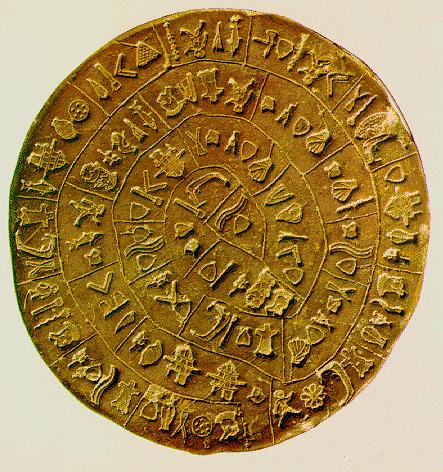
| ANSWER Sir Arthur Evans labeled the Minoan writing as "Linear B".���� When Sir Arthur Evans published the Pylos Linear B tablets, Michael Ventris, a London architect and linguist, noted 88 signs -- too many for an alphabet, too few for a system of ideographs or pitcorgraphs such as the Egyptian hieroglyphics.� He concluded that this system must build words on in-di-vi-dual syllables.��� He sought patterns, grouped and regrouped signs with similar vowels on a grid, tested sounds on syllables linked with recurring pictorial symbols. � |
| QUESTION What is "Linear B" |
| ANSWER In the 16th centry B.C., Knossos hummed with 80,000 people, and it was the sophisticated hub of Europe's first sea power. |
| QUESTION How many people lived in Knossos? |
| In a 1952 BBC talk on the Evans' tablets, Ventris revealed that they were written in Archaic Greek!� This was confirmed by American archeologist Carl Blegen, excavator of Pylos.� Ventris had proved that the Greek language had a 3,300-year history, rivaled only by the Chinese; and exploded Evans' view that the mainland was merely a backwater of Minoan Crete. Linear B was adopted by the Mycenaeans, by Mycenaean writing perished with its civilization c1200 B.C. After four dark centuries, Greeks took a Phoenician form of the world's oldest alphabet which consisted mostly of consonants, added vowels to it, thus forming melodic words. More exciting Links on Linear B: |
 |
| Ancient Scripts |
 |
 |
 |
 |
 |
|