|
Intermediate Art E.P.S.S. |
'Making Art Education Accessible' |
| Home | Curriculum | Lesson Database | Discussion Forum | Help |
|
|
|
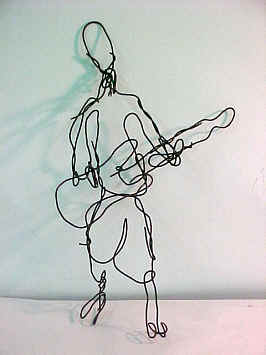
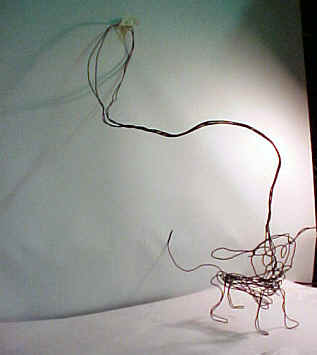
Key Learning Sculpture Sculpture differs from drawing, painting and printmaking in that is occupies three-dimensional space. It has mass, or volume. Sculpture should be viewed from as many angles as possible. Sometimes it is even possible to explore interiors as well as exteriors. Line In sculpture, line has three dimensions. It moves through and occupies space. Line may be irregular, free flowing, rectilinear, or rigid. Line in space implies movement as the eye, hand, and/or body follows its path. The line may not be static. Rather it may be possible to change the direction of the line so that the sculpture seems to become a moving, growing thing. Sometimes the line implies a form; it is just that parts have been omitted. Materials These depend on experiments and project chosen. Some possibilities include: ! thin malleable wire! pliers! rolled newspaper! pipe cleaners! chicken wire! wood! string! glue! masking tape! hammers! nails! paintMotivation Visuals SC 1, SC 2, SC 3, SC 4. After studying the slides individually compare them in terms of line. Would the words be as effective if line was minimized and some other design element accentuated? Experimentation To learn about three-dimensional line and ways of joining three-dimensional materials try some of the following: a) Arrange several 8" blocks of 2" x 4" wood in a variety of interesting ways. Begin with a static arrangement of the blocks, perhaps one on top of the other, to form a symmetrical column. Then little by little rearrange the blocks to discover more interesting variations. Move out into the surrounding space. Arrange them symmetrically, and asymmetrically. Walk around the arrangements to see the view from all sides. Wood blocks may be substituted with any other linear forms. b) Make free-form arrangements of linear cuts of chicken wire. Twist and turn the wire in any direction. Remember to view from all angles. The wire holds its shape and is easily fixed to a base made of a piece of discarded wood. c) Use pliable wire to capture in three-dimensional form the gesture or movement of a human figure or an animal. View from all sides. The lines of the wire should include the three-dimensional nature of the subject. Suggested Theme An abstract interpretation of mood or movement: joy, anger, tumbling, rushing, etc. Studio Make a sculpture using line to interpret a mood or a movement. Sculpture should be interesting from all sides. Summary Display all of the student work and discuss in terms of the objectives and the processes (successes, problems, surprises).
|
|
|||||
|
Copyright 2003 Krista Simmons. All Rights Reserved. Created by FrontPage Templates Resources |